NURS 400 Unit 4 (Well-enlightened)
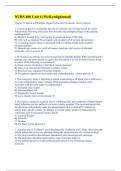
1. A nurse in the ICU is planning the care of a patient who is being treated for shock. Which of the following statements best describes the pathophysiology of this patients health problem? A) Blood is shunted from vital orgAns to peripheral areas of the body. B) Cells lack an adequate blood supply and are deprived of oxygen and nutrients. C) Circulating blood volume is decreased with a resulting change in the osmotic pressure gradient. D) Hemorrhage occurs as a result of trauma, depriving vital orgAns of adequate perfusion. correct answers B 2. In an acute care setting, the nurse is assessing an unstable patient. When prioritizing the patients care, the nurse should recognize that the patient is at risk for hypovolemic shock in which of the following circumstances? A) Fluid volume circulating in the blood vessels decreases. B) There is an uncontrolled increase in cardiac output. C) Blood pressure regulation becomes irregular. D) The patient experiences tachycardia and a bounding pulse. correct answers A 3. The emergency nurse is admitting a patient experiencing a GI bleed who is believed to be in the compensatory stage of shock. What assessment finding would be most consistent with the early stage of compensation? A) Increased urine output B) Decreased heart rate C) Hyperactive bowel sounds D) Cool, clammy skin correct answers D 4. The nurse is caring for a patient who is exhibiting signs and symptoms of hypovolemic shock following injuries suffered in a motor vehicle accident. The nurse anticipates that the physician will promptly order the administration of a crystalloid IV solution to restore intravascular volume. In addition to normal saline, which crystalloid fluid is commonly used to treat hypovolemic shock? A) Lactated Ringers B) Albumin C) Dextran D) 3% NaCl correct answers A 5. A patient who is in shock is receiving dopamine in addition to IV fluids. What principle should inform the nurses care planning during the administration of a vasoactive drug? A) The drug should be discontinued immediately after blood pressure increases. B) The drug dose should be tapered down once vital signs improve. C) The patient should have arterial blood gases drawn every 10 minutes during treatment.
Written for
- Institution
- NURS 400
- Course
- NURS 400
Document information
- Uploaded on
- December 4, 2023
- Number of pages
- 46
- Written in
- 2023/2024
- Type
- Exam (elaborations)
- Contains
- Questions & answers
Subjects
-
1 a nurse in the icu is planning the care of a pa

Also available in package deal