
Personal Trainer Certification Exam 2023 Solution Update
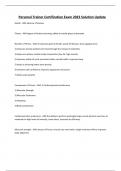
Personal Trainer Certification Exam 2023 Solution Update Health - ANS-absence of disease Fitness - ANS-degree of body functioning; ability to handle physical demands Benefits of Fitness - ANS-1) improves general health, wards off disease, slows aging process 2) improves mental outlook and mood through the release of endorphis 3) helps one achieve a better body composition (low fat, high muscle) 4) improves stat4e of mind, promotes better mental health, improves sleep 5) helps in achieving better bone density 6) enhances self-confidence; improves appearance of person 7) helps avoid atrophy Components of Fitness - ANS-1) Cardiorespiratory Endurance 2) Muscular Strength 3) Muscular Endurance 4) Flexibility 5) Body Composition Cardiorespiratory endurance - ANS-the ability to perform prolonged large-muscle dynamic exercises at moderate-to-high levels of intensity; trains heart, increases its efficiency Muscular strength - ANS-amount of force a muscle can exert with a single maximum effort; improves body alignment Muscular endurance - ANS-ability to sustain a given level of muscle tension; important for good posture and injury prevention Flexibility - ANS-the ability of the joints to move through their full range of motion; poor flexibility leads to stiffness, misalignment, and pain Body composition - ANS-proportion of fat-free mass (muscle, bone, water) to fat in a body; high proportion of fat-free mass to low proportion of fat is healthy Motor fitness - ANS-Speed, agility, eye-hand and eye-foot coordination; mostly inherited, can be developed over time VO2 Max - ANS-a measure of how much oxygen is consumed by a person per minute of exercise; athlete wears a mask during exercise to determine; the fitter a muscle, the more oxygen it draws from the blood Myoglobin - ANS-oxygen-storing protein in the muscle Anterio-Venous Oxygen Difference - ANS-AKA VO2 Difference; the measure of oxygen consumed by the muscles,; the different between oxygen content of the blood in the arteries andthe oxygen content of the blood in the veins Only about ___% of oxygen is utilized when a person is resting, as opposed to a potential ____% during exercise - ANS-25; 80 Calculating max heart rate - ANS-220-age Calculating lower limit of exercise heart rate range - ANS-maximum heart rate times 0.5 Calculating upper limit of exercise heart rate range - ANS-maximum heart rate times 0.85 Anaerobic activity - ANS-activities undertaken in the absence of oxygen; cannot be sustained for long periods of time; rely on fast-twitch muscle fibers; ex: weight lifting, sprinting; tested with the Anaerobic capacity test or the Wingate cycle test Aerobic/Cardiovascular activity - ANS-ability of the body to perform exercise over an extended period of time in the presence of oxygen; relies heavily on slow-twitch fibers; ex: cycling, marathon running; increased RBC count, improved heart function Principles of fitness - ANS-1) Specificity 2) Progressive Overload 3) Reversibility 4) Individual Differences 5) Warm-up and Stretching Principle of Specificity - ANS-relates to the development of a particular fitness component (ex: cardiorespiratory endurance); this requires performance of exercises specifically designed for that component Principle of Progressive Overload - ANS-based on the principle that when the amount of exercise (or overload) is progressively increased, the body continues to adapt and the overall level of fitness improves; when an individual is able to perform a task w/o momentary failure, the load should be increased by about 5% 3 Dimensions of Overload - ANS-1) Frequency 2) Intensity 3) Duration Frequency - ANS- CONTINUES...
Document information
- Uploaded on
- December 4, 2023
- Number of pages
- 12
- Written in
- 2023/2024
- Type
- Exam (elaborations)
- Contains
- Questions & answers


