NCLE exam prep| Questions| Correct Answers| Verified
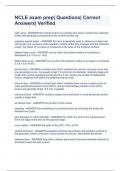
optic zone - ANSWER the central portion of a contact lens which contains the refractive power and generally corresponds to the central corneal cap posterior apecal radius - ANSWER this term is generally used in reference to spin-cast soft lenses. the curvature of the posterior surface of the lens changes with the refractive power. the radius of curvature is measured at the apex of the posterior surface. steeper base curve - ANSWER occurs when the posterior radius of curvature is decreased (i.e. 8.4 to 8.1 mm) flatter base curve - ANSWER occurs when the posterior radius of curvature is increased (i.e.8.1 to 8.4 mm) bicurve lens - ANSWER a contact lens which contains two curves: one base curve and one secondary curve. it is usually small 7.5 to 8.8 mm on diameter, relatively steep and made with narrow peripheral curves about 0.2 mm. lenses are usually intrapalpebral lenses, designed to fit within the palpebral fissure limits. tricurve lens - ANSWER a contact lens which contains three curves: a base curve, an outer peripheral posterior curve (PPC), and an intermediate posterior curve (IPC). lenses are generally larger, 9.5 mm or greater. multicurve lens - ANSWER contains a base curve and three or more peripheral curves. usually a larger lens. junctional zone - ANSWER the junction of two curves blending - ANSWER the smoothing of a junctional zone by removing the sharp line between the zones lens diameter or chord diameter - ANSWER the width of a lens or the measurement from one edge of the lens to the opposite edge curve widths - ANSWER the width of the CPC, PPC, or IPC central thickness - ANSWER separation between the anterior and posterior surface at the geometric center of the lens. minus lenses are thinner, plus lenses are thicker ballasted lens - ANSWER lens with a heavier base which becomes oriented inferiorly or downward when the lens is worn prism ballated lens - ANSWER a ballasted lens which utilizes a prism wedge designed to weight the lens truncated lens - ANSWER a lens which has been cut off, usually 0.5-1.5 mm along its lower edge, to form a horizontal base. double ________ along the top a
Written for
- Institution
- NCLE
- Course
- NCLE
Document information
- Uploaded on
- December 4, 2023
- Number of pages
- 40
- Written in
- 2023/2024
- Type
- Exam (elaborations)
- Contains
- Questions & answers
Subjects
- ncle
-
ncle exam prep questions correct answers verifi
-
optic zone answer the central portion of a conta
-
posterior apecal radius answer this term is gene
-
steeper base curve answer occurs when the p

Also available in package deal