

Mohammed Salam Unit 11: LA C
Human inheritance and predicting genetic traits
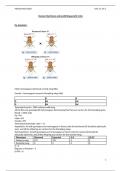
Fly simulator:
Male: homozygous dominant normal wing (DD)
Female = homozygous recessive Dumpling wings (dd)
d d
D Dd Dd
D Dd Dd
Theoretical result = 100% ordinary wild wing
All the flies are genotypically heterozygous Dd meaning that they are carriers for the Dumpling gene.
Result = 100% wild
Fly: 993
Male: 494
Female: 499
Theoretical phenotypic ratio = 1:1
Hypothesis: As both genotypes are homozygous in theory only the dominant DD should be physically
seen, and all the offspring are carriers for the Dumpling wings.
Null hypothesis: As both genotypes are homozygous in theory only the receive Dd should be
physically observed, and all the offspring are carriers for the normal wings.
Phenotype Observed Expected O-E (O-E)2
Ordinary wing 993 993 0 0
Dumpling wing 0 0 0 0
∑=0
Degrees of freedom = 1
0/993 = 0
1
, Mohammed Salam Unit 11: LA C
Which means p<0.05 which means that the answer is statistically significant, and the hypothesis is
statistically significant and null hypothesis is rejected.
Offspring
Both the female and male have the Dd allele (the wild but recessive Dumpling wing gene).
D d
D DD Dd
d Dd dd
75 % wild
25% dumpling wing
Male: 516
Female: 487
Total: 1007
Wild: 764
Dp: 239
764 of 75% = 191%
239 of 25% = 59.75%
Theoretical phenotypic ratio
3:1
3 is the number of offspring with the dominant D gene for ordinary wing, representing a 75%
likelihood, and 1 is the number of offspring who have a 25% probability of carrying the recessive d
dumpling gene.
Theoretical: there should be roughly 75% regular wings (DD / Dd) and 25% dumpling wings
present(dd).
The null hypothesis states that there should not be 75% Dumpling wings and 25% wild wings
present.
Phenotype Observed Expected O-E (O-E)2 (O-E)2
E
Wild wings 764 774 -10 100 0.13
Dumpling 239 229 10 100 0.44
wings
∑ = 0.57
Degrees of freedom = 1= 3.84
2
Human inheritance and predicting genetic traits
Fly simulator:
Male: homozygous dominant normal wing (DD)
Female = homozygous recessive Dumpling wings (dd)
d d
D Dd Dd
D Dd Dd
Theoretical result = 100% ordinary wild wing
All the flies are genotypically heterozygous Dd meaning that they are carriers for the Dumpling gene.
Result = 100% wild
Fly: 993
Male: 494
Female: 499
Theoretical phenotypic ratio = 1:1
Hypothesis: As both genotypes are homozygous in theory only the dominant DD should be physically
seen, and all the offspring are carriers for the Dumpling wings.
Null hypothesis: As both genotypes are homozygous in theory only the receive Dd should be
physically observed, and all the offspring are carriers for the normal wings.
Phenotype Observed Expected O-E (O-E)2
Ordinary wing 993 993 0 0
Dumpling wing 0 0 0 0
∑=0
Degrees of freedom = 1
0/993 = 0
1
, Mohammed Salam Unit 11: LA C
Which means p<0.05 which means that the answer is statistically significant, and the hypothesis is
statistically significant and null hypothesis is rejected.
Offspring
Both the female and male have the Dd allele (the wild but recessive Dumpling wing gene).
D d
D DD Dd
d Dd dd
75 % wild
25% dumpling wing
Male: 516
Female: 487
Total: 1007
Wild: 764
Dp: 239
764 of 75% = 191%
239 of 25% = 59.75%
Theoretical phenotypic ratio
3:1
3 is the number of offspring with the dominant D gene for ordinary wing, representing a 75%
likelihood, and 1 is the number of offspring who have a 25% probability of carrying the recessive d
dumpling gene.
Theoretical: there should be roughly 75% regular wings (DD / Dd) and 25% dumpling wings
present(dd).
The null hypothesis states that there should not be 75% Dumpling wings and 25% wild wings
present.
Phenotype Observed Expected O-E (O-E)2 (O-E)2
E
Wild wings 764 774 -10 100 0.13
Dumpling 239 229 10 100 0.44
wings
∑ = 0.57
Degrees of freedom = 1= 3.84
2


