

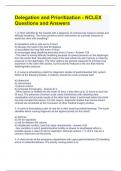
Delegation and Prioritization - NCLEX Questions with Complete Answers
1. A client admitted to the hospital with a diagnosis of cirrhosis has massive ascites and difficulty breathing. The nurse performs which intervention as a priority measure to assist the client with breathing? a) repositions side to side every 2 hours b) elevates the head of the bed 60 degrees c) auscultates the lung field every 4 hours d) encourages deep breathing exercises every 2 hours - Answer-1) B - The client is having difficulty breathing because of upward pressure on the diaphragm from the ascitic fluid. Elevating the head of the bed enlists the aid of gravity in relieving pressure on the diaphragm. The other options are general measures to promote lung expansion in the client with ascites, but the priority measure is the one that relieves diaphragmatic pressure. 2. A nurse is scheduling a client for diagnostic studies of gastrointestinal (GI) system. Which of the following studies, if ordered, should the nurse schedule last? a) ultrasound b) colonoscopy c) barium enema d) computed tomography - Answer-2) C - When barium is instilled into the lower GI tract, it may take up to 72 hours to clear the GI tract. The presence of barium could cause interference with obtaining clear visualization and accurate results of the other tests listed, if performed before the client has fully excreted the barium. For this reason, diagnostic studies that involve barium contrast are scheduled at the conclusion of other medical imaging studies. 3. A nurse is formulating a plan of care for a client receiving enteral feedings. The nurse identifies which nursing diagnosis as the highest priority for this client? a) diarrhea b) risk for aspiration c) risk for deficient flid volume d) imbalanced nutrition, less than body requirements - Answer-3) B - Any condition in which gastrointestinal motility is slowed or esophageal reflux is possible places a client at risk for aspiration. Although options 1, 3, and 4 may be a concern, these are not the priority. 4. A client arrives at the emergency department with upper gastrointestinal (GI) bleeding and is in moderate distress. The priority nursing action is to: a) obtain vital signs b) ask the client about the precipitating events c) complete an abdominal physical assessment d) insert a nasogastric (NG) tube and Hematest the emesis - Answer-4) A - The priority action is to obtain vital signs to determine whether the client is in shock from blood loss and to obtain a baseline by which to monitor the progress of treatment. The client may not be able to provide subjective data until the immediate physical needs are met. Insertion of an NG tube may be prescribed but is not the priority action. A complete abdominal physical assessment needs to be performed but is not the priority. 5. A client with a history of suicide attempts is admitted to the mental health unit with the diagnosis of depression. Upon the client's arrival, the client's therapist reports to the nurse that the clients telephoned the therapist earlier in the evening and reported having a overwhelming suicidal thoughts. Keeping this information in mind, the priority of the nurse is to assess for: a) interaction with peers b) the presence of suicidal thoughts c) the amount of food intake for the past 24 hours d) information regarding the past medication regimen - Answer-5) B The critical information from the therapist is that the client is having thoughts of self-harm; therefore, the nurse needs further information about present thoughts of suicide so that the treatment plan may be as appropriate as possible. The nurse must make sure the client is safe. The items in options A, C, and D should be assessed; however, evaluation for suicide potential is most important 6. A group of health nurse is caring for a group of homeless people. When planning for the potential needs of this group, what is the most immediate concern? a) peer support through structured groups b) finding affordable housing for the group c) setting up a 24-hour crisis center and hotline d) meeting the basic needs to ensure that adequate food, shelter, and clothing are available - Answer-6) D - The question asks about the immediate concern. The ABCs of community health are always attending to people's basic needs of food, shelter, and clothing
Document information
- Uploaded on
- November 26, 2023
- Number of pages
- 9
- Written in
- 2023/2024
- Type
- Exam (elaborations)
- Contains
- Questions & answers


