Table of Contents
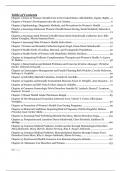
Chapter 1 Access to Women’s Health Care in the United States: Affordability, Equity, Rights ..2
Chapter 2 Women’s Development into the 21st Century ..............................................................6
Chapter 3 Epidemiology, Diagnostic Methods, and Procedures for Women’s Health ................9
Chapter 4 Assessing Adolescent Women’s Health Renee Sieving, Sarah Stoddard, Deborah A.
Raines .......................................................................................................................................... 13
Chapter 5 Assessing Adult Women’s Health Diane Marie Schadewald, Catherine Juve, Ellis
Quinn Youngkin, Marcia Szmania Davis .................................................................................... 18
Chapter 6 Assessing Older Women’s Health Debra Hain ..........................................................23
Chapter 7 Women and Sexuality Catherine Ingram Fogel, Diane Marie Schadewald ............... 27
Chapter 8 Health Needs of Lesbian, Bisexual, and Transgender Populations ...........................32
Chapter 9 Health Needs of Women with Disabilities Michele Davidson ................................... 35
Chapter 10 Integrating Wellness: Complementary Therapies and Women’s Health J o Lynne
W. Robins ................................................................................................................................... 38
Chapter 11 Menstruation and Related Problems and Concerns Kristine Alswager, Christine
Durler, Deborah Griswold..........................................................................................................43
Chapter 12 Contraceptive Management and Family Planning Beth Walcker, Coralie Pederson,
Kathryn A. Caufield ................................................................................................................... 49
Chapter 13 Infertility Michelle Valentine, Jennifer R. Gardella .................................................58
Chapter 14 Vaginitis and Sexually Transmitted Diseases Susan D. Schaffer, Jane Houston.... 61
Chapter 15 Women and HIV Dina Treloar, Susan D. Schaffer ................................................... 71
Chapter 16 Common Gynecologic Pelvic Disorders Jennifer M. Laubach, Reena P. Lorntson,
Donna E. Forrest ......................................................................................................................... 75
Chapter 17 Breast Health Linda Christinsen-Rengel ..................................................................85
Chapter 18 The Menopausal Transition Catherine Juve, Valerie T. Cotter, Ellis Quinn
Youngkin ..................................................................................................................................... 90
Chapter 19 Promotion of Women’s Health Care During Pregnancy ..........................................95
Chapter 20 Maternal Conditions Impacting Risk in Pregnancy Debbie Ringdahl, Melissa
Frisvold, Joan Corder-Mabe ..................................................................................................... 98
Chapter 21 Assessing Fetal Well-Being Michele Davidson, Marion Herndon Fuqua .............. 103
Chapter 22 Postpartum and Lactation Diane Schadewald, Cheri Friedrich, Kathleen M.
Akridge....................................................................................................................................... 106
Chapter 23 Common Medical Problems: Cardiovascular through Hematological Disorders
Mary Benbenek, Mary Dierich, Elaine Ferrary, Rita A. Seeger Jablonski ............................. 117
Chapter 24 Common Medical Problems: Musculoskeletal Injuries through Urinary Tract
Disorders Gwen Short, Rita A. Seeger Jablonski, Elaine Ferrary .......................................... 122
Chapter 25 Psychosocial Health Concerns Ann Bateman,Eugenia Zelanko ........................... 127
Chapter 26 Substance Use Disorders and Women .................................................................. 133
1|Page
,Chapter 1 Access to Women’s Health Care in the United States: Affordability,
Equity, Rights
1. Which health occupation has the highest percentage of women?
A. Pharmacists
B. Physical therapists
C. Registered nurses
D. Dental hygienists
Answer: D
2. Which health occupation has the lowest percentage of women?
A. Physicians
B. Dentists
C. Pharmacists
D. Physical therapists
Answer: B
3. Which health profession has the largest number of workers?
A. Health aides
B. Physicians
C. Licensed practical nurses
D. Registered
nurses Answer: D
4. Which of the following are certifications available in advanced practice registered nursing?
(Select all that
apply.)
A. Certified nurse midwife
B. Certified registered nurse anesthetist
C. Certified nurse pharmacologist
2|Page
, D. Clinical nurse specialist
E. Nurse
practitioner Answer:
A, B, D, E
5. What level of education is required to become a licensed practical nurse?
A. 2-year master’s degree (in addition to a 4-year bachelor’s degree)
B. 4-year bachelor’s degree
C. 2-year associate’s degree
D. 1-year certificate or diploma
Answer: D
6. What percentage of physicians and surgeons in the United States in 2014 were women?
A. 27%
B. 37%
C. 47%
D. 57%
Answer: B
7. What medical specialty has the highest percentage of women?
A. General pediatrics
B. Obstetrics and gynecology
C. Orthopedic surgery
D. Urology
Answer: A
8. On an average, the income of female physicians is what percentage of that of male physicians?
3|Page
, A. 59%
B. 79%
C. 99%
D. 109%
Answer: A
9. What level of education is required to become a pharmacist?
A. 6-year doctorate degree
B. 2-year master’s degree (in addition to a 4-year bachelor’s degree)
C. 4-year bachelor’s degree
D. 2-year associate’s degree
Answer: A
10. Which of the following is the median income of dentists in the United States (2012)?
A. $89,310
B. $109,310
C. $129,310
D. $149,310
Answer: D
11. Which of the following are the current trends in dentistry? (Select all that apply.)
A. More specialists than generalists
B. Research linking oral health to overall health
C. Focus on treatment of disease rather than prevention
D. Expected growth of 18% from 2014 to 2024
E. Increasing demand for dental implants, bridges, and cosmetic services
Answer: B, D, E
12. Which allied health occupation is projected to be the fastest growing?
A. Health information technicians
4|Page