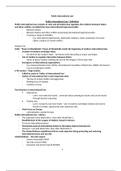
Public International Law
Public International Law - Definition
Public International Law consists of rules and principles that regulates the relations between States
and other entities, provided they have international legal personality.
- Between States
- Between States and other entities possessing international legal personality
- Covering a range of activities
- E.g. international agreements, diplomatic relations, trade, protection of human
rights, conduct of armed conflict.
Modern Era
1648 - “Peace of Westphalia”; Peace of Westphalia marks the beginning of modern international law
- Creation of modern sovereign States
- the birth of the modern State – territorial units interacting as equal sovereigns
- Use of treaties to regulate interaction between States
- Series of peace treaties marking the end of the religious Thirty Years War
- Emergence of international organizations
- E.g. Universal Postal Union (1874), International Committee of Red Cross (1863), Permanent
Court of Arbitration (1899)
17th century - Hugo Grotius
- Called by some as ‘father of international law’
- Author of international law’s most important texts
- The law of armed conflict and aggression
- Binding force of treaties
- Freedom of seas
Two theories on international law
Natural law
- Law is not made but found – universal values existing by nature and can be found
through human reasoning.
Positive law
- Law is not given, but man-made – law is made by sovereigns (States) and can be
found in treaties, agreements and customary law.
- Main focus on Europe
- colonialization outside Europe
Public International Law - History
- The outbreak of the World War I, then after World War I:
- Establishment of the League of Nations, based in Geneva
- To secure international peace
- Permanent Court of International Justice in The Hague (later to become ICJ)
- However: a second World War, then after World War II:
- The United Nations established with its main objective being protecting and restoring
international peace and security
United Nations – Six main organs
- General Assembly UNGA
- Security Council UNSC
- Economic and Social Council ECOSOC
1
, - Trusteeship Council
- International Court of Justice ICJ
- Secretariat
United Nations – Security Council
- 15 members
- 5 permanent members with a veto (China, France, UK, USA and Russia)
- 10 non-permanent members elected for two-years term
- The only UN body with the power to adopt binding resolution
- ‘Chapter VII’ resolution
- Core function: to maintain international peace
- In cases where there is a threat or breach of international peace and security, or an act of
aggression
UNCh Chapter VII, art. 39: “The Security Council shall determine the existence of any threat to the
peace, breach of the peace, or act of aggression and shall make recommendations, or decide what
measures shall be taken in accordance with Articles 41 and 42, to maintain or restore international peace
and security.”
United Nations – General Assembly (Hq in NYC)
- All members of the UN have a seat in the GA, and are equal to each other
- The representative body of the UN
- Can only adopt non-binding resolutions (soft law)
- Has the potential of becoming international customary law through passage of time, such as the
Declaration of Human Rights.
- Resolution subjects are a wide range of issues, e.g. political, economic, humanitarian, social
or legal matters
United Nations – International Court of Justice (Peace Palace)
- Consent-based jurisdiction to settle disputes between States
- ONLY States
- Binding decisions (enforced by UNSC)
- Advisory jurisdiction to advice UN organs on legal questions
- ONLY UN organs; UNSC and UNGA, other organs require UNGA authorization and limited to
questions within the scope of their field of expertise.
- Binding, advisory is never binding. It’s nature is to recommend.
Some major issues…
- Cold War
The world divided into two blocks
No armed violence, yet a failure of collective security (proxy war)
SC paralyzed, unable to pass resolutions and to act efficiently both the USA and USSR have veto
power, effectively freezing any and all initiatives. Same issue is currently plaguing any resolution
regarding Syria, which continues to be vetoed by Russia, and China.
- Decolonization- Requires recognition of sovereignty
♦ UN Special Committee on Decolonization
♦ Allowing a process of self-determination of peoples
2
,♦ Largely completed, still few territories waiting to be decolonized
International law today
- Growing interdependence of States, international organizations, multinationals
♦ New fields of international law
- E.g. international criminal law, human rights, environmental law, cyber law
♦ Growing number of international organizations
- CoE (Council of Europe), EU, NATO, AU
- But also judicial bodies, e.g. ECtHR, ICTY, ICTR, ICC, ITLOS
“International law is, at its best, written morality.”
“Law is a system backed by threats, therefore international law cannot be law.”
- John Austin
♦ International law cannot be law, because law is command issued by an uncommanded commander.
♦ Unlike domestic legal systems, there is no legislative and judicial powers at the international level
Where does international law come from? How is it made?
Code of International Law There is no code. International law comprises of various sources of PIL
International Parliament There is no world government. All states are sovereign.
International legislation No international legislation. International law is designed through international
conventions.
International judiciary?
International Court of Justice as the main legal organ of the UN
A range of specialized courts and tribunals
Compulsory jurisdiction based on state consent, may be conditional as determined by the
state.
International law is made on a decentralized basis by the actions of States which make up the
international community.
Sources of Public International Law
Article 38 of the ICJ Statute:
important to make distinction between primary, and secondary sources.
The Court, whose function is to decide in accordance with international law such disputes as are
submitted to it, shall apply:
International conventions, whether general or particular, establishing rules expressly recognized
by the contesting states;
International custom, as evidence of a general practice accepted as law;
General principles of law recognized by civilized nations;
Subject to the provisions of Article 59, judicial decisions and the teachings of the most highly
qualified publicists of the various nations, as subsidiary means for the determination of rules of
law.
Hierarchy of sources:
Primary sources:
3
, o Treaties, international custom and general principles of law (e.g.. Principle of law-
innocent until proven guilty)
o Based on the consent of States
Subsidiary (secondary) sources:
-Secondary source is about application of the law, not making the law, and lacks
influence from states.
o Judicial decisions and teachings of highly qualified publicists
o Courts cannot make law, they apply the law
Hierarchy between the primary sources:
o Treaties and international custom exist alongside each other
o General principles of law: to fill the gaps
Law of Treaties
Treaty as source of law:
o The most common source of international law norms
- E.g. international environmental law is almost exclusively regulated by treaties
o May have different names
- Convention, Agreement, Protocol, Pact, Charter
o Can be:
o Bilateral or multilateral
o Regional or global
o Regulating inter-State actions
o Establishing international organizations, e.g. UNCh
o Violations of treaties: Refer inter-State disputes to the ICJ
1969 Vienna Convention on the Law of Treaties (VCLT)
The main instrument that regulates treaties
- A treaty on treaties
- Containing the basic principles of treaty law
- Came into force in 1980
Article 2 VCLT
- “treaty” means an international agreement concluded between States in written
form and governed by international law, whether embodied in a single instrument
or in two or more related instruments and whatever its particular designation.
Basic principles:
Based on the free consent of States
- International law comes largely from State consent
Pacta sunt servanda
- A treaty in force is binding on the parties; must be performed by them in good faith
No binding force on third States (States not party to the conference from which the treaty
stems), unless;
- (some) provisions of the treaty reflect rules of international custom
• VCLT applies to treaties concluded by States
- Again, international law comes largely from State consent
• Treaties concluded by international organizations:
- Yes, but fall outside the scope of the 1969 VCLT (still a treaty; source: international custom)
4
Public International Law - Definition
Public International Law consists of rules and principles that regulates the relations between States
and other entities, provided they have international legal personality.
- Between States
- Between States and other entities possessing international legal personality
- Covering a range of activities
- E.g. international agreements, diplomatic relations, trade, protection of human
rights, conduct of armed conflict.
Modern Era
1648 - “Peace of Westphalia”; Peace of Westphalia marks the beginning of modern international law
- Creation of modern sovereign States
- the birth of the modern State – territorial units interacting as equal sovereigns
- Use of treaties to regulate interaction between States
- Series of peace treaties marking the end of the religious Thirty Years War
- Emergence of international organizations
- E.g. Universal Postal Union (1874), International Committee of Red Cross (1863), Permanent
Court of Arbitration (1899)
17th century - Hugo Grotius
- Called by some as ‘father of international law’
- Author of international law’s most important texts
- The law of armed conflict and aggression
- Binding force of treaties
- Freedom of seas
Two theories on international law
Natural law
- Law is not made but found – universal values existing by nature and can be found
through human reasoning.
Positive law
- Law is not given, but man-made – law is made by sovereigns (States) and can be
found in treaties, agreements and customary law.
- Main focus on Europe
- colonialization outside Europe
Public International Law - History
- The outbreak of the World War I, then after World War I:
- Establishment of the League of Nations, based in Geneva
- To secure international peace
- Permanent Court of International Justice in The Hague (later to become ICJ)
- However: a second World War, then after World War II:
- The United Nations established with its main objective being protecting and restoring
international peace and security
United Nations – Six main organs
- General Assembly UNGA
- Security Council UNSC
- Economic and Social Council ECOSOC
1
, - Trusteeship Council
- International Court of Justice ICJ
- Secretariat
United Nations – Security Council
- 15 members
- 5 permanent members with a veto (China, France, UK, USA and Russia)
- 10 non-permanent members elected for two-years term
- The only UN body with the power to adopt binding resolution
- ‘Chapter VII’ resolution
- Core function: to maintain international peace
- In cases where there is a threat or breach of international peace and security, or an act of
aggression
UNCh Chapter VII, art. 39: “The Security Council shall determine the existence of any threat to the
peace, breach of the peace, or act of aggression and shall make recommendations, or decide what
measures shall be taken in accordance with Articles 41 and 42, to maintain or restore international peace
and security.”
United Nations – General Assembly (Hq in NYC)
- All members of the UN have a seat in the GA, and are equal to each other
- The representative body of the UN
- Can only adopt non-binding resolutions (soft law)
- Has the potential of becoming international customary law through passage of time, such as the
Declaration of Human Rights.
- Resolution subjects are a wide range of issues, e.g. political, economic, humanitarian, social
or legal matters
United Nations – International Court of Justice (Peace Palace)
- Consent-based jurisdiction to settle disputes between States
- ONLY States
- Binding decisions (enforced by UNSC)
- Advisory jurisdiction to advice UN organs on legal questions
- ONLY UN organs; UNSC and UNGA, other organs require UNGA authorization and limited to
questions within the scope of their field of expertise.
- Binding, advisory is never binding. It’s nature is to recommend.
Some major issues…
- Cold War
The world divided into two blocks
No armed violence, yet a failure of collective security (proxy war)
SC paralyzed, unable to pass resolutions and to act efficiently both the USA and USSR have veto
power, effectively freezing any and all initiatives. Same issue is currently plaguing any resolution
regarding Syria, which continues to be vetoed by Russia, and China.
- Decolonization- Requires recognition of sovereignty
♦ UN Special Committee on Decolonization
♦ Allowing a process of self-determination of peoples
2
,♦ Largely completed, still few territories waiting to be decolonized
International law today
- Growing interdependence of States, international organizations, multinationals
♦ New fields of international law
- E.g. international criminal law, human rights, environmental law, cyber law
♦ Growing number of international organizations
- CoE (Council of Europe), EU, NATO, AU
- But also judicial bodies, e.g. ECtHR, ICTY, ICTR, ICC, ITLOS
“International law is, at its best, written morality.”
“Law is a system backed by threats, therefore international law cannot be law.”
- John Austin
♦ International law cannot be law, because law is command issued by an uncommanded commander.
♦ Unlike domestic legal systems, there is no legislative and judicial powers at the international level
Where does international law come from? How is it made?
Code of International Law There is no code. International law comprises of various sources of PIL
International Parliament There is no world government. All states are sovereign.
International legislation No international legislation. International law is designed through international
conventions.
International judiciary?
International Court of Justice as the main legal organ of the UN
A range of specialized courts and tribunals
Compulsory jurisdiction based on state consent, may be conditional as determined by the
state.
International law is made on a decentralized basis by the actions of States which make up the
international community.
Sources of Public International Law
Article 38 of the ICJ Statute:
important to make distinction between primary, and secondary sources.
The Court, whose function is to decide in accordance with international law such disputes as are
submitted to it, shall apply:
International conventions, whether general or particular, establishing rules expressly recognized
by the contesting states;
International custom, as evidence of a general practice accepted as law;
General principles of law recognized by civilized nations;
Subject to the provisions of Article 59, judicial decisions and the teachings of the most highly
qualified publicists of the various nations, as subsidiary means for the determination of rules of
law.
Hierarchy of sources:
Primary sources:
3
, o Treaties, international custom and general principles of law (e.g.. Principle of law-
innocent until proven guilty)
o Based on the consent of States
Subsidiary (secondary) sources:
-Secondary source is about application of the law, not making the law, and lacks
influence from states.
o Judicial decisions and teachings of highly qualified publicists
o Courts cannot make law, they apply the law
Hierarchy between the primary sources:
o Treaties and international custom exist alongside each other
o General principles of law: to fill the gaps
Law of Treaties
Treaty as source of law:
o The most common source of international law norms
- E.g. international environmental law is almost exclusively regulated by treaties
o May have different names
- Convention, Agreement, Protocol, Pact, Charter
o Can be:
o Bilateral or multilateral
o Regional or global
o Regulating inter-State actions
o Establishing international organizations, e.g. UNCh
o Violations of treaties: Refer inter-State disputes to the ICJ
1969 Vienna Convention on the Law of Treaties (VCLT)
The main instrument that regulates treaties
- A treaty on treaties
- Containing the basic principles of treaty law
- Came into force in 1980
Article 2 VCLT
- “treaty” means an international agreement concluded between States in written
form and governed by international law, whether embodied in a single instrument
or in two or more related instruments and whatever its particular designation.
Basic principles:
Based on the free consent of States
- International law comes largely from State consent
Pacta sunt servanda
- A treaty in force is binding on the parties; must be performed by them in good faith
No binding force on third States (States not party to the conference from which the treaty
stems), unless;
- (some) provisions of the treaty reflect rules of international custom
• VCLT applies to treaties concluded by States
- Again, international law comes largely from State consent
• Treaties concluded by international organizations:
- Yes, but fall outside the scope of the 1969 VCLT (still a treaty; source: international custom)
4