
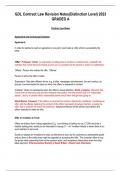
GDL Contract Law Revision Notes(Distinction Level) 2023 GRADED A
GDL Contract Law Revision Notes(Distinction Level) 2023 GRADED A Contract Law Notes Agreement and Contractual Intention Agreement: In order for parties to reach an agreement, one party must make an offer which is acceptedby the other. ‘Offer’: Professor Treitel: ‘an expression of willingness to contract on certain terms, madewith the intention that it shall become binding as soon as it is accepted by the person to whom it is addressed.’ ‘Offeror’: Person who makes the offer. ‘Offeree’: Person to whom the offer is made. ‘Expression’: May take different forms, e.g. a letter, newspaper advertisement, fax and conduct, as long as it communicates the basis on which the offeror is prepared to contract. ‘Intention’: Does not necessarily mean the offeror’s actual intention. Smith v Hughes: Objective test. Courts look at what was said and done between the parties, from the pointof view of a ‘reasonable person’, and try to decide what a reasonable person would have thought was going on. Allied Marine Transport: If the offeror so acts that his conduct, objectively considered, constitutes an offer, and the offeree, believing the conduct of the offeror represents hisactual intention, accepts the offer, then a contract will come into existence. Subjective element of the offeree must believe the offeror intended to make an offer. Offer or Invitation to Treat: Offers are distinct from inviting negotiation E.g. ‘I am thinking of selling my car, £7,000 would be a realistic asking price, would you be interested in buying it?’ – An ‘invitation totreat’ is where there is no such intention to be bound. Goods on display are invitations to treat, as otherwise as soon as the customer put selectedthe goods and put them in the trolley they might be regarded as accepting the offer. The customer offers to buy the goods when presenting them at the payment point, and acceptance takes place when the shop takes payment. (Pharmaceutical Society of Great Britain v Boots Cash Chemists). Advertisements: Generally regarded as invitations to treat. Partridge v Crittenden: Defendant not guilty with ‘offering for sale’ a live wild bird contrary to law, by placing an advertisement in a periodical. Seen as an invitation to treat, as if it was an offer anyone asking for the advertised goods would be accepting an offer which would be problematic ifthey had run out of stock. Advertisements of rewards traditionally treated as an offer, as there is intention to be bound as soon as the information is given (Williams v Carwadine). Payment has to be madeonce information supplied, no negotiation is involved – Encouraging people to come forward. In exceptional circumstances, advertisements may be an offer if there is a clear intention to be bound. Carlill v Carbolic Smoke Co: Company manufactured a product designed to prevent flu. Their advertisement in the newspaper stated a reward of £100 would be paid toanyone who contracted flu or a cold after using the smoke ball 3 times per day for 2 weeks according to supplied directions. Advertisement also stated company had deposited £1,000 with a named bank to show the sincerity of its offer. Claimant contracted flue whilst using it.Company raised 3 defences: (a) Advertisement was mere puff sales (dismissed, as £1,000 had been deposited as evidence of sincerity – meaning a reasonable person would treat £100 promise seriously); (b) No offer to any particular person (dismissed, as offer was to anyone who fulfilled conditions stated); (c) Claimant gave no notice of acceptance (dismissed, as held that company could not have been expected every user of product to contact them). Case is the authority for the proposition that an advertisement can constitute an offer to ‘the world’, and that it may, by the way in which it is stated, waive theneed for communication of acceptance prior to a claim under it. Unilateral and Bilateral Contracts: Bilateral Contract: Arises where one party makes a promise in return for a promise from theother party. Both parties are immediately bound. Unilateral Contract: A promise in return for an act – Commitment is one-sided. The promisor is bound to perform if, and only if, the person(s) to whom the promise is madeperforms the specified act. E.g. An offer of reward. Auctions: s.57(2) Sale of Goods Act 1979: A sale by auction is complete on the fall of the auctioneer’s hammer. Bids are offers which can be withdrawn at any time before acceptance. Auctioneers calling for bids is an invitation to treat. Sale in auction ‘without reserve’: Barry v Davies: Refusal of auctioneer to sell due to bid price being exceptionally low. Claimant could sue as there was a contract between auctioneer and bidder if good advertised ‘without reserve’ – Auctioneer is promising to sell to the highest bidder (unilateral contract). Bidder had accepted auctioneer’s unilateral offerby making the highest bid. Claimant could not sue owner of goods as there was no contractbetween them.
Document information
- Uploaded on
- November 16, 2023
- Number of pages
- 66
- Written in
- 2023/2024
- Type
- Exam (elaborations)
- Contains
- Questions & answers


