Outline how an organisation motivate its employees
There are seven motivation theories from seven writers: ‘F.W. Taylor, Elton Mayo, Abraham
Harold Maslow, Fredrick Hertzberg, Douglas McGregor, McClelland and Vroom’.
Motivational theories exist in order to try and describe what actually motivates individuals to
behave the certain way they do behave in the workspace. Motivational theories can be
applied to the workplace in order to identify why some employees may be working harder
than others and are much more dedicated to completing tasks set for them than others.
Motivational theories can then in turn assist business managers in gaining an idea as to how
they can motivate their employees to perform considerably better. Motivational theories can
be applied in the workspace using them to identify which employees are performing well and
which employees could use some motivation which can come in forms of rewards, discounts
and increased pay as well as which employees need to reach their needs before becoming
motivated.
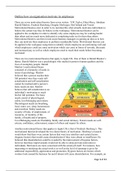
There are two motivational theories that apply to Apple UK. One of them is Harold Maslow’s
theory. Harold Maslow was a psychologist who studied in positive human qualities and the
lives of exemplary people. Harold
Maslow’s motivational theory
consisted of a hierarchy of needs in
terms of psychology. Maslow
believed that a person reaches their
full potential once they reach self-
actualization and self-actualization
cannot be reached until a person’s
basic needs are met. Maslow
believes that self-actualization is an
individual’s motivation to reach
his/her full potential. The basic
needs consist of physiological,
safety, love/belonging and esteem.
Physiological needs are breathing,
food, water, sex, sleep, homeostasis
and excretion. Safety needs are
security of body, of employment, of
resources, of morality, of the
family, of health and of property.
Love/Belonging needs are friendship, family and sexual intimacy. Esteem needs are self-
esteem, confidence, achievement, respect of others and respect by others.
Another motivational theory that applies to Apple UK is that of Fredrick Herzberg’s. This
motivational theorist developed the two-factor theory of motivation. Herzberg’s research
would show that there were certain factors that were true satisfiers and certain factors
(hygiene factors) that would create dissatisfaction if they were absent or insufficient. He
believed that dissatisfaction could be avoided by the improvement of hygiene factors,
however that these improvements would not be able to alone provide motivation to
individuals. Motivators are more concerned with the actual job itself. For instance, how
interesting or satisfying the actual work is as well as the level of openings it gives for
additional responsibility, appreciation and promotion. Hygiene factors are factors which
workers look around the business for and if absent will cause dissatisfaction. For example, an
Page 1 of 11