Neuroanatomy Through Clinical Cases
Hal Blumenfeld, second edition (2010)
Chapter 1: Introduction to Clinical Case Presentations
The General History and Physical Exam
When a new patient is admitted to the hospital, a good history and physical exam (H&P) must be
obtained and information communicated to other members of the medical team. Communication is the
main goal of the H&P. The general format contains the following elements:
- Chief complaint (CC) (or why patient was admitted)
o Includes patient’s age, sex, and presenting problem
- History of the present illness (HPI)
o Complete history of current medical problem, including possible risk factors or causes
of the illness & chronological description of symptoms.
- Past medical history (PMH)
o Medical history not directly related to HPI
- Review of systems (ROS)
o A brief head-to-toe review of all medical systems
- Family history (FHx)
o Should list all immediate relatives and familial illnesses, for example in family tree
format
- Social and environmental history (SocHx/EnvHx)
o Occupation, family situation, travel history, sexual history and habits.
- Medications and allergies
- Physical exam
o General appearance, vital signs, HEENT, neck, back & spince, lymph nodes, breasts,
lungs, heart, abdomen, extremities, pulses, neurologic, rectal, pelvic & genitalia,
dermatologic.
- Laboratory data
o All diagnostic tests
- Assessment and plan
o Assesment section starts with 1 or 2 sentence summary/formulation, and then main
clinical features and most likely diagnosis.
o Plan section consists of list of problems and proposed interventions and diagnostic
procedures.
Neurological Differential Diagnosis
The first step is localization base an neuroanatomical clues (integration of clinical and anatomical
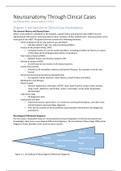
knowledge). Next step is neurological differential diagnosis. The Arrowhead of Neurologic Differential
Diagnosis shows disorders from acute to more chronic:
CSF circ
Epileptic
Vascular Degener/Develop
Trauma/mechan Infect/inflam/neoplas
Toxic/Metab Psych
Referred
Other non-neuro
Figure 1.1: Arrowhead of Neurological Differential Diagnosis
, Relationship between the General Physical Exam and the Neurological Exam
The neurological exam is part of the general physical exam. The patient must be treated as a whole,
with problems in different systems given priority depending on the situation. Additionally, information
about neurological disease can be extracted from all parts of the general physical exam.
Conclusions
Much can be learned about neurological disease form the non-neurologic portions of the general
physical exam. The neurologic portion ultimately provides much of the information that enables us to
localize lesions within the nervous system.
Chapter 2: Neuroanatomy Overview and Basic Definitions
Basic Macroscopic Organization of the Nervous System
Lesions in a particular neuroanatomical system often affect neighboring regions as well. Neighborhood
effects are critical in localizing lesions.
Main Parts of the Nervous System
Nervous system divided into CNS and PNS.
- Central nervous system (CNS) = brain and spinal cord
- Peripheral nervous system (PNS) = cranial nerves and spinal nerves
During embryological development, the CNS forms from a sheet of ectodermal cells, that fold into the
neural tube. Cavities within the neural tube develop into the ventricles, which contain CSF.
The developing brain has 3 main divisions:
The midbrain, pons and medulla together form the brainstem.
CSF is formed mainly by choroid plexus lying in the ventricles. CSF circulates from the lateral ventricles
to the 3rd ventricle, and leaves the ventricular system via foramina in the 4th ventricle, flows around the
outside surface of the brain (subarachnoid space) and spinal cord. Finally, CSF is reabsorbed into the
venous system by arachnoid villi.
The CNS is covered by 3 protective membranes called meninges. From inside to outside they are the
pia, arachnoid and dura (PAD).