
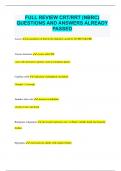
Full Review Crt/Rrt (Nbrc) Questions And Answers Already Passed
Ascites accumulation of fluid in the abdomen caused by LIVER FAILURE Venous distention -occurs with CHF -seen with obstructive patients (seen in exhalation phase) Capillary refill -indication of peripheral circulation -Normal 3 seconds Jaundice skin color -increase in bilirubin. -mostly in face and trunk Bradypnea (oligopnea) -decreased respiratory rate (12bpm) variable depth and irregular rhythm Hyperpnea -increased rate, depth, with regular rhythm Cheyne-Stokes -gradually increasing then decreasing rate and depth in a cycle lasting from 30 - 180 secs, with apnea up to 60 secs -increased ICP, meningitis, overdose Biots -increased rate and depth with irregular periods of apnea -CNS problem, head/brain injury Kussmaul's -increased rate, depth, irregular rhythm, breathing sounds labored -Raspy voice Apneustic prolonged gasping inspiration followed by extremely short, insufficient expiration -respiratory center problems, trauma, tumor cachectic muscle atrophy/loss of muscle tone retractions -chest moves inward during inspiratory efforts instead of outward -blocked airway in adults = INTUBATE -RDS in infants Character of cough -dry, non-productive cough may indicate tumor in the lungs or asthma -productive cough may indicate infection evidence of difficult airway -short receding mandible (chin) -enlarged tongue (macroglossia) -bull neck -limited neck range-of-motion pulsus paradoxus -pulse/blood pressure varies with respiration. may indicate severe air trapping (status asthmaticus or cardiac tamponade) tactile fremitus -vibrations felt by hand on chest wall -vocal fremitus: voice vibrations on the chest wall -pleural rub fremitus: grating sensation due to roughened pleural spaces -Rhonchial fremitus(palpable rhonchi): secretions in airways Crepitus -bubbles of air under skin that can be palpated and indicates subcutaneous emphysema Resonant percussion -hollow sound -normal lungs Flat percussion -heard over sternum, muscles, or areas of atelectasis Dull percussion -heard over fluid-filled organs such as heart or liver (thudding) -pleural effusion or pneumonia Tympanic percussion -heard over air-filled stomach. -drum-like sound and when heard over lung = increased volume Hyperresonant -found where pneumothorax or emphysema is present.
Document information
- Uploaded on
- November 3, 2023
- Number of pages
- 82
- Written in
- 2023/2024
- Type
- Exam (elaborations)
- Contains
- Questions & answers


