
MRO BUSINESS
Week 1
Airline fleet management
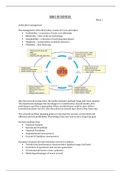
The management of the fleet policy consist of 5 core principles:
Profitability = economies of scale, cost efficiently
Modernity = state of the art technology
Sustainability = reduction of environmental impact
Simplicity = commonality, technical coherence
Flexibility = fleet financing
Also the network is important: the market demand, payload/range and route capacity.
The department manages this by taking in to consideration: aircraft market, fleet
performance and fleet commonality. Other considerations could be, pace of fleet
introduction/phase out of it. Also the policy per aircraft type about a buy/lease mix.
The network and fleet planning goals is to increase the revenue, productivity and
efficiency and the profitability. Decreasing of the cost/unit is also a long term goal.
Decision making steps:
Financial Analysis
Operational Feasibility
Financial Feasibility
Organizational Consequences
Growth & Flexibility consequences
Summary of typical Aircraft evaluation criteria for airlines:
Technical and performance characteristics (payload range, fuel burn)
Economics of operations and revenue generation
Environmental factors (noise, pollution)
Marketing advantages of newer aircraft
, Political and trade issues can dominate fleet decisions
When purchasing a new aircraft it is important to get the best contract deal which is
assured by:
Pricing negotiations
Support & Maintenance Guarantees
Options & Purchase Rights
Performance Guarantees
Performance Retention Guarantees
Service:
Introduce new aircraft into fleet
Monitor/Manage Performance & Aircraft Weights
Safeguard Asset Value
Perform Cost Control and Trend Analysis
Remarketing:
Address contract issues with lease
Find buyer
Redelivery with right paper work
Week 2
Engine Planning
An engine planning is necessary for multiple reasons such as:
Lease contract and return conditions
Operational costs
Life limits parts
Shop visit causes:
Major elements of the long term engine planning are:
Life Limited Parts (LLP)
EGT margin based on: theoretical input manufacturer
Risks for repairs after inspections, J-hook, dilution holes.


