

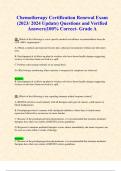
Chemo therapy Certification Renewal Exam (2023/ 2024 Update) Questions and Verified Answers|100% Correct - Grade A Q: Which of the following is a new specific medical surveillance recommendation from the USP <800> requirements? A. Obtain a medical and exposure history plus a physical examination without any laboratory tests. B. Development of a follow -up plan for workers who have shown health changes suggesting toxicity or who have been involved in a spill. C. Perform wipe testing routinely on an annual basis. D. Offer biologic monitoring when exposure is suspected or symptoms are observed. Answer: B. Development of a follow -up plan for workers who have shown health changes suggesting toxicity or who have been involved in a spill. Q: Which of the following is true regarding immune -related response criteria? A. RECIST criteria is used routinely with all therapies and types of cancers, solid tumors or blood malignancies. B. Pseudoprogression is common with checkpoint inhibitors where there is initial tumor regression followed by an increase in tumor burden. C. Because of the pseudoprogression phenomenon, it is recommended that immune -mediated therapies have their own subset of RECIST criteria guidelines. D. Response to immune -mediated therapies occurs almost immediately and tumor response can be seen on scans within 4 weeks of therapy. Answer: C. Because of the pseudoprogression phenomenon, it is recommended that immune -mediated therapies have their own subset of RECIST criteria guidelines. Q: Which of the following is true regarding informed consent to receive chemotherapy? A. Informed consent must be verbally affirmed prior to administration but can be documented at any time after initiation of therapy. B. All institutions will accept the general "consent to treat" document as the required form. C. The role of the nurse in informed consent often includes patient education and providing detailed explanation involving the administration process, roles and expectations. D. Informed consent cannot be reversed once treatment is agreed upon. Answer: C. The role of the nurse in informed consent often includes patient education and providing detailed explanation involving the administration process, roles and expectations. Q: Which of the following is true regarding dose calculation in oncology? A. A height and weight that was measured within the last 5 days can be used to calculate dose. B. Rechecking and recalculating the drug dose and comparing it to the current chemotherapy order is part of the safety steps with administration. C. Dosing of a drug will always be the same whether administered with the goal of cure or if given in a palliative setting. D. Area under the curve is the most common method used to calculate chemotherapy dosing. Answer: B. Rechecking and recalculating the drug dose and comparing it to the current chemotherapy order is part of the safety steps with administration. Q: Exposure to HDs can take place through a variety of routes, including dermal contact with contaminated surfaces. A. TRUE B. FALSE Answer: A. TRUE Q: Which of the following is the mainstay of treatment for immune -related adverse events (irAEs) with checkpoint inhibitors? A. Decreasing dose of therapy B. Corticosteroids C. Cytokine therapy D. Give smaller doses, more frequently Answer: B. Corticosteroids Q: One of your nurses comes to you to make you aware that she is breastfeeding her baby. What is the most appropriate response to this employee? A. "You will need to be extra vigilant with safe handling and PPE since you are breastfeeding." B. "We will work and find you alternate duties that do not include HD preparation or administration while you are breastfeeding." C. "There is no increased risk of harm to babies once they are out of the womb, therefore no changes need to be made." D. "The risk for harm is only for those that prepare/mix the chemotherapy." Answer: B. "We will work and find you alternate duties that do not include HD preparation or administration while you are breastfeeding."
Preview 3 out of 25 pages
Exam (elaborations)
Chemotherapy Certification Renewal Exam (2023/ 2024 Update) Questions and Verified Answers|100% Correct- Grade A
Preview 3 out of 25 pages
Chemotherapy Certification Renewal Exam (2023/ 2024 Update) Questions and Verified Answers|100% Correct- Grade A Q: Which of the following is a new specific medical surveillance recommendation from the USP 800 requirements? A. Obtain a medical and exposure history plus a physical examination without any laboratory tests. B. Development of a follow-up plan for workers who have shown health changes suggesting toxicity or who have been involved in a spill. C. Perform wipe testing routinely on an annual basis. D. Offer biologic monitoring when exposure is suspected or symptoms are observed. Answer: B. Development of a follow-up plan for workers who have shown health changes suggesting toxicity or who have been involved in a spill. Q: Which of the following is true regarding immune-related response criteria? A. RECIST criteria is used routinely with all therapies and types of cancers, solid tumors or blood malignancies. B. Pseudoprogression is common with checkpoint inhibitors where there is initial tumor regression followed by an increase in tumor burden. C. Because of the pseudoprogression phenomenon, it is recommended that immune-mediated therapies have their own subset of RECIST criteria guidelines. D. Response to immune-mediated therapies occurs almost immediately and tumor response can be seen on scans within 4 weeks of therapy. Answer: C. Because of the pseudoprogression phenomenon, it is recommended that immune-mediated therapies have their own subset of RECIST criteria guidelines. Q: Which of the following is true regarding informed consent to receive chemotherapy? A. Informed consent must be verbally affirmed prior to administration but can be documented at any time after initiation of therapy. B. All institutions will accept the general "consent to treat" document as the required form. C. The role of the nurse in informed consent often includes patient education and providing detailed explanation involving the administration process, roles and expectations. D. Informed consent cannot be reversed once treatment is agreed upon. Answer: C. The role of the nurse in informed consent often includes patient education and providing detailed explanation involving the administration process, roles and expectations. Q: Which of the following is true regarding dose calculation in oncology? A. A height and weight that was measured within the last 5 days can be used to calculate dose. B. Rechecking and recalculating the drug dose and comparing it to the current chemotherapy order is part of the safety steps with administration. C. Dosing of a drug will always be the same whether administered with the goal of cure or if given in a palliative setting. D. Area under the curve is the most common method used to calculate chemotherapy dosing. Answer: B. Rechecking and recalculating the drug dose and comparing it to the current chemotherapy order is part of the safety steps with administration. Q: Exposure to HDs can take place through a variety of routes, including dermal contact with contaminated surfaces. A. TRUE B. FALSE Answer: A. TRUE Q: Which of the following is the mainstay of treatment for immune-related adverse events (irAEs) with checkpoint inhibitors? A. Decreasing dose of therapy B. Corticosteroids C. Cytokine therapy D. Give smaller doses, more frequently Answer: B. Corticosteroids Q: One of your nurses comes to you to make you aware that she is breastfeeding her baby. What is the most appropriate response to this employee? A. "You will need to be extra vigilant with safe handling and PPE since you are breastfeeding." B. "We will work and find you alternate duties that do not include HD preparation or administration while you are breastfeeding." C. "There is no increased risk of harm to babies once they are out of the womb, therefore no changes need to be made." D. "The risk for harm is only for those that prepare/mix the chemotherapy." Answer: B. "We will work and find you alternate duties that do not include HD preparation or administration while you are breastfeeding." Q: Which of the
Content preview
Document information
- Uploaded on
- October 29, 2023
- Number of pages
- 25
- Written in
- 2023/2024
- Type
- Exam (elaborations)
- Contains
- Questions & answers
$11.49
Wrong document? Swap it for free
Within 14 days of purchase and before downloading, you can choose a different document. You can simply spend the amount again.
Written by students who passed
Immediately available after payment
Read online or as PDF

Reputation scores are based on the amount of documents a seller has sold for a fee and the reviews they have received for those documents. There are three levels: Bronze, Silver and Gold. The better the reputation, the more your can rely on the quality of the sellers work.

