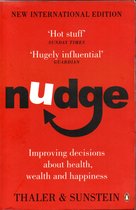
Nudge. Improving decisions about health, wealth and
happiness.
By – Thaler & Sunstein
Introduction
Choice Architect: a choice architect has the responsibility for organizing the context in which people make
decisions.
• There is no such thing as a ‘neutral’ design!
• Good architects realize that they can’t make a perfect design, but they can make some design choices
that will have beneficial effects.
Nudges are a form of: Libertarian Paternalism
- Libertarian aspect: people should be free to do what they like.
- Paternalistic aspect: lies in the claim that it is legitimate for choice architects to try to influence
people’s behaviour in order to make their lives longer, healthier, and better.
Nudge: is any aspect of the choice architecture that alters people’s behaviour in a predictable way without
forbidding any options or significantly chaining their economic incentives.
• Their interventions must be easy and cheap to avoid.
By properly deploying both incentives (economic) and nudges, we can improve our ability to improve people’s
lives and help solve many society’s major problems.
Chapter 1: Biases and Blunders
Knowing something about the cognitive system allowed others to discover systematic biases in the way we
think!
Two systems of thinking:
System 1: “Automatic System”: is intuitive & System 2: “Reflective System”: is reflective &
automatic rational
o Uncontrolled o Controlled
o Effortless o Effortful
o Associative o Deductive
o Fast o Slow
o Unconscious o Self-aware
o Skilled o Rule-following
Rules of thumb (shortcuts to help decision making) can be very helpful, but their use can also lead to systematic
biases.
Tversky & Khaneman: Identified: Three Heuristics (“rules of thump”), and show the biases associated with
each:
1. Anchoring: “Anchoring & Adjustment” means that you start with some anchor, the number you know,
and adjust in the direction you think is appropriate.
o Bias: The bias occurs because the adjustments are typically insufficient. (Because sometimes
the anchor that you place is groundless.
o Nudge: Anchors can serve as nudges! We can influence a figure that you will choose in a
particular situation by everso-sublty suggesting a starting point for your thought process.
§ Think amount of money you will spend on donation: When they give you an option
between 100, 200, 300 or other amount, you will donate more when they give you the
option of 10, 20, 30 to donate!
1
, 2. Availability: People asses the likelihood of risks by asking how readily examples come to mind. This is
due to:
§ The easy of recall: If people can easily think of relevant examples, they are far more
likely to be frightened and concerned than if they cannot.
§ Accessibility
§ Salience
o Bias: You think some cases are riskier than others just because they are more available in your
memory, but mostly that’s not a sufficient probability of a case to be risky.
o Nudge: When ‘availability bias’ is at work, both private and public decisions may be improved
if judgements can be nudged back in the direction of true possibilities.
3. Representativeness: It can be explained as a Similarity Heuristic. The idea is when asked to judge how
likely it is that A belongs to category B, people (and especially their Automatic System) answers by
asking themselves how similar A is to their image or stereotype of B (that is, how ‘representative’ A is
of B).
--
Optimism & Overconfidence
Unrealistic Optimism: can explain a lot of individual risk taking, especially in the domain of risks to life and
health.
• Unrealitisc Optimism is a pervasive feature of human life; it characterizes most people in most social
categories.
• When they overestimate their personal immunity from harm, people may fail to take sensible preventive
steps.
à If people are running risks because of unrealistic optimism, they might be able to benefit from a nudge.
o If people are reminded of a bad event, they may not continue to be so optimistic.
--
Gains & Losses
People are Loss Averse: The feeling of losing something hurts more than the pleasure of gaining something.
That is why people seek pleasure and avoid losing.
- Loss aversion helps produce Inertia, meaning a strong desire to stick with your current holdings.
à Loss aversion operates as a kind of cognitive nudge, pressing us to not make changes, even when changes are
very much in our interests.
--
Status Quo Bias
Status Quo Bias: People have a tendency to stick with their current situation.
(It is easily exploited… think about a subscription on a magazine… Unless you take action to undo the
subscription, you will get the magazine monthly. People often keep it the way it is…)
à The combination of Loss Aversion with mindless choosing, implies that if an option is designated as the
“Default”, it will attract a large market share.
à Default options thus act as powerful nudges.
--
Framing
Framing: is a kind of conviction technique, where you choose words and images in a way that it indicates
certain aspects that you want to highlight.
• Framing works because people tend to be somewhat mindless, passive decision makers. Their reflective
system does not do the work that would be required to check and see whether reframing the question
would produce a different answer.
à This implies that frames are powerful nudges, and must be selected with caution.
2