HESI MED SURG WITH LATEST VERSIONS 1-5 WITH QUESTIONS AND CORRECT ANSWERS A GRADE GUARANTEED 2023/2024
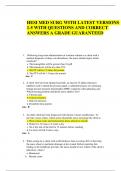
HESI MED SURG WITH LATEST VERSIONS 1-5 WITH QUESTIONS AND CORRECT ANSWERS A GRADE GUARANTEED 1. 1Following long-term administration of warfarin sodium to a client with a medical diagnosis of deep vein thrombosis, the nurse should expect which treatment? a. The hemoglobin will be greater than 10 g/dl b. The hematocrit will be less than 35% c. The PT will be 1.5 times the normal d. The PTT will be 1.5 times the normal Ans. C 2. A client who has been taking finasteride, an enzyme (5 alpha reductase) inhibitor used to shrink the prostate gland, is admitted because of continuing benign prostate prostatic hypertrophy (BPH) symptoms when planning care. Which nursing problem should the nurse address first? a. Chronic pain b. Urinary retention c. Risk for infection d. Disturbed sleep pattern Ans. B 3. An older client has been diagnosed with chronic venous insufficiency. To prevent venous return, which action should the nurse encourage the client to a. Wear cotton socks and enclosed toe shoes whenever outside b. Drink 8 to 10 ounces of water a day c. Sit at the side of the bed for 15 minutes before standing d. Lie down in bed 2 times a day Ans. A 4. When caring for a client with a full thickness burn covering 40% of the body, the nurse observes pertinent drainage at the wound. Before reporting this finding to the healthcare provider, the nurse should review which of the client’s laboratory values? a. Hematocrit b. Platelet count c. White blood cell (WBC) count d. Blood pH level Ans. C 5. An older client arrives at the outpatient eye surgery clinic for a right cataract extraction and implant. During the immediate postoperative period, which intervention should the nurse implement a. Provide an eye shield to be worn while sleeping b. Obtain vital signs every 2 hours during hospitalization c. Encourage deep breathing and coughing exercises d. Teach a family member to administer eye drops Ans. A 6. After several days of coughing and taking acetaminophen to treat temperatures of 101 F (38. 3 C), a client with DI is admitted to the hospital with an upper respiratory infection. Several hours after admission, the client reports having a severe headache and feeling dizzy. Which intervention should the nurse implement first? a. Reassess vital signs b. Obtain sputum for culture c. Obtain a fingerstick glucose d. Administer an antipyretic Ans. A 7. A client takes daily supplemental iron tablets for iron deficiency anemia reports feeling increasingly fatigued. Which laboratory values should the nurse review? a. Serum electrolytes b. Complete blood count c. Liver enzymes d. Platelet count Ans. B 8. The nurse is caring for a client post anesthesia care unit (PACU) who underwent a thoracotomy two hours ago. The nurse observes the following vital signs: heart rate 140 beats/ minute, respirations 26 breaths/minute, and blood pressure 140/90 mmHg. Which intervention is most important for the nurse to implement? a. Administer IV fluid bolus as prescribed by the healthcare provider b. Medicate for pain and monitor vital signs according to protocol c. Encourage the client to splint the incision with a pillow to cough and deep breathe d. Apply oxygen at 10 L via non-rebreather mask and monitor pulse oximeter Ans. B 9. A client who was involved in a motor vehicle collision is admitted with a fractured left femur which is immobilized using a fracture traction splint in preparation for an open reduction internal fraction (ORIF). The nurse determines that the client’s distal pulses are diminished in the left foot. Which interventions should the nurse implement? (SATA) a. Offer ice chips and oral clear liquids b. Verify pedal pulses using a doppler pulse device c. Monitor left leg for pain, pallor, paresthesia, paralysis, pressure d. Evaluate the application of the splint to the left leg e. Administer oral antispasmodics and narcotics analgesics Ans. B, C, D 10. A nurse is caring for a client with Diabetes Insipidus (DI). which data warrants the most immediate intervention by the nurse? a. Dry skin with inelastic turgor b. Apical rate of 110 beats per minute c. Polyuria and excessive thirst d. Serum sodium of 185 mEq/L Ans. D 11. The nurse assesses a client with petechiae and ecchymosis scattered across the arms and legs. Which laboratory result should the nurse review? a. Platelet count b. Red blood cell count c. Hemoglobin levels d. White blood cell count Ans. A 12. A male client is admitted to the emergency department with vomiting of dark brown, foul- smelling emesis. He reports he had a surgical repair of a recurrent inguinal hernia one week ago and complains of intense abdominal pain. After assessing that his bowel sounds are hyperactive, which prescription should the nurse implement first? a. Place an indwelling urinary catheter and attach a bedside drainage unit b. Give a prescribed analgesic for temp above 101 F c. Insert a NGT and attach to low suction d. Send the patient to x-ray for a flat plate of the abdomen Ans. C 13. A client is admitted to the hospital for shortness of breath and chest pain after an episode of syncope. Which laboratory finding is most important for the nurse to report to the healthcare provider? a. Hematocrit
Document information
- Uploaded on
- October 25, 2023
- Number of pages
- 56
- Written in
- 2023/2024
- Type
- Exam (elaborations)
- Contains
- Questions & answers