Hematology Lecture Notes Update Final
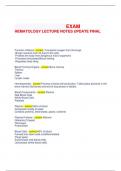
EXAM HEMATOLOGY LECTURE NOTES UPDATE FINAL Function of Blood - correct--Transports oxygen from the lungs. -Brings nutrients from GI tract to the cells -Protects the body from dangerous micro-organisms -Promotes hemostasis/Blood clotting -Regulates body temp Blood Forming Organs - correct-Bone marrow Thymus Spleen Liver Lymph nodes Hematopoiesis - correct-Process of blood cell production. Takes place primarily in the bone marrow (flat bones and end of long bones in adults) Blood Components - correct-Plasma Red Blood Cells White Blood Cells Platelets Plasma - correct-55% of blood Composed mostly of water Contains proteins, electrolytes, gases, nutrients Plasma Proteins - correct-Albumin Globulins (3 types) Fibrinogen Prothrombin Blood Cells - correct-45% of blood Formed from stem cells (undifferentiated) Three types: Erythrocytes (red blood cells) Leukocytes (white blood cells) Thrombocytes (platelets) Erythrocytes - correct-Transport of gases Assist in maintaining acid base balance Leukocytes - correct-Protection from infection, cancer Platelets - correct-Promote blood coagulation in response to injury Erythrocyte structure and function - correct-Thin cell wall to facilitate diffusion of gases Flexible cell wall, able to alter shape to pass through small capillaries Primarily composed of hemoglobin Live approx 120 days Growth factor Erythropoietin involved in development Hemoglobin - correct-Produced by erythrocytes Each normal RBC contains hundreds of thousands of Hgb molecules Each molecule of Hgb needs one molecule of iron to transport up to four molecules of oxygen. Leukocytes structure and function - correct-Appear white when separated from blood Two categories: Granulocytes, Agranulocytes 5 types of WBC, various functions Platelets structure and function - correct-Smallest of blood cells Perform most of their functions through aggregation Develop in the bone marrow Growth factor thrombopoietin involved in development Hemostasis: The process of blood clotting - correct-Vascular spasm Plug formation Development of fibrin clot Lysis of clot Coagulation Modifiers (pharma) - correct-Heparins Coumadin Direct Thrombin inhibitors Selective factor Xa inhibitor Aggregation inhibitors Hematologic Assessment - Testing - correct-Complete Blood Count Reticulocyte Count Peripheral Blood Smear Coomb's Test Coagulation Screening Tests Bone Marrow Aspiration and Biopsy Complete Blood Count (CBC) - correctReticulocyte Count - correct-Used to determine the responsiveness of the bone marrow to the depletion of circulating RBCs. Peripheral Blood Smear - correct-Looking at the blood under a microscope to determine the abnormalities or variations of RBCs, WBCs, and Platelets. Coomb's Test - correct-Used for blood typing and crossmatching. Identifies antibodies on RBCs. Coagulation Screening Tests - correct-Partial Thromboplastin Time (PTT): used to identify deficiencies of coagulation factors, prothrombin and fibrinogen. Prothrombin Time (Pro-Time or PT): measures the activity and interactions of prothrombin, fibrinogen, factors V, VII, and X. Bone Marrow Aspiration and Biopsy - correct-Performed to evaluate the pt's hematological status when other tests show persistent abnormal findings, that indicate problems with blood cell production or maturation. Erythrocyte Disorders - correct-Erythrocytes are the major cell in the blood Responsible for tissue oxygenation RBC disorders include problems in production, function, and destruction. Anemia - correct-Decreased production of RBCs, Hgb, or hematocrit (HCT) Polycythemia - correct-Excess production of RBCs Anemia symptoms - correct-Integumentary: Pallor, jaundice, pruritis Cardiopulmonary: increased HR, tachypnea, orthopnea, dyspnea at rest, orthostatic hypotension, decreased oxygen saturation. GI: anorexia, sore mouth, splenomegaly, hepatomegaly General: sensitivity to cold, lethargy Nutritional Deficit Anemias - correct-Iron Deficient Anemia Vitamin B12 Anemia Folic Acid deficient anemia Iron Deficiency Anemia - correct-A c microcytic anemia due to inadequate absorption of iron. Most common anemia worldwide Often affects the very young, menstuating women, vegetarians, and people with very poor diets
Document information
- Uploaded on
- October 23, 2023
- Number of pages
- 25
- Written in
- 2023/2024
- Type
- Class notes
- Professor(s)
- Hematology lecture notes
- Contains
- All classes