
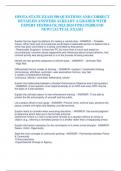
OPOTA STATE EXAM 500 QUESTIONS AND CORRECT DETAILED ANSWERS ALREADY A GRADED WITH EXPERT FEEDBACK 2023 -2024 UPDATE|BRAND NEW!!{ACTUAL EXAM} Explain the two legal foundations for making a vehicle stop - ANSWER - - Probable Cause - When facts and circumstances would lead a reasonable person to believe that a crime has been committed or is being committed by that person. - Reaso nable Suspicion - Is less than PC but more than a hunch and based on circumstances, common sense judgements and inferences about human behavior, that criminal activity was being planned or is in the process of being executed. Identify the two general categ ories of vehicle stops. - ANSWER - - Unknown Risk - High Risk Differentiate the two modes of t hinking. - ANSWER - •(system 1) Automatic thinking Unconscious, effortless, automatic, uses associative memory, very fast •( system 2) Deliberative thinking Conscious, effortful, controlled, deliberative, slower Explain the relationship between a Student Performance Objective and a test question. - ANSWER - A test question must respond directly to an SPO and every SPO may be the basis of a test question. Explain the ultimate reason for law enforcement training. - ANSWER - To be able to protect the life and property of yourself and the public. List a peace officer's main goals - ANSWER - Prevent crim e, enforce laws, preserve the peace, protect civil rights and liberties, provide services. Explain items to consider when exercising discretion. - ANSWER - Use sound judgment to determine which laws are to be formally enforced Determine if there is a more constructive remedy to a situation without an arrest or citation (e.g., referring a homeless person to a shelter rather than a trespassing arrest) Explain the factors necessary for the commission of a crime (crime triangle) - ANSWER - Desire, Victim, Oppor tunity State the core concepts of community policing - ANSWER - -Partnership between Police & Community -Crime prevention -Organizational Change in Agency -A problem solving approach to the police role that is proactive Recognize considerations for off duty situations - ANSWER - • behavior often critisized by the community even when not on duty • not only does this refer to physical and verbal • also online media • officers are expected to up hold the law enforcement code of ethics. • Situational awareness - an officer should make every effort to remain alert even when not working. State the purposes of the bill of right. - ANSWER - To protect individual freedoms. To prevent the government from interfering in your protected rights. Describe the major components of the criminal justice system. - ANSWER - law enforcement, courts, corrections List the goals of sentencing - ANSWER - Punish the offender and in many cases, rehabilitate the offender Protect society Restore the vict im as much as possible Distinguish the concepts of lawful actions and police legitimacy - ANSWER - "Lawful" is defined by laws and standards "Police Legitimacy" Exists when the public views the police as authorized to exercise power in order to maintain so cial order. Identify three resulting judgements of police legitimacy in action that translate into positive results. - ANSWER - •judgement - public trust and confidence in the police as being honest, trying to do jobs well, trying to protect community. Resu lt- Individuals are more likely to become actively involved in police -community partnerships •Judgement - public willingness to defer to the law and police authority. Result - there is a correlation between those who obey the laws and those who view the police as legitimate: in addition, those who see the police as legitimate have an increased willingness to cooperate by reporting crimes and providing valuable information about known and suspected offenders. • Judgement - public belief that police actions are morally justified and appropriate. Result - citizens are more likely to cooperate and defer in moments of crisis. Determine when it is permissible for citizens to film police - ANSWER - • At least one party to the encounter consents or • When officers are carrying out their duties in public, so long as it does not interfere with the officers carrying out their duties Identify the relationship between race, genetics, and physical characteristics - ANSWER - Race is a modern concept used to classify people by similar, observable physical characteristics It is not, as many people think, based on genetics Despite surface appearances, humans are one of the most genetically similar of all species and ... Within the human species, there is no distinct genetic profile that completely distinguishes one so -called race from another This is because most genetically influenced traits, like skin color, hair, eye shape, blood type, athleticism, and intelligence, are inherited completely independent of one another Differentiate the types of racism. - ANSWER - Individual racism - Internalized, unexpressed biases and prejudices based on race Interpersonal racism - Occurs between individuals. Includes public expressions of racial prejudice and hate made b y individuals Institutional racism -Race based discriminatory policies and treatment that are produced and perpetuated by institutions (e.g., schools, mass media, governments, banks) that result in inequitable opportunities and impacts -Occurs within and between institutions -Includes the discriminatory actions of individuals exercising the authority of the institution (e.g., a bank loan officer, representing a banking institution, treating someone with racial bias; a police officer, representing a law en forcement institution, treating someone with racial bias) Structural racism -Refers to the collective way history, culture, and institutions reinforce and perpetuate racialized outcomes, even in the absence of racist intent -It is broadly encompassing - it touches on all aspects of society (e.g., history, politics, economics) and is the foundation from which the other types of racism emerge -Indicators include power inequalities, unequal access to opportunities, and differing policy outcomes by race, whet her or not intentional Identify the components of bias. - ANSWER - Stereotypes - generalizations about the perceived "typical" characteristics of a social category (i.e., cognitive component) • We categorize people by age, gender, race, and role • Stereotypes do not necessarily have to have a negative connotation, as social scientist point out that it is just a way for our brain to quickly sort people into recognizable groups Prejudices - an often -negative prejudgment based on characteristics such as race, age, etc., that is not necessarily reasonable or logical Attitude - positive or negative feelings associated with individuals or groups; the tendency to like or dislike, or to act favorably or unfavorably toward someone or something Differentiat e bias -based profiling and criminal profiling - ANSWER - • Bias -based profiling, racial profiling, and illegal profiling have the same meaning and are used interchangeably. • Bias -based profiling is unequal treatment by a law enforcement officer of any per son by stopping, questioning, searching, detaining or arresting him/her on the basis of the person's ethnic or racial characteristics, gender, religion, or sexual orientation. • Criminal profiling: based on observed behaviors and characteristics • Bias -based profiling: the factors of race/ethnicity and bias towards that race are initiating factors for law enforcement intervention Explain explicit biases and implicit biases - ANSWER - Explicit bias and implicit bias - common characteristics • Everyone poss esses them • They have real -world effects on behavior • They can relate, for example, to race, religion, gender, sexuality, disability, height, weight, or age Explicit bias - conscious preference (positive or negative) for a social category Implicit bias - preference (positive or negative) for a social category based on stereotypes or attitudes that we hold and tend to develop early in life and that operate outside of our awareness Implicit biases are related to explicit biases, but they are still distinct concepts • While the two types of biases may reinforce each other, implicit biases can be dissociated from explicit biases - our implicit biases do not necessarily align with our explicit beliefs • Implicit biases are largely hidden from us, but their effec ts are pervasive and powerful and understanding implicit biases is important because they have the potential to impact our interactions and efforts to effectively use procedural justice tactics to promote police legitimacy Identify strategies to counter implicit bi ases - ANSWER - Guarding against its influence in decision making • Recognize that everyone has biases and think critically about your own potential biases • Seek greater awareness and more education to increase motivation to be fair Know when you are susceptible • Conditions o Ambiguous or incomplete information o Time constraints o Compromised cognitive control High cognitive load (i.e., processing many thoughts at one time)
Preview 4 out of 132 pages
Exam (elaborations)
OPOTA STATE EXAM 500 QUESTIONS AND CORRECT DETAILED ANSWERS ALREADY A GRADED WITH EXPERT FEEDBACK UPDATE|BRAND NEW!!{ACTUAL EXAM}
Preview 4 out of 132 pages
OPOTA STATE EXAM 500 QUESTIONS AND CORRECT DETAILED ANSWERS ALREADY A GRADED WITH EXPERT FEEDBACK UPDATE|BRAND NEW!!{ACTUAL EXAM}
Content preview
Document information
- Uploaded on
- October 20, 2023
- Number of pages
- 132
- Written in
- 2023/2024
- Type
- Exam (elaborations)
- Contains
- Questions & answers
$28.39
Wrong document? Swap it for free
Within 14 days of purchase and before downloading, you can choose a different document. You can simply spend the amount again.
Written by students who passed
Immediately available after payment
Read online or as PDF
Reputation scores are based on the amount of documents a seller has sold for a fee and the reviews they have received for those documents. There are three levels: Bronze, Silver and Gold. The better the reputation, the more your can rely on the quality of the sellers work.
Available in package deal
Package deal
A PACKAGE DEAL FOR ALL OPOTA EXAMS ALL ARE A GRADED


