
AP Bio Chapter 8 Practice: An Introduction to Metabolism Questions With Complete Solutions
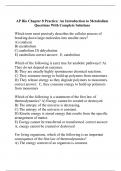
Which term most precisely describes the cellular process of breaking down large molecules into smaller ones? A) catalysis B) metabolism C) anabolism D) dehydration E) catabolism correct answer: E, catabolism Which of the following is (are) true for anabolic pathways? A) They do not depend on enzymes. B) They are usually highly spontaneous chemical reactions. C) They consume energy to build up polymers from monomers. D) They release energy as they degrade polymers to monomers. correct answer: C, they consume energy to build up polymers from monomers Which of the following is a statement of the first law of thermodynamics? A) Energy cannot be created or destroyed. B) The entropy of the universe is decreasing. C) The entropy of the universe is constant. D) Kinetic energy is stored energy that results from the specific arrangement of matter. E) Energy cannot be transferred or transformed. correct answer: A, energy cannot be created or destroyed For living organisms, which of the following is an important consequence of the first law of thermodynamics? A) The energy content of an organism is constant. B) The organism ultimately must obtain all of the necessary energy for life from its environment. C) The entropy of an organism decreases with time as the organism grows in complexity. D) Organisms are unable to transform energy. E) Life does not obey the first law of thermodynamics. correct answer: B, the organism ultimately must obtain all of the necessary energy for life from its environment Living organisms increase in complexity as they grow, resulting in a decrease in the entropy of an organism. How does this relate to the second law of thermodynamics? A) Living organisms do not obey the second law of thermodynamics, which states that entropy must increase with time. B) Life obeys the second law of thermodynamics because the decrease in entropy as the organism grows is balanced by an increase in the entropy of the universe. C) Living organisms do not follow the laws of thermodynamics. D) As a consequence of growing, organisms create more disorder in their environment than the decrease in entropy associated with their growth. E) Living organisms are able to transform energy into entropy. correct answer: D, as a consequence of growing, organisms create more disorder in their environment than the decrease in entropy associated with their growth Whenever energy is transformed, there is always an increase in the A) free energy of the system. B) free energy of the universe. C) entropy of the system. D) entropy of the universe.
Document information
- Uploaded on
- October 17, 2023
- Number of pages
- 21
- Written in
- 2023/2024
- Type
- Exam (elaborations)
- Contains
- Questions & answers


