Embryology (Exam 2)
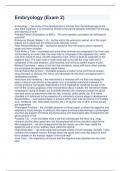
Embryology (Exam 2) Embryology - "the study of the development of animals from the fertilized egg to the new adult organism; it is sometimes limited to the period between fertilization of the egg and hatching or birth" Prenatal Period (Fertilization to Birth) - "the time between conception [or fertilization] and birth" Embryonic Period (Weeks 1- 8) - by the end of the embryonic period, all of the major organs are in place and the embryo looks distinctly human Fetal Period (Weeks 9-38) - during this period of time the organs grow to become larger and more complex Tube within a Tube - chordates and some other animals are composed of an inner tube surrounded by an outer tube; the inner tube is composed of the digestive tract, which runs from mouth to anus, and the respiratory tract, which is itself an outgrowth of the digestive tract. The outer tube or outer body wall surrounds the inner tube and is composed of the axial skeleton, axial muscles, and nervous system organs in part. Bilateral Symmetry - refers to the fact that chordates, along with many other animals, are composed two approximately equal halves Dorsal Hollow Nerve Cord - chordates possess a hollow nerve cord that is located along the back or dorsum; this nerve cord develops into the brain and spinal cord in vertebrates/craniates Notochord and Vertebrae - the notochord is a relatively stiff rod that runs along the back or dorsum just inferior to the spinal cord; a complete notochord is present in
Document information
- Uploaded on
- October 17, 2023
- Number of pages
- 4
- Written in
- 2023/2024
- Type
- Exam (elaborations)
- Contains
- Questions & answers