

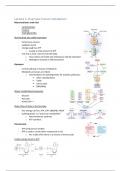
Lecture 1: Overview human metabolism
Macronutrients: main fuel
- Carbohydrates
- Proteins
- Fat/triglycerides
Burning food also called respiration
- Continuous process
- oxidation by O2
- energy caught as ATP
o usually a small amount of ATP
- rest lost as heat: used to heat the body
o Two carbons of Acetyl-CoA released as CO2 by expiration
o Hydrogens released as H20 (secreted )
Glycolysis
- central pathway in human metabolism
- Metabolic processes are linked:
o Intermediates are building blocks for anabolic pathways:
▪ other carbohydrates
▪ Lipids
▪ amino acids
▪ DNA/RNA)
Mayor metabolites/compounds
- Glucose
- Pyruvate
- Acetyl CoA ->
Major fates of fuels in the fed state
- free energy carriers: ATP, GTP, NAD(P)H, FADH
- building blocks: 12 “precursor metabolites”
o Macromolecule synthesis
o ATP synthesis
Homeostasis
- ATP produced as needed
- ATP is used to create other compounds or fat
o Fat: made when there is an excess of amino acids
Useful energy stored in ATP
,Compartmentalization of metabolic reactions
- Many organs have their own tissue metabolism
- Liver is the central factory: does most of the reactions
Regulation OXPHOS & ATPase
- ATP synthase uses energy from proton gradient to produce ATP ↓
- When all ADP has been converted to ATP the enzyme stops! ↓
- No regeneration of NAD+
NADH produced in the TCA cycle
- Regulated by
o The amount of ATP
o NAD+: without this the reaction from isocitrate to ketoglutarate can not happen, so
the cycle does not continue
- TCA catches energy in small steps (NADH)
- When all ATP is used → no new ATP
- When OXPHOS stops recycling NADH: TCA will also stop
A self regulating system!
- From 1500 calories a day you make 60 kilograms ATP!
- You only have several grams of ADP
- Under homeostatic conditions ATP is constantly being
synthesized and used
o Rest influences the system negatively but creates a larger concentration of ATP
o Exercise: stimulates the system, creates a lower concentration of ATP
When there is sufficient ATP
excess Acetyl CoA is converted to fat instead of going
into the TCA cycle
Glucose
- Excess glucose converted to fat
o (liver store glycogen limited to ~200 gram)
,nitrogen balance
- Negative balance:
o body protein breakdown
o Nitrogen excretion during fasting
o Loss of muscle mass: used to make glucose
Starvation
- Ketone bodies: back up fuel for the brain
- Fatty acids from the adipose: used as fuel for
organs, besides the brain
The laws of thermodynamics
- Exothermic: energy is released from the system into the surroundings
- Endothermic: when energy is absorbed from the surroundings in the form of heat
- Coupling of endotherm and exotherm reaction:
o In living organisms energy requiring
process (∆G > 0, endothermic) are driven
by energy generating processes (∆G < 0,
exothermic), often ATP hydrolysis.
KEY CONCEPTS:
- Fuel: carbohydrates, proteins and fat
- Catabolized for ATP generation (=self-regulating system)
- Metabolism regulated through intermediate metabolites and hormones
o Big three: glucose, pyruvate, acetyl CoA
- Metabolism is compartmentalized (Liver, mitochondria)
- Glycolysis and TCA are central pathways in metabolism
- ALL excess fuel stored as fat
- Between meals:
o Protein degradation for glucose synthesis (brain)
o Mobilization of fatty acids
- Starvation:
o To spare muscles, fatty acids converted to keton bodies (brain)
, Lecture 2 Carbohydrate and glucose metabolism
- Each day 160-200 g of glucose used
- Brain uses 120-150 g!
- Storage as glycogen, ~190 gram (liver)
- During fasting all glucose stores are finished within 1 day!
- Brain/ neuronal cells have no beta-oxidation → cannot absorb long chain fatty acids (myelin!)
- Brain relies on glucose, only backup is ketone bodies
o The brain maintains the blood-glucose level
Sugar
- Stereo-isomers: different types of sugars:
- Can change conformation from cyclic to linear and the other way around
- 3D conformational changes are large:
o enzymes are often very specific to specific sugars
o so they do not recognize different ring structure
Dietary sources of carbohydrates
Starch plant dairy Every western processed food
Polymers
- Some polymers (starch) need several enzymes to be degraded
- Saliva contains enzymes to break down starch fibers
- Fibers: cellulose of the walls of plant cells
o But some of those enzymes are not present in humans, so these fibers can not be
broken down
o When there is a beta 1,4 bond of cellulose
▪ No enzyme available to digest
Macronutrients: main fuel
- Carbohydrates
- Proteins
- Fat/triglycerides
Burning food also called respiration
- Continuous process
- oxidation by O2
- energy caught as ATP
o usually a small amount of ATP
- rest lost as heat: used to heat the body
o Two carbons of Acetyl-CoA released as CO2 by expiration
o Hydrogens released as H20 (secreted )
Glycolysis
- central pathway in human metabolism
- Metabolic processes are linked:
o Intermediates are building blocks for anabolic pathways:
▪ other carbohydrates
▪ Lipids
▪ amino acids
▪ DNA/RNA)
Mayor metabolites/compounds
- Glucose
- Pyruvate
- Acetyl CoA ->
Major fates of fuels in the fed state
- free energy carriers: ATP, GTP, NAD(P)H, FADH
- building blocks: 12 “precursor metabolites”
o Macromolecule synthesis
o ATP synthesis
Homeostasis
- ATP produced as needed
- ATP is used to create other compounds or fat
o Fat: made when there is an excess of amino acids
Useful energy stored in ATP
,Compartmentalization of metabolic reactions
- Many organs have their own tissue metabolism
- Liver is the central factory: does most of the reactions
Regulation OXPHOS & ATPase
- ATP synthase uses energy from proton gradient to produce ATP ↓
- When all ADP has been converted to ATP the enzyme stops! ↓
- No regeneration of NAD+
NADH produced in the TCA cycle
- Regulated by
o The amount of ATP
o NAD+: without this the reaction from isocitrate to ketoglutarate can not happen, so
the cycle does not continue
- TCA catches energy in small steps (NADH)
- When all ATP is used → no new ATP
- When OXPHOS stops recycling NADH: TCA will also stop
A self regulating system!
- From 1500 calories a day you make 60 kilograms ATP!
- You only have several grams of ADP
- Under homeostatic conditions ATP is constantly being
synthesized and used
o Rest influences the system negatively but creates a larger concentration of ATP
o Exercise: stimulates the system, creates a lower concentration of ATP
When there is sufficient ATP
excess Acetyl CoA is converted to fat instead of going
into the TCA cycle
Glucose
- Excess glucose converted to fat
o (liver store glycogen limited to ~200 gram)
,nitrogen balance
- Negative balance:
o body protein breakdown
o Nitrogen excretion during fasting
o Loss of muscle mass: used to make glucose
Starvation
- Ketone bodies: back up fuel for the brain
- Fatty acids from the adipose: used as fuel for
organs, besides the brain
The laws of thermodynamics
- Exothermic: energy is released from the system into the surroundings
- Endothermic: when energy is absorbed from the surroundings in the form of heat
- Coupling of endotherm and exotherm reaction:
o In living organisms energy requiring
process (∆G > 0, endothermic) are driven
by energy generating processes (∆G < 0,
exothermic), often ATP hydrolysis.
KEY CONCEPTS:
- Fuel: carbohydrates, proteins and fat
- Catabolized for ATP generation (=self-regulating system)
- Metabolism regulated through intermediate metabolites and hormones
o Big three: glucose, pyruvate, acetyl CoA
- Metabolism is compartmentalized (Liver, mitochondria)
- Glycolysis and TCA are central pathways in metabolism
- ALL excess fuel stored as fat
- Between meals:
o Protein degradation for glucose synthesis (brain)
o Mobilization of fatty acids
- Starvation:
o To spare muscles, fatty acids converted to keton bodies (brain)
, Lecture 2 Carbohydrate and glucose metabolism
- Each day 160-200 g of glucose used
- Brain uses 120-150 g!
- Storage as glycogen, ~190 gram (liver)
- During fasting all glucose stores are finished within 1 day!
- Brain/ neuronal cells have no beta-oxidation → cannot absorb long chain fatty acids (myelin!)
- Brain relies on glucose, only backup is ketone bodies
o The brain maintains the blood-glucose level
Sugar
- Stereo-isomers: different types of sugars:
- Can change conformation from cyclic to linear and the other way around
- 3D conformational changes are large:
o enzymes are often very specific to specific sugars
o so they do not recognize different ring structure
Dietary sources of carbohydrates
Starch plant dairy Every western processed food
Polymers
- Some polymers (starch) need several enzymes to be degraded
- Saliva contains enzymes to break down starch fibers
- Fibers: cellulose of the walls of plant cells
o But some of those enzymes are not present in humans, so these fibers can not be
broken down
o When there is a beta 1,4 bond of cellulose
▪ No enzyme available to digest


