Seidel s guide to physical examination 9th edition test bank 2
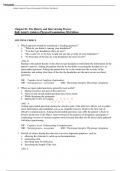
Seidel s guide to physical examination 9th edition test bank 2Chapter 01: The History and Interviewing Process Ball: Seidel’s Guide to Physical Examination, 9th Edition MULTIPLE CHOICE 1. Which question would be considered a “leading question?” a. “What do you think is causing your headaches?” b. “You don’t get headaches often, do you?” c. “On a scale of 1 to 10, how would you rate the severity of your headaches?” d. “At what time of the day are your headaches the most severe?” ANS: B Stating to the patient that he or she does not get headaches would limit the information in the patient’s answer. Asking the patient what he or she thinks is causing the headaches is an open-ended question. Asking the patient how he or she would rate the severity of the headaches and asking what time of the day the headaches are the most severe are direct questions. DIF: Cognitive Level: Applying (Application) OBJ: Nursing process—assessment MSC: Physiologic Integrity: Physiologic Adaptation 2. When are open-ended questions generally most useful? a. During sensitive area part of the interview b. After several closed-ended questions have been asked c. While designing the genogram d. During the review of systN emsR I G B.C M ANS: A U S N T O Asking open-ended questions during the sensitive part of the interview allows you to gather more information and establishes you as an empathic listener, which is the first step of effective communication. Asking closed-ended questions may stifle the patient’s desire to discuss the history of the illness. Interviewing for the purpose of designing a genogram or conducting a review of systems requires more focused data than can be more easily gathered with direct questioning. DIF: Cognitive Level: Understanding (Comprehension) OBJ: Nursing process—assessment MSC: Physiologic Integrity: Physiologic Adaptation 3. Periods of silence during the interview can serve important purposes, such as: a. allowing the clinician to catch up on documentation. b. promoting calm. c. providing time for reflection. d. increasing the length of the visit. ANS: C harryson Seidels Guide to Physical Examination 9th Edition Test Bank 2 Silence is a useful tool during interviews for the purposes of reflection, summoning courage, and displaying compassion. This is not a time to document in the chart, but rather to focus on the patient. Periods of silence may cause anxiety rather than promote calm. The length of the visit is less important than getting critical information. harryson Seidels Guide to Physical Examination 9th Edition Test Bank 2 DIF: Cognitive Level: Understanding (Comprehension) OBJ: Nursing process—assessment MSC: Physiologic Integrity: Physiologic Adaptation 4. Mr. Franklin is speaking with you, the healthcare provider, about his respiratory problem. Mr. Franklin says, “I’ve had this cough for 3 days, and it’s getting worse.” You reply, “Tell me more about your cough.” Mr. Franklin states, “I wish I could tell you more. That’s why I’m here. You tell me what’s wrong!” Which caregiver response would be most appropriate for enhancing communication? a. “After 3 days, you’re tired of coughing. Have you had a fever?” b. “I’d like to hear more about your experiences. Where were you born?” c. “I don’t know what’s wrong. You could have almost any disease.” d. “I’ll examine you and figure out later what the problem is.” ANS: A “After 3 days, you’re tired of coughing. Have you had a fever?” is the only response aimed at focusing on the chief compliant to gather more data and does not digress from the issue. DIF: Cognitive Level: Analyzing (Analysis) OBJ: Nursing process—assessment MSC: Physiologic Integrity: Physiologic Adaptation 5. After you ask a patient about her family history, she says, “Tell me about your family now.” Which response is generally most appropriate? a. Ignore the patient’s comment and continue with the interview. b. Give a brief, undetailed answer. c. Ask the patient why she needs to know. d. Tell the patient that you do not discuss your family with patients. ANS: B NURSINGTB.COM Giving a brief, undetailed answer will satisfy the patient’s curiosity about yourself without invading your private life. Ignoring the patient’s comment, continuing with the interview, and telling the patient that you do not discuss your family with patients will potentially anger or frustrate her and keep her from sharing openly. Asking the patient why she needs to know will distract from the real reason she is seeking care and instead move the interview conversation away from the topics that should be discussed. DIF: Cognitive Level: Applying (Application) OBJ: Nursing process—assessment MSC: Physiologic Integrity: Physiologic Adaptation 6. A 36-year-old woman complains that she has had crushing chest pain for the past 2 days. She seems nervous as she speaks to you. An appropriate response is to: a. continue to collect information regarding the chief complaint in an unhurried manner. b. finish the interview as rapidly as possible. c. ask the patient to take a deep breath and calm down. d. ask the patient if she wants to wait until another day to talk to you. ANS: A
Document information
- Uploaded on
- October 14, 2023
- Number of pages
- 211
- Written in
- 2023/2024
- Type
- Exam (elaborations)
- Contains
- Questions & answers