DAVITA DIALYSIS STUDY GUIDE QUESTIONS WITH CORRECT ANSWERS
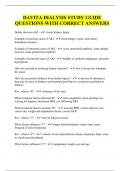
Define the term AKI - Acute Kidney Injury Example of prerenal cause of AKI - hemorrhage, sepsis, renal artery thrombosis/stenosis Example of intrarenal cause of AKI - acute interstitial nephritis, acute tubular necrosis, acute glomerulus nephritis Example of postrenal cause of AKI - bladder or urethral malignancy, prostatic hyperplasia How do you help in restoring kidney function? - best to keep wet; eliminate the cause How do you protect kidneys from further injury? - avoid use of substances that may be toxic to kidneys and maintain good bp's to avoid poor profusion to kidneys Kt/v, what is "K" - clearance of the urea What treatment factors decrease K? - anti-coagulation, poor priming, not waiting for heparin, decreased BFR, not following P&P What treatment factors increase "K" - increase BFR, correct dialyzer size, correct dry weight and amputation factor, correct DFR Kt/v, what is "T" - time of dialysis session What factors influence 'T'? - longer blood/dialysate contact time, more frequent or extra treatments Kt/v, what is 'V'? - volume of urea distribution/volume of patients body water in which urea distributed What factors influence 'V'? - amputation, height, sex and age 17 needle gauge - 200-250 pump speed 16 needle gauge - 250-350 pump speed 15 needle gauge - 350-450 pump speed 14 needle gauge - 450 or greater Post BUN procedure - 1. turn off UFR or decrease it to 50 ase DFR tp 300 3. decrease BFR to 100 4, wait 15 seconds Lab mistakes that would falsely increase kt/v - 1. BFRs not reduced 2. waiting 5 seconds 3. drawing post BUN from venous line Lab mistakes that would falsely decrease kt/v - 1. accidentally diluting pre treatment arterial BUN blood sample with saline 2. waiting longer than 15 seconds to draw blood sample What is important when monitoring weight and BP? - keep pts more wet than dry to drops in blood pressure AKI patients are at increased risk for which complication? - infections and GI bleeds What do you need to consider in regards to their vascular access? - CVC usually in place and avoid infections Explain the difference between AKI and CRF - AKI-sudden, onset/reversible CRF-slow to progress Outline the treatment goals for a patient with CKD - 1. slow progression 2. manage co morbidities 3. control symptoms 4. minimize CKD effects on lifestyles What are the most common causes for CRF in the USA? - diabetes and hypertension Why is it important to know what caused your patients CRF? - to inquire about possible problems during data collection and assessment What is the primary device for water purification in dialysis? - RO What does TRAMP stand for? - Time, Route, Amount, Medication, Patient Hypotension symptoms - cold and clammy skin, nausea and vomiting, shortness of breath Hypertension symptoms - headache, dizziness, edema, elevated bp Angina symptoms - chest pain, difficulty breathing, nausea Angina intervention - administer oxygen, decrease BFR, UFR to minimum Crenation symptoms - dark red blood, headache, nausea and vomiting Crenation intervention - stop pump and clamp lines, do not return blood Air Embolism symptoms - air in venous line, chest pain, difficulty breathing
Written for
- Institution
- DAVITA
- Course
- DAVITA
Document information
- Uploaded on
- October 12, 2023
- Number of pages
- 5
- Written in
- 2023/2024
- Type
- Exam (elaborations)
- Contains
- Questions & answers
Subjects
-
davita dialysis study guide questions
-
davita dialysis study guide

Also available in package deal