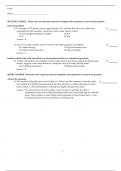
.Ischemia and other toxic injuries increase the accumulation of intracellular calcium as a D)physiologic hypertrophy D)decreasing protein synthesis and function D)attraction of calcium to fatty infiltrates. result of: C)rapid phagocytosis A)caspase activ
.Ischemia and other toxic injuries increase the accumulation of intracellular calcium as a D)physiologic hypertrophy D)decreasing protein synthesis and function D)attraction of calcium to fatty infiltrates. result of: C)rapid phagocytosis A)caspase activation D)protein p53 deficiency 4.Bacteria and viruses cause cell damage by , which is unique from the 3.A person eating peanuts starts choking and collapses. His airway obstruction is partially cells. A)release of stored calcium from the mitochondria. C)compensatory hyperplasia C)disrupting calcium storage in the cell. hypoxic cell injury and the release of free radicals. Free radicals damage cells by: B)altering the immune response of the cell. B)improved intracellularvolume regulation. A)destroying phospholipids in the cell membrane. C)replicating and producing continued injury C)decreased influx across the cell membrane. intracellular damage caused by other injurious agents. cleared, but he remains hypoxic until he reaches the hospital. The prolonged cell hypoxia caused a cerebral infarction and resulting __________ in the brain. B)interrupting oxidative metabolism processes B)coagulation necrosis A)metaplasia Adaptation to the reduced size of the liver leads to ___________ of the remaining liver 5.The patient has a prolonged interruption in arterial blood flow to his left kidney, causing A)disrupting the sodium/potassium ATPase pump B)organ atrophy 2.The patient is found to have liver disease, resulting in the removal of a lobe of his liver. D)inactivation of enzymes and mitochondria.
Document information
- Uploaded on
- October 10, 2023
- Number of pages
- 29
- Written in
- 2023/2024
- Type
- Exam (elaborations)
- Contains
- Questions & answers