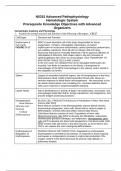
N5315 Advanced Pathophysiology Hematologic System Prerequisite Knowledge Objectives with Advanced Organizers
Hematologic Anatomy and Physiology 1. Analyze the normal structure and function of the following cells/organs. CH 27 Cell/Organ Structure and Function Erythrocytes & Iron Cycle FIGURE 27-17 (RBC’s) most abundant cell of the body. Responsible for tissue oxygenation. Contains: Hemoglobin, Electrolytes, [A mature erythrocyte=no nucleus/no mitochondria, cannot synthesize protein/carry out oxidative reactions]. Short life d//t no mitosis=100-120 days. Biconcave disk/can be reversibly deformed. Flat for gaseous diffusion of cell/capable of deformity. Odd shape helps to slip into sinusoids of spleen/capillaries then return to normal shape. GAS TRANSPORT TO AND FROM TISSUE CELLS AND LUNGS. In the iron cycle, iron released from old or damaged erythrocytes are recycled. Iron binds to transferrin in the blood, is transported to macrophages of the MPS (macrophages in the spleen), and is stored in the cytoplasm as ferritin. Spleen Largest of secondary lymphoid organs, site of hematopoiesis in the fetus. Filters/cleans blood. Holds lymphocytes/other blood cells. Mount an immune response to blood-borne microorganisms. Not necessary to live. No spleen=leukocytosis, low circulating Fe+, incr
Written for
- Institution
-
University Of Texas - Arlington
- Course
-
NURSING NURS 5315
Document information
- Uploaded on
- October 9, 2023
- Number of pages
- 10
- Written in
- 2023/2024
- Type
- Exam (elaborations)
- Contains
- Unknown