Patho NSG 533- module 1 - Cell Injury/Death/Adaptation
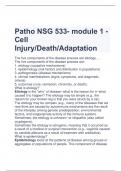
Patho NSG 533- module 1 - Cell Injury/Death/Adaptation The five components of the disease process are etiology.... The five components of the disease process are: 1. etiology (causative mechanisms) 1. epidemiology (risk factors and distribution in populations) 3. pathogenesis (disease mechanisms) 4. clinical manifestations (signs, symptoms, and diagnostic criteria) 5. outcomes (cure, remission, chronicity, or death). What is etiology? Etiology is the "why" of disease--what is the reason for it--what caused it to happen? The etiology may be simple (e.g., the reason for your broken leg is that you were struck by a car). The etiology may be complex (e.g., many of the diseases that we now think are caused by autoimmune mechanisms are the result of the interplay among genetic predisposition, environmental factors, and inappropriate activity of the immune system). Sometimes, the etiology is unknown--or idiopathic (also called cryptogenic). Sometimes the etiology is iatrogenic, meaning that it occurred as a result of a medical or surgical intervention (e.g., vaginitis caused by candida albicans as a result of treatment with antibiotics). What is epidemiology? Epidemiology looks at the patterns of disease among groups or aggregates or populations of people. This component of disease represents the relationship between numerous population characteristics (e.g., age, ethnicity, socioeconomic status, geographic location) and the incidence and prevalence of disease. What is the incidence of a disease? The incidence of a disease, as it is usually defined, is the number of new cases occurring in a given population within a given time period--usually 1 year. For example, the incidence of Down Syndrome in the US is 1 in 690 births (1/690 x 100 = 0.14%). What is prevalence? The prevalence of a disease involves the number of cases existing (both old and new) in a given time period. The prevalence of Down Syndrome in the US is 400,000. For a population of about 314 million that is a prevalence of 0.13% (400,000/314,000,000 x 100 = 0.13%). What is pathogenesis? pathogenesis involves the sequence of events that occurs between the stimulus event(s) and the manifestations of the disease. In the case of a pharyngeal infection, it involves what occurred physiologically and pathologically between the time that the individual encountered the infecting organism and the appearance of clinical manifestations. What is primary prevention? Primary prevention is directed towards preventing the initial occurrence of a disorder What are secondary and tertiary prevention? Secondary and tertiary prevention seek to arrest or retard existing disease and its effects through early detection and appropriate treatment; or to reduce the occurrence of relapses and the establishment of chronic conditions What are the four categories of stressors that can cause disease? four categories of stressors are: ATP depletion Oxygen and oxygen-derived free radicals
Document information
- Uploaded on
- October 9, 2023
- Number of pages
- 12
- Written in
- 2023/2024
- Type
- Exam (elaborations)
- Contains
- Questions & answers