Pediatric Nursing Exam 1 Questions With Correct Answers
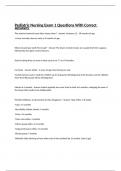
The anterior fontanel most often closes when? - Answer -between 12 - 18 months of age. -It may normally close as early as 9 months of age. Where do primary teeth first erupt? - Answer The lower central incisors are usually the first to appear, followed by the upper central incisors. Start brushing them as soon as they come in at 5-7 or 6-8 months. Car Seats - Answer Infant - 2 years of age: Rear-facing car seat. 5-point harness seat is made for children up to 40 pounds (18 kilograms) & the booster seat for children from 40 to 80 pounds (18 to 36 kilograms). Infants at 4 months - Answer Infants typically turn over front to back at 4 months, enlarging the area of the house that needs to be childproofed. Primitive Reflexes: at what point do they disappear? - Answer -Step reflex: 4-8 weeks -Suck: 2-5 months -Root Reflex (Stroke cheek): 3 months -Moro: 4-6 months -Tonic neck reflex: 4 months -Palmar grasp reflex: 4-6 months -Tongue Extrusion reflex: 4-6 months -Plantar grasp: 9 months -Babinski reflex (fanning of toes when sole of foot stroked) by 12 months. [last to go] Protective Reflexes & emergence - Answer -Neck righting: 4-6 months -Parachute (sideways): 6 months -Parachute (forward): 6-7 months -Parachute (backward): 9-10 months Infants at 7-10 months - Answer -Sit up *w/ assistance* by 7 months -Transferring an object from one hand to the other expected at 7 months. -*8 months: sit up independently* -8 months: *Stranger Anxiety* starts, gets worse -*Crawl at 9 months* -Pull to standing at 10 months. Gross & fine motor skills develop - Answer in a cephalocaudal fashion Capacity of the normal newborn's stomach is - Answer between 1/2 - 1 ounce Babies are considered newborn (or perinatal) - Answer birth - 28 days, then they are infants (till 12 months). By 1 year of age, the infant's weight should - Answer have tripled their birth weight & grown 10 to 12 inches (25 to 30 cm) or length increases by 50%. -Most infants double their birth weight by 4-6 months of age & triple their birth weight by 1 year old. Toys - age appropriate: birth - 4 months - Answer Birth - 1 month: -mobile w/ contrasting colors -unbreakable mirror -soft bright colored toys 1-4 months: (all toys above +) -bright mobile -rattles -singing parent -high contrast in books/images What age does a child start playing with their hands? - Answer Around 3 months Toys - age appropriate: 4 - 12 months - Answer 4-7 months: -Fabric or board books -Different types of music -Easy-to-hold toys that do things/make noise (fancy rattles) -Floating, squirting bath toys -Soft dolls/animals 8-12 months: -Plastic cups, bowls, buckets, unbreakable mirror -Large building blocks -Stacking toys -Busy boxes (w. buttons/knobs that make things happen) -Balls -Dolls -Board books with large pictures -Push-pull toys (older infants) What age can a child use a spoon? - Answer 18 months Colic - Answer -Inconsolable crying lasting 3 or more hours/day w/ no physical cause, more prevalent in evenings. -May begin as early as 2 wks -Treatment is a restful, soothing environment. -Typically resolves by 3 months of age. When is the first social smile? - Answer 2 months Maturation, Growth & Development - Answer Maturation = increase in functionality of various body systems or developmental skills. Growth = increase in physical size. Development = sequential process by which infants & children gain various skills & functions. Foods commonly associated with ALLERGIES in infants/young children - Answer -Cow's milk -Peanut butter -Strawberries -Wheat -Egg Whites +any small foods child can choke on (hot dog slices, popcorn, etc) Erikson's psychosocial developmental task for the infant is - Answer to develop a sense of trust (Trust vs Mistrust) Ch 26: Average Toddler Weight & Height - Answer -Average toddler weight gain is 1.36 to 2.27 kg (3 - 5 lb) per year. -Length/height increases by an average of 7.62 cm (3 inches) per year. -Toddlers generally reach about half of their adult height by 2 years of age! Ch 26: Toddler Head Circumference - Answer -Increases about 2.54 cm (1 inch) b/t 1 & 2 years age, then increases avg of 1.27 cm (1/2 inch) per year until age 5. -Head circumference (reflective of brain growth) reaches about 90% of its adult size by 2 years of age, when it is measured until. -Head size becomes more proportional to rest of body near age of 3 years. Ch 26: Typical toddler appearance - Answer Rounded abdomen (d/t still-weak abdominal muscles), a slight swayback, & a wide-based stance. Infant HR & RR - Answer HR: 80-150 RR: 25-55 -Infants normally display uneven/irregular breathing pattern, w/ short pauses b/t some breaths. -This may be accentuated when they are ill Toddler HR & RR - Answer As a child grows into a toddler, their: -HR decreases -BP increases HR Norm: 70-120 RR Norm: 20-30 Preschooler HR & RR - Answer HR: 65-110 RR: 20-25 BP taken usually once per visit starting at age 3, unless issue present. (text pg 1170) School Age HR & RR - Answer HR: 60-100 RR: 14-22 Adolescent HR & RR - Answer HR: 55-95 RR: 12-18
Document information
- Uploaded on
- October 5, 2023
- Number of pages
- 19
- Written in
- 2023/2024
- Type
- Exam (elaborations)
- Contains
- Questions & answers