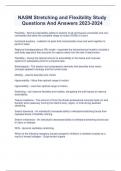
NASM Stretching and Flexibility Study Questions And Answers
Flexibility - Normal extensibility (ability to stretch) of all soft tissues (contractile and non-contractile) that allow the complete range of motion (ROM) of a joint. functional anatomy - collection of parts that mechanically move and work together to perform tasks. Regional Interdependence (RI) model - expanded the biomechanical model to include a total-body approach that accounts for regions away from the site of dysfunction. Flexibility - having the optimal amount of extensibility in the fascia and muscular systems to adequately perform a physical task. Biotensegrity - The tension and compression elements that describe force vector concepts applied to biology and the human body. Mobility - used to describe joint motion Hypermobility - More than optimal range of motion. Hypomobility - Less than optimal range of motion. Stretching - can improve flexibility and mobility. elongating the soft tissues to improve extensibility. Tissue resistance - The amount of force the fitness professional manually feels (or lack thereof) when passively moving the client's body, region, or limb during assisted stretching. Stretch tolerance - An individual's increased ability to withstand stretching forces from repeated bouts of flexibility training. Stretch intolerance - An individual's decreased ability to withstand stretching forces due to injury or disease. DOS - dynamic oscillatory stretching Which of the following receptors causes autogenic inhibition in skeletal muscles as a result of tensed collagen - Golgi tendon organs
Written for
- Institution
- NASM ,
- Course
- NASM ,
Document information
- Uploaded on
- October 3, 2023
- Number of pages
- 2
- Written in
- 2023/2024
- Type
- Exam (elaborations)
- Contains
- Questions & answers
Subjects
-
nasm stretching and flexibility study questions

Also available in package deal