Finance
College 1 – introduction to investment policy
Time value of money:
- Future value
- Present value
Risk return relationship (risico rendement):
- CAPM
1. How to make well-founded capital investment decisions? – this is the ultimate goal
of the current course.
2. How to finance your capital investments? – we do a bit, but most in postponed until
year 2.
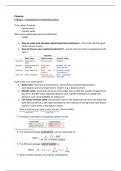
How much is an asset worth?
1. Book value: historical purchase price, minus all accumulated depreciation,
amortization and any impairments. Used in e.g. a balance sheet.
2. Market value: would you sell of an asset today, this is what the market is expected to
pay for it. Market values typically depend upon market conditions as supply and
demand, cost and availability of capital, etc.
3. Fair value/ intrinsic value: the present value of the expected cash flows the asset will
yield (discounted at a rate representative for the riskiness of earing these cash flows).
Used for some items in the balance sheet.
, - Given a simple yet powerful profitability criterion that ROIC ≥WACC, we will later see
that we will use the WACC as the discount rate in our (net) present value
calculations.
- We want to maximise the value of a firm (investment), and need to know where that
value is coming from...
- Let me postulate that maximizing shareholder value is analogous to maximizing
EVA, which nails down to solely picking those projects that have the highest NPV
ROIC omhoog
WACC omlaag
• Recall:
EVA = (ROIC −WACC) ×Av. Tot. Invested Capital
which is disentangled as follows...
Future value: you have some money now that you put at a savings account, and wish to
know how much it is worth somewhere in the future.
Present value (contante waarde): you get some money somewhere in the future, and wish
to know how much today’s equivalent would be worth.
Future value:
Simple interest: money does not earn money over money→
Interest earned = interest rate x initial deposit
FV= A(t)= P0 ×(1 + r ·T)
where P0 is the initial inlay, r the percentage interest rate, and T the number of time
periods (years) during which your money earns interest.
,Compound interest: the exponential is the compounding effect, which may lead to an
explosive increase in wealth (if both r an T grow big)→ FV = P0 ×(1 + R)ˆT
Per period compound interest rates:
, College 2 – applications of future value
Typical applications of future value:
1. Estate planning: you need an amount of money in the future, and today you start
saving or investing is
a. Savings on savings account
b. Investing in stocks/bonds/trackers
c. Contributing to a pension fund savings plan
2. Calculating effective annual rates (EAR): the return you effective pay on a loan or
receive on a savings account, adjusted for the compounding frequency.
3. Calculating annual percentage rates (APR): the annualised simple interest
percentage, without any intra-period (quarterly/monthly/etc.) compounting. And
adjusted for any costs/expensens.
Explaining EAR
- Imagine you are indebted on your current account. The bank charges you R=10% per
annum but this is compounded monthly.
- The EAR shows what you effectively pay on a annualised basis.
o EAR= (1+(R/M))ˆm -1
→ What EAR do you effectively pay per annum?
- Morale: the higher the frequency of compounding, the bigger the differencee
between the ‘stated annual rate’ (which a lender may communicate to you) an the
rate you effectively pay.
Explaining APR
- The APR is the average yearly cost of a loan over the lifespan of that loan, including
any financing charges and any fees or additional charges associated with the loan:
o
Where:
- Fees are any additional costs
- Interest is total interest paid over the life of the loan
- Principal is the total loan principal
- N is the total number of compounding periods over the loan’s lifespan
- n is the number of compounding periods per annum
- The Apr thus quotes a simple interest rate per annum, without the effect of
compounding.
- If there are no additional charges the APR probably equals the nominal rate:
College 1 – introduction to investment policy
Time value of money:
- Future value
- Present value
Risk return relationship (risico rendement):
- CAPM
1. How to make well-founded capital investment decisions? – this is the ultimate goal
of the current course.
2. How to finance your capital investments? – we do a bit, but most in postponed until
year 2.
How much is an asset worth?
1. Book value: historical purchase price, minus all accumulated depreciation,
amortization and any impairments. Used in e.g. a balance sheet.
2. Market value: would you sell of an asset today, this is what the market is expected to
pay for it. Market values typically depend upon market conditions as supply and
demand, cost and availability of capital, etc.
3. Fair value/ intrinsic value: the present value of the expected cash flows the asset will
yield (discounted at a rate representative for the riskiness of earing these cash flows).
Used for some items in the balance sheet.
, - Given a simple yet powerful profitability criterion that ROIC ≥WACC, we will later see
that we will use the WACC as the discount rate in our (net) present value
calculations.
- We want to maximise the value of a firm (investment), and need to know where that
value is coming from...
- Let me postulate that maximizing shareholder value is analogous to maximizing
EVA, which nails down to solely picking those projects that have the highest NPV
ROIC omhoog
WACC omlaag
• Recall:
EVA = (ROIC −WACC) ×Av. Tot. Invested Capital
which is disentangled as follows...
Future value: you have some money now that you put at a savings account, and wish to
know how much it is worth somewhere in the future.
Present value (contante waarde): you get some money somewhere in the future, and wish
to know how much today’s equivalent would be worth.
Future value:
Simple interest: money does not earn money over money→
Interest earned = interest rate x initial deposit
FV= A(t)= P0 ×(1 + r ·T)
where P0 is the initial inlay, r the percentage interest rate, and T the number of time
periods (years) during which your money earns interest.
,Compound interest: the exponential is the compounding effect, which may lead to an
explosive increase in wealth (if both r an T grow big)→ FV = P0 ×(1 + R)ˆT
Per period compound interest rates:
, College 2 – applications of future value
Typical applications of future value:
1. Estate planning: you need an amount of money in the future, and today you start
saving or investing is
a. Savings on savings account
b. Investing in stocks/bonds/trackers
c. Contributing to a pension fund savings plan
2. Calculating effective annual rates (EAR): the return you effective pay on a loan or
receive on a savings account, adjusted for the compounding frequency.
3. Calculating annual percentage rates (APR): the annualised simple interest
percentage, without any intra-period (quarterly/monthly/etc.) compounting. And
adjusted for any costs/expensens.
Explaining EAR
- Imagine you are indebted on your current account. The bank charges you R=10% per
annum but this is compounded monthly.
- The EAR shows what you effectively pay on a annualised basis.
o EAR= (1+(R/M))ˆm -1
→ What EAR do you effectively pay per annum?
- Morale: the higher the frequency of compounding, the bigger the differencee
between the ‘stated annual rate’ (which a lender may communicate to you) an the
rate you effectively pay.
Explaining APR
- The APR is the average yearly cost of a loan over the lifespan of that loan, including
any financing charges and any fees or additional charges associated with the loan:
o
Where:
- Fees are any additional costs
- Interest is total interest paid over the life of the loan
- Principal is the total loan principal
- N is the total number of compounding periods over the loan’s lifespan
- n is the number of compounding periods per annum
- The Apr thus quotes a simple interest rate per annum, without the effect of
compounding.
- If there are no additional charges the APR probably equals the nominal rate: