HESI OB Exam Study Guide Newborn: Updated A+ Guide Solution
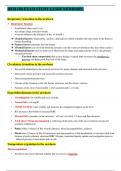
Respiratory transition in the newborn Respiratory function • Established when cord is cut. • Air inflates lungs with first breath. • 4 factors influence the initiation of the 1st breath Chemical factors: hypercarbia, acidosis, and hypoxia which stimulate the resp center in the brain to initiate breathing. Sensory factors stimulate the first breath. Thermal factors are involved when the neonate exits the warm environment they have been used to. Mechanical factors such as removal of fluid from the lungs and replacements of air is the primary mechanical factor. • The fetal chest compression that occurs during a vaginal birth increases the intrathoracic pressure and helps push fluid out of the lungs. Circulatory transition in the newborn • Successful adaptation in the neonate involves five major changes and increased aortic pressure • Decreased venous pressure and increased systemic pressure • Decreased pulmonary pressure • Closure of the foramen ovale, the ductus arteriosus and the ductus venosus. • Foramen ovale closes functionally 1-2 hrs anatomically 1-2 weeks Hyperbilirubinemia in the newborn • Unconjugated: fat soluble and toxic to body • Normal bili = 4-6 mg/dl • CONJUGATED: water soluble and nontoxic & conjugation happens in the liver • Bili increases after birth r/t increased RBC • Elevated bili = jaundice in the newborn - will rise over first 3-5 days and then decrease • Total above 5 from unconjugated = yellowing of the skin, one of the most common reasons for newborn readmission • Patho within 24 hours of life r/t polycythemia, blood incompatibilites, acidosis • Physio after 24 hours of life r/t limitations and abnormalities of bili metabolism, r/t increased bili load because of polycythemia, shortened RBC lifespan, immature hepatic uptake and conjugation process - delayed passage of meconium puts at risk Temperature regulation in the newborn Thermoregulation: • Newborns have poor thermal stability due to excessive heat loss. • It is closely related to rate of metabolism, oxygen consumption, amount of brown fat, and amount of subcutaneous tissue. • Increased metabolic demands and/or increased oxygen demands can quickly lead to hypoglycemia (neonatal hypoglycemia is less than 40 mg/dl blood glucose level). • Infants produce heat by increasing their metabolic rate, increasing muscular activity, or through nonshivering thermogenesis (break down brown fat into heat). • Four ways an infant loses heat: ▪ Convection: Air current blows heat away ▪ Radiation: Cold area, body radiates/loses heat ▪ Evaporation: When water evaporates it takes heat with it ▪ Conduction: If baby is put on cold surface it loses body heat to warm the surface • Things you can do to help keep baby warm: ▪ Skin to skin contact, radiant warmer, wrap in warm blankets, use hats, monitor temperature, dry them after a bath, heat oxygen and humidify (if on oxygen therapy), teach family to keep them warm. You want their temp to stay around 98.6 but the normal range is 97.7-99.4. Blood glucose changes in the newborn • Normal BG • 1-Day: 40-60 mg/dL • 1-Day: 50-90 mg/dL • Baby experiences an energy crunch @ the time of birth with the cutting of the umbilical cord and resultant removal of the maternal glucose supply (baby’s BG 15 mg/dL lower than maternal BG) • This is significant because baby needs adequate amount of glucose in order to withstand the birth process and extrauterine life. • Fuel sources are consumed at a faster rate because: ▪ The work of breathing ▪ Loss of heat when exposed to cold ▪ Activity ▪ Activation of muscle tone. Patho: As stores of liver and muscle glycogen and blood glucose decrease, the newborn compensates by changing form a predominantly carbohydrate metabolism to fat metabolism. ▪ Energy is derived from fat and protein as well as from carbohydrates. • Assessment: • 1st and 2nd hour after birth: blood glucose declines • 3rd hour after birth: blood glucose reaches a steady level Umbilical cord clamping and cutting • Must use two clamps: one to cut off blood flow to placenta and one to keep baby form bleeding out • Placement should be closer to baby than placenta and an inch or two between both clamps • When cutting between two clamps: make sure clamps are tight enough and no blood is being exploited from umbilical cord • After cutting: make sure two arteries and one vein are visible
Document information
- Uploaded on
- October 2, 2023
- Number of pages
- 24
- Written in
- 2023/2024
- Type
- Exam (elaborations)
- Contains
- Questions & answers