

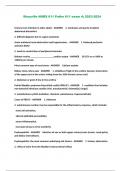
Maryville NURS 611 Patho 611 exam 4;
Urinary tract infection in older adults - ANSWER 2. Confusion and poorly localized abdominal discomfort 2. difficult diagnose due to vague symptoms Acute unilateral renal obstruction and hypertension. - ANSWER 1. Reduced perfusion activates RAAS 2. Leads to constriction of peripheral arterioles kidneys receive ___________________cardiac output - ANSWER 20-25% or or 1000 to 1200ml per minute Most common type of renal stone - ANSWER Calcium oxalate Kidney stone refers pain - ANSWER 1. Umbilicus if high in the urethra (sensory innervation of the upper part of the ureter arising from the 10th thoracic nerve root) 2. Abdomen or groin if low in the urethra Painful bladder syndrome/interstitial cystitis (PBS/IC) - ANSWER 1. condition that includes non-bacterial infectious cystitis (viral, mycobacterial, chlamydial, fungal) 2. noninfectious cystitis (radiation, chemical, autoimmune, hypersensitivity) Cause of PBS/IC - ANSWER 1. Unknown 2. autoimmune reaction may be responsible for the inflammatory response, which includes mast cell activation, altered epithelial permeability, neuro-inflammation, increased sensory nerve sensitivity Pyelonephritis - ANSWER infection of one or both upper urinary tracts (ureter, renal pelvis, and kidney interstitium). Pyelonephritis: the most common underlying risk factors - ANSWER 1. Urinary obstruction 2. reflux of urine from the bladder (vesicoureteral reflux)3. Pregnancy 4. neurogenic bladder 5. instrumentation: catheters, endoscopy 6. female sexual trauma Microorganisms usually associated with acute pyelonephritis - ANSWER 1. E. coli 2. Proteus, or 3. Pseudomonas. These microorganisms also split urea into ammonia, making alkaline urine that increases the risk of stone formation. specific diagnosis: cystitis vs pyelonephritis - ANSWER 1. Difficult to do by clinical manifestations alone 2. urine culture, 3. urinalysis, and 4. clinical signs and symptoms pyelonephritis UA lab finding - ANSWER White blood cell casts, but they are not always present in the urine. Reduced GFR during glomerular disease - ANSWER 1. elevated plasma urea, 2. creatinine concentration, or 3. reduced renal creatinine clearance. Acute glomerulonephritis - ANSWER includes renal diseases in which glomerular inflammation is caused by immune mechanisms that damage the glomerular capillary filtration membrane including the endothelium, basement membrane, and epithelium (podocytes) Acute glomerulonephritis: classic symptoms - ANSWER 1. sudden onset of hematuriaincluding red blood cell casts and 2. proteinuria (milder than nephrotic syndrome), Acute glomerulonephritis: severe symptoms - ANSWER 1. Hematuria 2. protienuria 3. Edema 4. HTN 5. Impaired renal function Nephrotic syndrome - ANSWER 1. excretion of 3.0 g or more of protein (massive proteinuria) in the urine per day, 2. hypoalbuminemia (less than 3.0 g/dl), and 3. peripheral edema Nephrotic syndrome is characteristic of - ANSWER Glomerular injury Primary causes of nephrotic syndrome - ANSWER 1. minimal change disease (lipoid nephrosis), 2. membranous glomerulonephritis, and 3. focal segmental glomerulosclerosis (see Table 38-7). Secondary forms of nephrotic syndrome - ANSWER occur in systemic diseases including 1. diabetes mellitus, 2. amyloidosis, and 3. systemic lupus erythematosus Nephrotic syndrome also is seen with - ANSWER 1. certain drugs, 2. infections, malignancies, and 3. vascular disorders
Document information
- Uploaded on
- September 24, 2023
- Number of pages
- 36
- Written in
- 2023/2024
- Type
- Exam (elaborations)
- Contains
- Questions & answers


