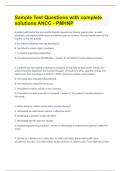
Sample Test Questions with complete
solutions ANCC - PMHNP
A patient with borderline personality disorder experiences intense anxiety when an adult
psychiatric and mental health nurse practitioner goes on vacation. The best explanation for this
reaction is that the patient:
A. has failed to develop clear ego boundaries.
B. has failed to master object constancy.
C. is employing primitive idealization.
D. is employing projective identification. - answer B. has failed to master object constancy
2. A patient has been taking escitalopram (Lexapro) 10 mg daily for four weeks. Initially, the
patient reported depression and suicidal thoughts. The patient's sleep, appetite, energy, and
appearance have now begun to improve. Which statement applies to this patient?
A. The medication should be discontinued.
B. The medication should be increased.
C. The patient's risk for suicide is not a concern.
D. The patient's suicide potential is increased. - answer D. The patient's suicide potential is
increased.
3. Which behavior reflects existentially oriented therapy?
A. Attempting to understand a patient's subjective world
B. Challenging a patient's irrational beliefs
C. Developing specific plans for change
D. Establishing general group goals - answer A. Attempting to understand a patient's subjective
world
4. Serving as a member on a crisis team, an adult psychiatric and mental health nurse
practitioner provides crisis intervention to the survivors of a plane crash. Forty-eight hours after
, the accident, the survivors describe vivid flashbacks, startle reactions, and disrupted sleep
patterns. The nurse practitioner responds by:
A. advising the survivors to consider using a hypnotic medication for a brief period.
B. educating the survivors about prodromal symptoms of posttraumatic stress disorder.
C. encouraging the survivors to rest during the day.
D. suggesting that the survivors join a posttrauma support group. - answer B. educating the
survivors about prodromal symptoms of posttraumatic stress disorder.
5. An adult psychiatric and mental health nurse practitioner uses the interpersonal therapy
model with a patient to establish a therapeutic alliance based upon empathy and trust. The
nurse practitioner recognizes the patient's readiness to terminate therapy when the patient
demonstrates:
A. an understanding that leaving a significant other may be painful, but also presents an
opportunity for growth.
B. breathing and muscle relaxation exercises that decrease muscle tension and anxiety.
C. free association, and considers the nurse practitioner's interpretation of the patient's dreams.
D. new adaptive skills and responses after completing "homework assignments." - answer A. an
understanding that leaving a significant other may be painful, but also presents an opportunity
for growth.
6. An Hispanic patient informs an adult psychiatric and mental health nurse practitioner during a
wellness visit that he or she occasionally uses hot chili juice to relieve a "nervous condition."
The patient denies any complaints related to this practice. The nurse practitioner's response is
to:
A. actively discourage the patient from continuing this treatment.
B. offer a medication to treat the nervous condition.
C. suggest an alternative food to relieve the nervous condition.
D. view this as a self-care ritual that needs to be preserved. - answer D. view this as a self-care
ritual that needs to be preserved.
solutions ANCC - PMHNP
A patient with borderline personality disorder experiences intense anxiety when an adult
psychiatric and mental health nurse practitioner goes on vacation. The best explanation for this
reaction is that the patient:
A. has failed to develop clear ego boundaries.
B. has failed to master object constancy.
C. is employing primitive idealization.
D. is employing projective identification. - answer B. has failed to master object constancy
2. A patient has been taking escitalopram (Lexapro) 10 mg daily for four weeks. Initially, the
patient reported depression and suicidal thoughts. The patient's sleep, appetite, energy, and
appearance have now begun to improve. Which statement applies to this patient?
A. The medication should be discontinued.
B. The medication should be increased.
C. The patient's risk for suicide is not a concern.
D. The patient's suicide potential is increased. - answer D. The patient's suicide potential is
increased.
3. Which behavior reflects existentially oriented therapy?
A. Attempting to understand a patient's subjective world
B. Challenging a patient's irrational beliefs
C. Developing specific plans for change
D. Establishing general group goals - answer A. Attempting to understand a patient's subjective
world
4. Serving as a member on a crisis team, an adult psychiatric and mental health nurse
practitioner provides crisis intervention to the survivors of a plane crash. Forty-eight hours after
, the accident, the survivors describe vivid flashbacks, startle reactions, and disrupted sleep
patterns. The nurse practitioner responds by:
A. advising the survivors to consider using a hypnotic medication for a brief period.
B. educating the survivors about prodromal symptoms of posttraumatic stress disorder.
C. encouraging the survivors to rest during the day.
D. suggesting that the survivors join a posttrauma support group. - answer B. educating the
survivors about prodromal symptoms of posttraumatic stress disorder.
5. An adult psychiatric and mental health nurse practitioner uses the interpersonal therapy
model with a patient to establish a therapeutic alliance based upon empathy and trust. The
nurse practitioner recognizes the patient's readiness to terminate therapy when the patient
demonstrates:
A. an understanding that leaving a significant other may be painful, but also presents an
opportunity for growth.
B. breathing and muscle relaxation exercises that decrease muscle tension and anxiety.
C. free association, and considers the nurse practitioner's interpretation of the patient's dreams.
D. new adaptive skills and responses after completing "homework assignments." - answer A. an
understanding that leaving a significant other may be painful, but also presents an opportunity
for growth.
6. An Hispanic patient informs an adult psychiatric and mental health nurse practitioner during a
wellness visit that he or she occasionally uses hot chili juice to relieve a "nervous condition."
The patient denies any complaints related to this practice. The nurse practitioner's response is
to:
A. actively discourage the patient from continuing this treatment.
B. offer a medication to treat the nervous condition.
C. suggest an alternative food to relieve the nervous condition.
D. view this as a self-care ritual that needs to be preserved. - answer D. view this as a self-care
ritual that needs to be preserved.