
Biological Membranes
Plasma membrane = the partially permeable membrane at the surface of cells
which acts as a barrier between the cell and its environment.
It controls what enters and leaves the cell.
They allow recognition by other cells and communication between cells (cell
signalling)
Fluid Mosaic structure
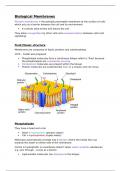
Membranes are composed of lipids, proteins and carbohydrates.
1972 – model was proposed.
Phospholipid molecules form a continuous bilayer which is ‘fluid’ because
the phospholipids are constantly moving.
Cholesterol molecules are present within the bilayer
Protein molecules are scattered like tiles in a mosaic and can move.
Phospholipids
They have a head and a tail
Head = hydrophilic (attracts water)
Tail = hydrophobic (repels water)
Molecules automatically arrange into a bilayer where the heads face out
towards the water on either side of the membrane.
Centre is hydrophobic so membrane doesn’t allow water-soluble substances,
e.g. ions through – it acts as a barrier.
Lipid-soluble molecules can dissolve in the bilayer.
, Cholesterol
It gives the membrane stability.
Cholesterol molecules fit between the phospholipids and bind to the
hydrophobic tails of the phospholipids, causing them to pack more closely
together – less fluid membrane.
At lower temperatures, cholesterol prevents phospholipids packing too close
together, so it increases membrane fluidity.
Proteins
Channel proteins allow small or polar particles through.
Carrier proteins transport molecules and ions across the membrane by
facilitated diffusion.
Receptor proteins are responsible for cell signalling. When a molecule binds, a
chemical reaction is triggered inside the cell.
Plasma membrane = the partially permeable membrane at the surface of cells
which acts as a barrier between the cell and its environment.
It controls what enters and leaves the cell.
They allow recognition by other cells and communication between cells (cell
signalling)
Fluid Mosaic structure
Membranes are composed of lipids, proteins and carbohydrates.
1972 – model was proposed.
Phospholipid molecules form a continuous bilayer which is ‘fluid’ because
the phospholipids are constantly moving.
Cholesterol molecules are present within the bilayer
Protein molecules are scattered like tiles in a mosaic and can move.
Phospholipids
They have a head and a tail
Head = hydrophilic (attracts water)
Tail = hydrophobic (repels water)
Molecules automatically arrange into a bilayer where the heads face out
towards the water on either side of the membrane.
Centre is hydrophobic so membrane doesn’t allow water-soluble substances,
e.g. ions through – it acts as a barrier.
Lipid-soluble molecules can dissolve in the bilayer.
, Cholesterol
It gives the membrane stability.
Cholesterol molecules fit between the phospholipids and bind to the
hydrophobic tails of the phospholipids, causing them to pack more closely
together – less fluid membrane.
At lower temperatures, cholesterol prevents phospholipids packing too close
together, so it increases membrane fluidity.
Proteins
Channel proteins allow small or polar particles through.
Carrier proteins transport molecules and ions across the membrane by
facilitated diffusion.
Receptor proteins are responsible for cell signalling. When a molecule binds, a
chemical reaction is triggered inside the cell.


