Biology Spec Led Revision
Chapter 14 - Respiration
Aerobic Respiration
4 Stages of Aerobic Respiration
1) Glycolysis
2) Link Reaction
3) Krebs Cycle
4) Oxidative Phosphorylation
• The first 3 stages are series of reactions, who's products
are used in the final stage to produce ATP
• First stage occurs in cytoplasms, while the other three
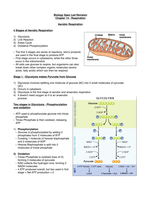
occur in the mitochondria
• All cells use glucose to respire, but organisms can also
break down other complex organic molecules (amino
acids, fatty acids) which can then be respired.
Stage 1 - Glycolysis makes Pyruvate from Glucose
1) Glycolysis involves splitting one molecule of glucose (6C) into 2 small molecules of pyruvate
(3C)
2) Occurs in cytoplasm
3) Glycolysis is the first stage of aerobic and anaerobic respiration
4) It doesn't need oxygen so it is an anaerobic
process
Two stages in Glycolysis - Phosphorylation
and oxidation
• ATP used to phosphorylate glucose into triose
phosphate
• Triose Phosphate is then oxidised, releasing
ATP
1) Phosphorylation
• Glucose is phosphorylated by adding 2
phosphates from 2 molecules of ATP
• Creating 1 molecule of hexose bisphosphate
and 2 molecules of ADP
• Hexose Bisphosphate is split into 2
molecules of triose phosphate
2) Oxidation
• Triose Phosphate is oxidised (loss of H)
forming 2 molecules of pyruvate
• NAD collects the hydrogen ions, forming 2
NADH molecules
• 4 ATP produced overall, but two used in first
stage = Net ATP production = 2
,Stage 2 - The Link Reaction Converts Pyruvate to Acetyl Coenzyme A
The link reaction takes place in the mitochondrial matrix:
1) Pyruvate is decarboxylated - 1 C removed to form CO2
2) NAD is reduced - collecting hydrogen from the pyruvate, changing pyruvate into acetate
3) Acetate is combined with coenzyme A to form acetyl coenzyme A
4) No ATP is produced in this reaction
The Link Reaction occurs twice for every glucose molecule
2:1
Pyruvate : Glucose
Meaning that link reaction and Krebs cycle occur twice for every glucose molecule
For each glucose molecule:
1) 2 Molecules of acetyl coenzyme A go into the Krebs cycle
2) 2 CO2 molecules are released as a waste product of respiration
3) 2 molecules of NADH are formed to go on to oxidative phosphorylation
Aerobic Respiration
Stage 3- The Krebs Cycle Produces Reduced Coenzymes and ATP
Krebs cycle involves a series of oxidation-reduction reactions, which take place in the matrix of
the mitochondria.
The Krebs cycle happens once for every pyruvate molecule, so it happens twice for every glucose
molecule
1) - Acetyl CoA from link reaction combines with oxalocetate to form citrate. Catalysed by citrate
synthesis
- Coenzyme A goes back to link reaction to be used again
2) - The 6 carbon citrate molecule is converted into a 5 carbon molecule
- Decarboxylation occurs where CO2 is removed
- Dehydrogenation also occurs where hydrogen is removed
- The hydrogen is used to produce reduced NAD from NAD
, 3) - The 5 carbon molecule is converted into a 4 Carbon molecule
- Decarboxylation and dehydrogenation occur, producing one molecule of reduced FAD and
two of reduced NAD
- ATP is produced by the direct transfer of phosphate group from an intermediate compound to
ADP
- When a phosphate group is directly transferred from one molecule to another its called
substrate level phosphorylation.
- Citrate has now been converted into oxalocetate
Some Products of the Krebs Cycle are used in Oxidative Phosphorylation
1 Coenzyme A —> Reused in next link reaction
Oxalocetate —> Regenerated for use in the next Krebs cycle
2 CO2 —> Released as waste product
1 ATP —> Used for energy
3 NADH —> To oxidative phosphorylation
1 FADH —> To oxidative phosphorylation
Stage 4 - Oxidative Phosphorylation
1) Oxidative phosphorylation is where energy carried by electrons, from reduced coenzymes
(FADH & NADH) is used to make ATP.
(THE REASON FOR THE KREBS CYCLE IS TO MAKE NADH & FADH FOR THE FINAL STAGE)
2) Oxidative phosphorylation takes place in the inner mitochondria membrane.
Chapter 14 - Respiration
Aerobic Respiration
4 Stages of Aerobic Respiration
1) Glycolysis
2) Link Reaction
3) Krebs Cycle
4) Oxidative Phosphorylation
• The first 3 stages are series of reactions, who's products
are used in the final stage to produce ATP
• First stage occurs in cytoplasms, while the other three
occur in the mitochondria
• All cells use glucose to respire, but organisms can also
break down other complex organic molecules (amino
acids, fatty acids) which can then be respired.
Stage 1 - Glycolysis makes Pyruvate from Glucose
1) Glycolysis involves splitting one molecule of glucose (6C) into 2 small molecules of pyruvate
(3C)
2) Occurs in cytoplasm
3) Glycolysis is the first stage of aerobic and anaerobic respiration
4) It doesn't need oxygen so it is an anaerobic
process
Two stages in Glycolysis - Phosphorylation
and oxidation
• ATP used to phosphorylate glucose into triose
phosphate
• Triose Phosphate is then oxidised, releasing
ATP
1) Phosphorylation
• Glucose is phosphorylated by adding 2
phosphates from 2 molecules of ATP
• Creating 1 molecule of hexose bisphosphate
and 2 molecules of ADP
• Hexose Bisphosphate is split into 2
molecules of triose phosphate
2) Oxidation
• Triose Phosphate is oxidised (loss of H)
forming 2 molecules of pyruvate
• NAD collects the hydrogen ions, forming 2
NADH molecules
• 4 ATP produced overall, but two used in first
stage = Net ATP production = 2
,Stage 2 - The Link Reaction Converts Pyruvate to Acetyl Coenzyme A
The link reaction takes place in the mitochondrial matrix:
1) Pyruvate is decarboxylated - 1 C removed to form CO2
2) NAD is reduced - collecting hydrogen from the pyruvate, changing pyruvate into acetate
3) Acetate is combined with coenzyme A to form acetyl coenzyme A
4) No ATP is produced in this reaction
The Link Reaction occurs twice for every glucose molecule
2:1
Pyruvate : Glucose
Meaning that link reaction and Krebs cycle occur twice for every glucose molecule
For each glucose molecule:
1) 2 Molecules of acetyl coenzyme A go into the Krebs cycle
2) 2 CO2 molecules are released as a waste product of respiration
3) 2 molecules of NADH are formed to go on to oxidative phosphorylation
Aerobic Respiration
Stage 3- The Krebs Cycle Produces Reduced Coenzymes and ATP
Krebs cycle involves a series of oxidation-reduction reactions, which take place in the matrix of
the mitochondria.
The Krebs cycle happens once for every pyruvate molecule, so it happens twice for every glucose
molecule
1) - Acetyl CoA from link reaction combines with oxalocetate to form citrate. Catalysed by citrate
synthesis
- Coenzyme A goes back to link reaction to be used again
2) - The 6 carbon citrate molecule is converted into a 5 carbon molecule
- Decarboxylation occurs where CO2 is removed
- Dehydrogenation also occurs where hydrogen is removed
- The hydrogen is used to produce reduced NAD from NAD
, 3) - The 5 carbon molecule is converted into a 4 Carbon molecule
- Decarboxylation and dehydrogenation occur, producing one molecule of reduced FAD and
two of reduced NAD
- ATP is produced by the direct transfer of phosphate group from an intermediate compound to
ADP
- When a phosphate group is directly transferred from one molecule to another its called
substrate level phosphorylation.
- Citrate has now been converted into oxalocetate
Some Products of the Krebs Cycle are used in Oxidative Phosphorylation
1 Coenzyme A —> Reused in next link reaction
Oxalocetate —> Regenerated for use in the next Krebs cycle
2 CO2 —> Released as waste product
1 ATP —> Used for energy
3 NADH —> To oxidative phosphorylation
1 FADH —> To oxidative phosphorylation
Stage 4 - Oxidative Phosphorylation
1) Oxidative phosphorylation is where energy carried by electrons, from reduced coenzymes
(FADH & NADH) is used to make ATP.
(THE REASON FOR THE KREBS CYCLE IS TO MAKE NADH & FADH FOR THE FINAL STAGE)
2) Oxidative phosphorylation takes place in the inner mitochondria membrane.