Immunologie 2016-2017 (ADP-20306) Sharelle Verheij Wageningen University
Immunologie
College 1 Leerdoelen
Immunologische termen
Innate en adaptieve immuniteit
Antigenen
Verschillende type immuniteiten en de gevolgen
Epigenetica = celdifferentiatie
Betere immuniteit ≠ Hogere immuniteit
Immuniteit ≠ Gezondheid
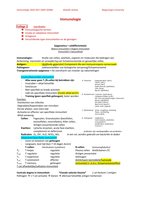
Immunologie= Studie van cellen, weefsels, organen en moleculen die bijdragen aan
herkenning, inactivatie en verwijdering van lichaamsvreemde en gevaarlijke cellen.
Antigen= (Antibody generator) Component die een immuunrespons veroorzaakt
Pathogeen= ziekteverwekker van biologische oorsprong/lichaamsvreemd
Transgenerationele epigenese = De overdracht van moeder op nakomelingen
Innate/Natuurlijke immuniteit
- Alles waar geen T-/B-cellen bij betrokken zijn
- Invariabel = altijd hetzelfde
- Snel/acuut
- Niet-specifiek en brede activiteit
- Lijdt tot specifieke immuniteit (innate altijd eerst!)
- Training (geen specifiek geheugen); beter worden
Functies:
-Voorkomen van infecties
-Degradatie/kapotmaken van microben
-Eerste afweer, voor extra tijd
-Activatie en effector van specifieke immuniteit
-Altijd aanwezig
Cellen: Fagocyten, Granulocyten (basofielen,
eosinofielen, neutrofielen), Killer cellen,
Antigen presenterende cellen
Eiwitten: Lytische enzymen, acute fase-eiwitten,
complement en defensines prebiotics zijn voedingstoffen van probiotics
Radicalen: O2, OH-, H2O, HClO3, NOx in een cel, worden gebruikt om bacteriën te doden
Adaptieve/Specifieke immuniteit
- Leren en bewaren van geheugen
- Langzaam, kost tijd (kan 7-10 dagen duren)
T-cellen: interleukines (cytokines) B-cellen: (immunoglobulins)
Th: T-helper regulatie Plasma cellen Antilichamen (Y)
Treg: T-regulator regulatie Antigen presentatie
Ts : T-suppressor regulatie Geheugen
Tcyt: T-cytotoxisch effector Antilichaam-bemiddeld/humorale
Tmem: T-memory geheugen immuniteit (= m.b.v. lichaamsvloeistoffen)
T-cel afhankelijke/cellulaire immuniteit
Centrale dogma in immuniteit: “Clonale selectie theorie” 1 cel herkent 1 antigen
Pathogen 1 T-cel activatie klonen allemaal hetzelfde antigen herkennen
,Immunologie 2016-2017 (ADP-20306) Sharelle Verheij Wageningen University
Infectie: Microbe (product) innate immuun reactie ( specifieke immuunreactie )
1. Geen (klinische) symptomen
2. Ziekte herstel
3. Ziekte dood
4. Bescherming geen klinische symptomen
Actieve immuniteit: zelf verworven, actieve vaccinatie, infectie, experimentele sensitisatie (in vivo)
Passieve immuniteit: maternaal, niet zelf antistoffen aanmaken
passieve vaccinatie (=ook maternale antistoffen) (donor serum bv. bij toxische beet)
IMMUNITEIT Zelf Niet zelf
Gevaarlijk Tumoren Pathogenen (virussen, bacteriën)
Onschuldig Anergie (=afwezigheid van reactie) Tolerantie: Voeding / Maternaal
Gevolgen:
______Beschermend
Concomitant levende pathogeen blijft aanwezig, maar wel beschermd (bv. koortslip)
Steriliserend pathogeen is volledig weg
Modulerend pathogeen is aanwezig, maar inactief (bv. parasiet eieren)
______Counter-protective Bescherming of verbetering van pathogeen (bv. HIV)
______Irrelevant Th1 (cellulair) - Th2 (humoraal = antistof) dogma (dus verkeerde immuunreactie)
______Schadelijk Pathologie/Ontsteking
Overgevoeligheid
Auto-immuniteit = immuun reactie tegen jezelf
1. PAMP: LPS LTA 5. TCR a. cytotoxische T cel
2. Ag peptide 6. Interferon gamma b. B cel
3. TLR 7. IL4
4. MHC-II (antigenpresentatie) 8. CD4
, Immunologie 2016-2017 (ADP-20306) Sharelle Verheij Wageningen University
College 2 Leerdoelen
Verschillende immuunsysteem celtypes & belangrijke karakteristieken & functie
Innate systeem myeloïd Specifiek systeem lymfoïd
- Fagocyten - T cellen thymus (in beenmerg)
- Granulocyten - B cellen bursa (bij vogels) / beenmerg
- Megakaryocyten Bloedplaatjes = platelets
- Antigen presenterende (=accessory) cellen = Dendrietcellen
- Natural Killer cellen / Null cellen
Specifiek Lymfocyten - Regulation: T-helper cellen, T-regulatie cellen
- Effector: T-cytotoxisch, B-, plasmacellen (maken antistoffen)
Thymus: 90% van lymfoïde cellen sterft, 10% gaat naar circulatie (periferie)
Beenmerg/Bursa: 90% van lymfoïde cellen sterft, 10% gaat naar lymfeknopen
90% zijn de forbidden clones die dood worden gemaakt = auto-immuniteit
CD = Cluster of Designation = molecuul aanwezig op een cel T-helper/-cytotoxisch
- CD2 oude namen: LFA2, SRBC-receptor - CD3 T-cel receptor complex
- CD4 T-helper cel, MHC-II ligand - CD8 T-cytotoxisch, MHC-I ligand
T-cellen = ‘Managers’ immuunsysteem, bepalen wat gebeurt m.b.v. boodschappermoleculen
Producten: - Interleukines: welke cel actief gemaakt wordt & hoe afweersysteem zich ontwikkelt
Additief / Synergistisch vs. Antagonistisch
- MAF = Macrophage Arming Factors; - MIF = Macrophage Migration Inhibiting Factors
- CSF = Colony Stimulating Factors; - MG-CSF = Macrophage Granulocyte CSF
- TGF = Transforming Growth Factor; - ɣ-interferon
T-cytotoxisch geheugen cellen
T-helper
B-cellen differentiëren in plasmacellen, maar kunnen ook antigenen presenteren
5-10% in bloed lymfocyten, 70-80% in lymfeklieren
Innate Bij geboorte al aanwezig
Null cellen/Natural Killer cellen: geen TCR, Killer cell Immunoglobulin-like Receptor (KIR)
Fagocyten: Macrofagen eten grote deeltjes & hebben antigenpresentatie (andere namen:)
Monocyten = bloed gerelateerde celtypes
Kupfercellen (in lever, belangrijk voedsel filterweefsel)
Osteoclast (beenformatie)
- Veel RER, dus produceert veel eiwit
- Plakken aan glas/plastic
- Fc-receptoren voor immunoglobulines
- ɣ-interferon, MAF receptoren
- receptoren (TLR’s) voor homotopes, PAMP’s:
- MHC-II moleculen, CD14
Fagocytose 1. Chemotaxis “ruiken” dat er iets is
Met fagocyt 2. Hechting aan microbe via Toll-Like Receptoren (TLR) of via hydrofobe fusie
3. Activatie van spierachtige verbindingen, vorming van pseudopodia (mond)
4. Engulfment “omgeven/opslokken” in fagosoom
5. Fusie van fagosoom met lysozome (=phagolysozome)
6. Fagolyse afbreken van het deeltje en uitscheiden
Opsonisatie = Antigen ‘coating’ met complement receptoren of specifieke/natuurlijke antilichamen
fagocytose mogelijk (binden met Fc receptor van macrofagen)
Immunologie
College 1 Leerdoelen
Immunologische termen
Innate en adaptieve immuniteit
Antigenen
Verschillende type immuniteiten en de gevolgen
Epigenetica = celdifferentiatie
Betere immuniteit ≠ Hogere immuniteit
Immuniteit ≠ Gezondheid
Immunologie= Studie van cellen, weefsels, organen en moleculen die bijdragen aan
herkenning, inactivatie en verwijdering van lichaamsvreemde en gevaarlijke cellen.
Antigen= (Antibody generator) Component die een immuunrespons veroorzaakt
Pathogeen= ziekteverwekker van biologische oorsprong/lichaamsvreemd
Transgenerationele epigenese = De overdracht van moeder op nakomelingen
Innate/Natuurlijke immuniteit
- Alles waar geen T-/B-cellen bij betrokken zijn
- Invariabel = altijd hetzelfde
- Snel/acuut
- Niet-specifiek en brede activiteit
- Lijdt tot specifieke immuniteit (innate altijd eerst!)
- Training (geen specifiek geheugen); beter worden
Functies:
-Voorkomen van infecties
-Degradatie/kapotmaken van microben
-Eerste afweer, voor extra tijd
-Activatie en effector van specifieke immuniteit
-Altijd aanwezig
Cellen: Fagocyten, Granulocyten (basofielen,
eosinofielen, neutrofielen), Killer cellen,
Antigen presenterende cellen
Eiwitten: Lytische enzymen, acute fase-eiwitten,
complement en defensines prebiotics zijn voedingstoffen van probiotics
Radicalen: O2, OH-, H2O, HClO3, NOx in een cel, worden gebruikt om bacteriën te doden
Adaptieve/Specifieke immuniteit
- Leren en bewaren van geheugen
- Langzaam, kost tijd (kan 7-10 dagen duren)
T-cellen: interleukines (cytokines) B-cellen: (immunoglobulins)
Th: T-helper regulatie Plasma cellen Antilichamen (Y)
Treg: T-regulator regulatie Antigen presentatie
Ts : T-suppressor regulatie Geheugen
Tcyt: T-cytotoxisch effector Antilichaam-bemiddeld/humorale
Tmem: T-memory geheugen immuniteit (= m.b.v. lichaamsvloeistoffen)
T-cel afhankelijke/cellulaire immuniteit
Centrale dogma in immuniteit: “Clonale selectie theorie” 1 cel herkent 1 antigen
Pathogen 1 T-cel activatie klonen allemaal hetzelfde antigen herkennen
,Immunologie 2016-2017 (ADP-20306) Sharelle Verheij Wageningen University
Infectie: Microbe (product) innate immuun reactie ( specifieke immuunreactie )
1. Geen (klinische) symptomen
2. Ziekte herstel
3. Ziekte dood
4. Bescherming geen klinische symptomen
Actieve immuniteit: zelf verworven, actieve vaccinatie, infectie, experimentele sensitisatie (in vivo)
Passieve immuniteit: maternaal, niet zelf antistoffen aanmaken
passieve vaccinatie (=ook maternale antistoffen) (donor serum bv. bij toxische beet)
IMMUNITEIT Zelf Niet zelf
Gevaarlijk Tumoren Pathogenen (virussen, bacteriën)
Onschuldig Anergie (=afwezigheid van reactie) Tolerantie: Voeding / Maternaal
Gevolgen:
______Beschermend
Concomitant levende pathogeen blijft aanwezig, maar wel beschermd (bv. koortslip)
Steriliserend pathogeen is volledig weg
Modulerend pathogeen is aanwezig, maar inactief (bv. parasiet eieren)
______Counter-protective Bescherming of verbetering van pathogeen (bv. HIV)
______Irrelevant Th1 (cellulair) - Th2 (humoraal = antistof) dogma (dus verkeerde immuunreactie)
______Schadelijk Pathologie/Ontsteking
Overgevoeligheid
Auto-immuniteit = immuun reactie tegen jezelf
1. PAMP: LPS LTA 5. TCR a. cytotoxische T cel
2. Ag peptide 6. Interferon gamma b. B cel
3. TLR 7. IL4
4. MHC-II (antigenpresentatie) 8. CD4
, Immunologie 2016-2017 (ADP-20306) Sharelle Verheij Wageningen University
College 2 Leerdoelen
Verschillende immuunsysteem celtypes & belangrijke karakteristieken & functie
Innate systeem myeloïd Specifiek systeem lymfoïd
- Fagocyten - T cellen thymus (in beenmerg)
- Granulocyten - B cellen bursa (bij vogels) / beenmerg
- Megakaryocyten Bloedplaatjes = platelets
- Antigen presenterende (=accessory) cellen = Dendrietcellen
- Natural Killer cellen / Null cellen
Specifiek Lymfocyten - Regulation: T-helper cellen, T-regulatie cellen
- Effector: T-cytotoxisch, B-, plasmacellen (maken antistoffen)
Thymus: 90% van lymfoïde cellen sterft, 10% gaat naar circulatie (periferie)
Beenmerg/Bursa: 90% van lymfoïde cellen sterft, 10% gaat naar lymfeknopen
90% zijn de forbidden clones die dood worden gemaakt = auto-immuniteit
CD = Cluster of Designation = molecuul aanwezig op een cel T-helper/-cytotoxisch
- CD2 oude namen: LFA2, SRBC-receptor - CD3 T-cel receptor complex
- CD4 T-helper cel, MHC-II ligand - CD8 T-cytotoxisch, MHC-I ligand
T-cellen = ‘Managers’ immuunsysteem, bepalen wat gebeurt m.b.v. boodschappermoleculen
Producten: - Interleukines: welke cel actief gemaakt wordt & hoe afweersysteem zich ontwikkelt
Additief / Synergistisch vs. Antagonistisch
- MAF = Macrophage Arming Factors; - MIF = Macrophage Migration Inhibiting Factors
- CSF = Colony Stimulating Factors; - MG-CSF = Macrophage Granulocyte CSF
- TGF = Transforming Growth Factor; - ɣ-interferon
T-cytotoxisch geheugen cellen
T-helper
B-cellen differentiëren in plasmacellen, maar kunnen ook antigenen presenteren
5-10% in bloed lymfocyten, 70-80% in lymfeklieren
Innate Bij geboorte al aanwezig
Null cellen/Natural Killer cellen: geen TCR, Killer cell Immunoglobulin-like Receptor (KIR)
Fagocyten: Macrofagen eten grote deeltjes & hebben antigenpresentatie (andere namen:)
Monocyten = bloed gerelateerde celtypes
Kupfercellen (in lever, belangrijk voedsel filterweefsel)
Osteoclast (beenformatie)
- Veel RER, dus produceert veel eiwit
- Plakken aan glas/plastic
- Fc-receptoren voor immunoglobulines
- ɣ-interferon, MAF receptoren
- receptoren (TLR’s) voor homotopes, PAMP’s:
- MHC-II moleculen, CD14
Fagocytose 1. Chemotaxis “ruiken” dat er iets is
Met fagocyt 2. Hechting aan microbe via Toll-Like Receptoren (TLR) of via hydrofobe fusie
3. Activatie van spierachtige verbindingen, vorming van pseudopodia (mond)
4. Engulfment “omgeven/opslokken” in fagosoom
5. Fusie van fagosoom met lysozome (=phagolysozome)
6. Fagolyse afbreken van het deeltje en uitscheiden
Opsonisatie = Antigen ‘coating’ met complement receptoren of specifieke/natuurlijke antilichamen
fagocytose mogelijk (binden met Fc receptor van macrofagen)