

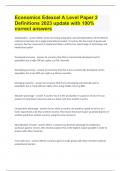
Economics Edexcel A Level Paper 2 Definitions 2023 update with 100% correct answers
Globalisation Refers to the increasing integration and interdependence of the World's national economies into a single international market. It involves the free trade of goods and services, the free movement of capital and labour and the free interchange of technology and intellectual capital Developed economy An economy that that is economically developed and its population has a high GDP per capita e.g USA, Australia Developing economy An economy that that is less economically developed and its population has a low GDP per capita e.g African countries Emerging economy An economy that that is developing economically and its population has a rising GDP per capita and a rising middle class e.g BRIC Absolute advantage A country has it in the production of a good or service if it can produce it using fewer resources and at a lower cost than another country Comparative advantage Occurs when a country can produce a good or service at a lower opportunity cost than another country. This means they have to give up producing less of another good than another country, using the same resources Specialisation of trade When a country has absolute advantage in producing a particular good or service, they tend to produce this at the highest output possible in order to trade it with other countries Free trade area Where countries agree to trade goods with other members without protectionist barriers Customs union Countries in this agreement have an established common trade policy with the rest of the world e.g they might use a common external tariff. They also have free trade between members. The EU is an example of a Customs union Common market Establishes free trade in goods and services, a common external tariff and allows free movement of capital and labour across borders - when the EU was established it was a common market. EU citizens can work in any country in the EU Monetary union/currency union Members of this share the same currency. More economically integrated than a customs union and free trade area. A common central monetary policy is established when a monetary union is formed and monetary unions use the same interest rate. Tariffs Taxes on imports to a country. The impact of them is that the quantity demanded of domestic groups increases whilst the quantity demanded of imports decreases. They result in higher prices for consumers and a loss in consumer surplus Quota Limits the quantity of a foreign produced good that is sold on the domestic market. It sets a physical limit on a specific food imported in particular period of time. Leads to a rise in prices of imported goods so therefore demand for them falls. Subsidies to domestic producers Makes domestic goods relatively cheaper when compared to imported goods, encourages domestic production to rise in supply so average price falls and consumption increases Voluntary export restraints When two countries make an agreement to limit the volume of exports to each other over a period of time. They are used when governments want to protect domestic industries from competing imports Embargoes A complete ban on trade with a particular country - usually politically motivated Excessive administration/red tape Increases the cost of trading, hence discourages imports, makes it difficult to trade with countries importing red tape and is particularly harmful for developing countries which are unable to access these markets Protectionism The restriction on the free movement of trade between countries Balance of Payments A record of all financial transactions made between consumers, firms and government from one country with other countries. It includes the current account, the capital and the financial account. Current account surplus There is a net inflow of money into the circular flow of income. The UK has a surplus with services but a deficit with goods Current account deficit Means the value of imports of goods/services and investment incomes is greater than the value of exports. It indicates that a nation is a net borrower to the rest of the world. The UK has a net current account deficit as it spends more on imports from tiebreaker countries than they earn from exports to foreign countries. It means that Aggregate demand will be negative Current account Measures the trade in goods and trade in services (trade balance) Capital account Measures the debt forgiveness e.g inheritance taxes that need to be paid internationally, international death duties and the transfer of financial assets by migrants coming and out of the country. Financial account Measures financial assets e.g corporate/government bonds, shares and derivatives Floating exchange rate The value of the exchange rate is determined by the forces of supply and demand Fixed exchange rate The value of the exchange rate is determined by the government compared to other currencies Managed exchange rate Combines the characteristics of fixed and floating exchange rate systems Revaluation When a country's currency is adjusted relative to a baseline e.g price of gold/another currency or wage rates Appreciation Increase in a currency value, each £ buys more $ for example Devaluation When the value of a currency is officially lowered in a fixed exchange rate system Depreciation When the value of a currency falls relative to another in a floating exchange rate system Marshall-Lerner condition States that a devaluation in a currency only improves the balance of trade if the absolute sum of long run exports and import demand elasticities is greater than or equal to 1 International competitiveness The ability of a nation to compete successfully overseas and sustain improvements in real output and living standards
Document information
- Uploaded on
- September 15, 2023
- Number of pages
- 8
- Written in
- 2023/2024
- Type
- Exam (elaborations)
- Contains
- Questions & answers


