CHAPTER 3 OF BASIC GERIATRICS NURSING PRACTICE TEST EXAM LATEST
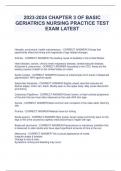
CHAPTER 3 OF BASIC GERIATRICS NURSING PRACTICE TEST EXAM LATEST Heredity, enviroment, health maintantence. - CORRECT ANSWER-3 things that significantly affect the timing and magnitude of age related changes. Arthritis - CORRECT ANSWER-The leading cause of disability in the United States. Heart disease, cancer, chronic lower respiratory disease, cerebrovascular disease, Alzheimer's, pneumonia - CORRECT ANSWER-According to the CDC, these are the leading causes of death in the United States (in order) Senile Lentigo - CORRECT ANSWER-Clusters of melanocytes form areas of deepened pigmentation. AKA age/liver spots. Seborrheic Keratosis - CORRECT ANSWER-Slightly raised, wart-like macules wit distinct edges. Color: tan- black. Mostly seen on the upper body. May cause discomfort and itching Cutaneous Papilloma - CORRECT ANSWER-Small, brown, or flesh colored projections of the skin that are most often observed on the neck AKA skin tags Xeriois - CORRECT ANSWER-Most common skin complaint of the older adult. AKA dry skin Pruritus - CORRECT ANSWER-Medical name for itching Senile pupura - CORRECT ANSWER-Red, purple, brown areas commonly seen on the legs or the arms caused by capillary walls becoming to fragile with age. Basal cell carcinoma - CORRECT ANSWER-Precancerous or cancerous condition that is observed in older adults who have spent significant amounts of time in the sun Melanoma - CORRECT ANSWER-The unusual appearance of moles. Irregular shape & boarder. Change in size & color. Symptoms: itching and bleeding may occur Pressure ulcers - CORRECT ANSWER-Break down of skin and tissue over bony prominences. Rosacea - CORRECT ANSWER-Redness, dilated superficial BV, and small pimples on the nose and the center of the face. If this is left untreated it could lead to swelling and conjunctivitis. Lifestyle modification: Avoid stress, extreme heat, sun exposure, spicy foods & alcohol - CORRECT ANSWER-Treatment for Rosacea Hypothermia - CORRECT ANSWER-This is seen when insulation is lost by the subcutaneous and adipose tissue and older adult is put into an enviroment that is too cold Bone - CORRECT ANSWER-Calcium, phosphorus, and protein make up: Calcium - CORRECT ANSWER-Necessary for the bone strength, muscle and myocardial contraction, blood clotting and neuronal activity. Dairy products and dark green leafy veggies - CORRECT ANSWER-Calcium is normally obtained by eating Vitamin D - CORRECT ANSWER-Needed for the absorption of calcium and phosphorus through the small instestine Calcitonin - CORRECT ANSWER-Produced by the thyroid gland. Slows the movement of calcium from the bones to the blood stream, lowering the blood calcium level. Isometric exercise - CORRECT ANSWER-Muscle contraction without body movement. Isotonic exercise - CORRECT ANSWER-Muscle contraction with body movement. Aerobic exercise - CORRECT ANSWER-Isotonic exercise that last 30 min or longer. This strengthens the skeletal, cardiac and respiratory muscles Kyphosis - CORRECT ANSWER-Stooped or hunch back appearance with the head going forward toward the chest. This happens when the intervertebral disk shrink as the thoracic vertebrae change. Osteoporosis - CORRECT ANSWER-Excessive loss of calcium from bone without sufficient replacement results in Osteoporosis - CORRECT ANSWER-Porous, brittle, fragile bones. Hormone therapy - CORRECT ANSWER-Beneficial to bone density Heart attack, stroke, blood clots & breast cancer - CORRECT ANSWER-Hormone therapy also increases the risk for Osteoarthritis - CORRECT ANSWER-The most common form of arthritis Hernerden nodes - CORRECT ANSWER-Cause by abnormal cartilage or bone enlargement in the distant finger joints. Pain may occur during activity or worse with emotional stresss Rheumatoid arthritis - CORRECT ANSWER-Collagen disease that results from autoimmune process, affecting more women than men. This cause inflammation to the synovium, damage to the cartilage and bone of joints and instability of tendons and ligaments 30-50 - CORRECT ANSWER-RA is onset is usually between the ages Pain/stiffness Unwell feeling Fever Fatigue Warm/tender joints - CORRECT ANSWER-Symptoms of RA Life style changes: Avoid stress Balanced exercise and diet Joint care such as joint splints - CORRECT ANSWER-Tx for RA Bursitis - CORRECT ANSWER-Inflammation of the bursa and the surrounding fibrosis tissue, can result from excessive stress on a joint Shoulder, hip, elbow, knee - CORRECT ANSWER-Most common sites for Bursitis Rest joint Taking NSAIDs Mild ROM - CORRECT ANSWER-Tx for bursitis Gouty Arthritis - CORRECT ANSWER-AKA "great toe" Caused by inborn error of metabolism that results in elevated levels of uric acid in the body. COPD (Chronic Obstructive Pulmonary Disorder) - CORRECT ANSWER-Commonly occurring respiratory disorders of emphysema and chronic bronchitis
Written for
- Institution
- GERIATRICS NURSING
- Course
- GERIATRICS NURSING
Document information
- Uploaded on
- September 15, 2023
- Number of pages
- 8
- Written in
- 2023/2024
- Type
- Exam (elaborations)
- Contains
- Questions & answers
Subjects
-
chapter 3 of basic geriatrics nursing p
-
heredity enviroment health maintantence
-
heart disease cancer chronic lower respiratory d
-
classic signs of hypoglycemia

Also available in package deal