Neurological
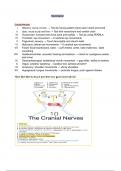
Cranial Nerves:
I. Olfactory; sense of smell → Test by having patient close each nostril and smell
II. Optic; visual acuity and field → Test with rosenbaum and snellen chart
III. Oculomotor; muscles that move eyes and eyelids → Test by using PERRLA
IV. Trochlear; eye movement → 6 cardinal eye movements
V. Trigeminal; sensory → Touch face lightly and clench teeth
VI. Abducens; lateral eye movements → 6 cardinal eye movements
VII. Facial; facial expressions, taste → puff cheeks ,smile, raise eyebrows, taste
something
VIII. Vestibulocochlear; acoustic/ hearing and balance → check for nystagmus (weber
and rinne)
IX. Glossopharyngeal; swallowing/ mouth movement → gag reflex, ability to swallow
X. Vagus; swallow/ speaking → swallow test, aphasia present?
XI. Accessory; shoulder movements → shrug shoulders
XII. Hypoglossal; tongue movements → protrude tongue, push against cheeks
“Ooh Ooh Ooh to touch and feel very good velvet ah ha”
,Neurological assessment:
● Mental status
● Pupillary responses
● Cranial nerves
● Motor and sensory function
● Muscle tone
● Cerebral function
● Vital signs
● Cerebellar function;
- Finger to nose test; touch examiners outstretched finger to nose
- Tandem walking; heel to toe
- Romberg test; feet together and close eyes, some swaying is okay
Muscle grade strength:
Drift test: close eyes with arms at 90 degrees; if drifting occurs then = weakness
5. Normal
4. Slight weakness
3. Moderate weakness
2. Severe weakness
1. Very severe
0. Complete paralysis
ROM:
Adduction, abduction, flexion, extension, plantar and dorsiflexion
Sensory:
Pain, temperature, and vibration
- Use needle to prick patient (dull or sharp)
Speech:
Global aphasia: cannot express or receive
Expressive: cannot get words out
Receptive: cannot understand words
Cortical function:
Stereognosis: recognize objects placed in hand
Graphesthesia: draw letter/ number on hand and patient guesses
Extinction: same spot touched on both sides; do they feel both? Or only one side?
Point location: touch patient and have them tell you where
Tone:
Babinski reflex: not normal in adults (CNS disease)
Deep tendon reflexes
Plantar response
,GCS:
Eye opening, best motor response, verbal response
Spontaneous, to speech, to pain, no response
3 = lowest (neurological defect), 15 = highest
, Brain lobes and functions:
CNS: composed of brain and spinal cords
PNS: cranial and spinal nerves, autonomic and somatic nerves
Frontal lobe: judgment, broca's area (speech), motor function
Parietal lobe: All senses; speech, touch, taste, temperature sensation
Occipital lobe: vision
Temporal lobe: auditory, language comprehension (wernicke's area)
Cerebellum: balance and coordination of muscle movements
Cerebrum : conscious thoughts and cognition
Medulla oblongata: respirations, heart rate, circulation (involuntary controls)
Pons: sleeping, dreaming, unconscious movements
Neuron: basic functional unit
Midbrain: motor movement, respirations, heart rate, consciousness
Cranial Nerves:
I. Olfactory; sense of smell → Test by having patient close each nostril and smell
II. Optic; visual acuity and field → Test with rosenbaum and snellen chart
III. Oculomotor; muscles that move eyes and eyelids → Test by using PERRLA
IV. Trochlear; eye movement → 6 cardinal eye movements
V. Trigeminal; sensory → Touch face lightly and clench teeth
VI. Abducens; lateral eye movements → 6 cardinal eye movements
VII. Facial; facial expressions, taste → puff cheeks ,smile, raise eyebrows, taste
something
VIII. Vestibulocochlear; acoustic/ hearing and balance → check for nystagmus (weber
and rinne)
IX. Glossopharyngeal; swallowing/ mouth movement → gag reflex, ability to swallow
X. Vagus; swallow/ speaking → swallow test, aphasia present?
XI. Accessory; shoulder movements → shrug shoulders
XII. Hypoglossal; tongue movements → protrude tongue, push against cheeks
“Ooh Ooh Ooh to touch and feel very good velvet ah ha”
,Neurological assessment:
● Mental status
● Pupillary responses
● Cranial nerves
● Motor and sensory function
● Muscle tone
● Cerebral function
● Vital signs
● Cerebellar function;
- Finger to nose test; touch examiners outstretched finger to nose
- Tandem walking; heel to toe
- Romberg test; feet together and close eyes, some swaying is okay
Muscle grade strength:
Drift test: close eyes with arms at 90 degrees; if drifting occurs then = weakness
5. Normal
4. Slight weakness
3. Moderate weakness
2. Severe weakness
1. Very severe
0. Complete paralysis
ROM:
Adduction, abduction, flexion, extension, plantar and dorsiflexion
Sensory:
Pain, temperature, and vibration
- Use needle to prick patient (dull or sharp)
Speech:
Global aphasia: cannot express or receive
Expressive: cannot get words out
Receptive: cannot understand words
Cortical function:
Stereognosis: recognize objects placed in hand
Graphesthesia: draw letter/ number on hand and patient guesses
Extinction: same spot touched on both sides; do they feel both? Or only one side?
Point location: touch patient and have them tell you where
Tone:
Babinski reflex: not normal in adults (CNS disease)
Deep tendon reflexes
Plantar response
,GCS:
Eye opening, best motor response, verbal response
Spontaneous, to speech, to pain, no response
3 = lowest (neurological defect), 15 = highest
, Brain lobes and functions:
CNS: composed of brain and spinal cords
PNS: cranial and spinal nerves, autonomic and somatic nerves
Frontal lobe: judgment, broca's area (speech), motor function
Parietal lobe: All senses; speech, touch, taste, temperature sensation
Occipital lobe: vision
Temporal lobe: auditory, language comprehension (wernicke's area)
Cerebellum: balance and coordination of muscle movements
Cerebrum : conscious thoughts and cognition
Medulla oblongata: respirations, heart rate, circulation (involuntary controls)
Pons: sleeping, dreaming, unconscious movements
Neuron: basic functional unit
Midbrain: motor movement, respirations, heart rate, consciousness