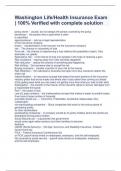
Washington Life/Health Insurance Exam | 100% Verified with complete solution
Washington Life/Health Insurance Exam | 100% Verified with complete solution policy owner - usually, but not always the person covered by the policy beneficiary - the person who is paid when a claim is submitted agent/producer - acts as a legal representative of the insurance company broker - representative of the Insured, not the insurance company risk - The chance or uncertainty of loss Pure risk - the chance of experiencing a loss (without the possibility of gain). Only downside, no upside. Speculative risk - s the chance of loss one accepts in the hope of realizing a gain Risk avoidance - staying away from risky activities altogether Risk reduction - reduce the chance of something bad happening Risk shifting - Get someone else to accept the risk Buying insurance - transfer a portion of your risk to the Insurer Risk Retention - the individual or business that opts not to buy insurance retains the entire risk Indemnification - an insurance concept that states that some portions of the insurance industry prefer that we be made only whole after a loss rather than coming out ahead (Only getting back what you are owed, not getting more than what you had to start with) Subrogation - the transfer to the Insurer of the Insured's rights to recover damages from a responsible third party Peril - the cause of loss Law of Large numbers - the mathematical concept that makes it easier to predict losses if we have a large number of Insureds Insurable losses are... - Economic, Predictable, Accidental, Measurable, Non-Catastrophic non-participating companies - Stock companies that exist for the sole purpose of generating profits for their stockholders participating companies - A company owned by its policy holders where the profits are distributed among policy holders Social Security act - a guarantee that government would never again allow workers (and their families) to become destitute OASDI (Social Security) - Old Age, Survivors, and Disability Insurance...Federal Government law FICA - Federal Insurance Contributions Act or FICA, payroll taxes levied on employees, employers, and the self-employed. Not covered by social security - payroll taxes levied on employees, employers, and the self-employed. FICA Fully Insured - (Worked for 10 years) payroll taxes levied on employees, employers, and the self-employed. Retirement Benefits; Disability Income Benefits; and Survivor Benefits. Currently Insured - Worked less than ten years. Only eligeable for Survivor Benefits Average Indexed Monthly Earnings - Averages earnings over time period. Either way, the more a worker has paid into Social Security, the more the worker (or dependents) will get out of it. (What you get at age 65) Primary Insurance Amount (PIA). - Full retirement benefit someone is entitled to at age 65 (some cases, 66-67) elimination period (Disability) - the person must be disabled for 5 months before starting to receive Disability Benefits underwriting - the selection and classification of risks. actuary - A person who tracks the lifespan and chance of illness or accident based on specific factors Mortality table - predict the age at which people in a given group are likely to die (Used by life insurers) Morbidity table - predict how often people in a given group are likely to get sick or have an accident. (Used by health insurers) field underwriters - Insurance agents declined risks - Applicants who are too risky are declined Adverse selection - the tendency for high risk people to be more likely to apply for insurance than low risk people. Premium = - Risk + Expenses - Interest Premium mode - how frequently an Insured will pay the premium Accelerated Death Benefit Rider - requires the Insurer to pay out part of the death benefit (usually 50%) if the Insured has a diagnosis of a particular illness likely to cause death within 12 months Viatical Settlements - sell the policy to an investment company that will continue to make the premium payments and collect the death benefit when the Insured dies. The Insured will sell only if an investment company will pay more than the current cash surrender value. Group Policies share these three characteristics - Reduced Cost; Reduced Adverse Selection; and Fixed Benefits. Adverse selection - people who need insurance the most are the ones most likely to buy it - and buy more of it causing more loss claims experience rating - looks at the claims history for this particular group. Experience rating puts the burden for high premiums (and the credit for low ones) squarely on the shoulders of the group, because of the particular group's past claims history community rating - combines claims history over a class of groups that are similar in nature and may even be in a similar geographic area Master Contract - The one overriding contract that can affect the lives of hundreds or thousands Certificate of Insurance - a booklet explaining the coverage and an identification card Single Employer Group - an insurance plan administered by an employer to cover employees, officers, and even the board of directors (but not shareholders because they aren't employees). Multiple Employer Group - When two or more employers join forces to meet minimum member requirements and in other ways jointly provide insurance for their employees non-contributory plan - a Group Insurance plan in which the entire cost of coverage for all eligible group members is covered by the organizing entity, usually the employer contributory plan - all or part of the costs of coverage must be paid by individual group members eligibility period - after the probationary period when an employee is eligible to receive health insurance open enrollment period - a month in which all employees who have become eligible to enroll can voluntary plans - "add on" programs that are reasonably priced because of volume discounts Voluntary Employer-Sponsored (Worksite) Plans - Optional plans offered to the employees that they pay for out of pocket (Aflac) Supplemental Accident Benefit policies - pay a specified dollar over and above any other insurance a worker already has - and there is no deductible involved Hospital Indemnity Policies - pay a predetermined benefit (for example, $500) for each day spent in the hospital. legal purpose - a contract is to be valid, its purpose must be legal a contract is to be valid, its purpose must be legal - only people who are capable of understanding the terms of a contract and who are not under duress may become parties to a contract mutual consideration - For a contract to be valid, the parties must exchange something of value. Agreement = - offer + acceptance Statement of Continued Good Health - assures the company that no material changes have occurred since the time the application was completed several weeks earlier. Conditional Receipt - Promises that the policy will be in effect from the date of the application or the medical exam, whichever is later, thus providing coverage while the application is being processed Material fact - information that would have caused the Insurer to not issue the policy at that premium had it known the truth Warranty - A statement made on an application for insurance that the applicant gaurentees to be true (Not allowed in life and health insurance forms) Representation (in a policy agreement) - statement regarding a material fact that the applicant believes to be true to the best of the applicant's knowledge and belief Misrepresentation - a lie about a material fact Concealment - An intentional non-disclosure of hiding material facts Unilateral - The insurer has made a legally enf
Document information
- Uploaded on
- September 14, 2023
- Number of pages
- 19
- Written in
- 2023/2024
- Type
- Exam (elaborations)
- Contains
- Questions & answers