

Proteins: Williams' Basic Nutrition & Diet Therapy - Chapter 4 exam with well explained answers
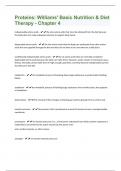
ndispensable amino acids - the nine amino acids that must be obtained from the diet because the body does not make adequate amounts to support body needs dispensable amino acids - the five amino acids that the body can synthesize from other amino acids that are supplied through the diet and thus do not have to be consumed on a daily basis conditionally indispensable amino acids - the six amino acids that are normally considered dispensable amino acids because the body can make them; however, under certain circumstances (e.g., illness), the body cannot make them in high enough quantities, and they become indispensable (cannot do without) in the diet catabolism - the metabolic process of breaking down large substances to yield smaller building blocks anabolism - the metabolic process of building large substances from smaller parts; the opposite of catabolism deamination - the removal of the nitrogen-containing part (amino group) from an amino acid osmotic pressure - the pressure that is produced as a result of osmosis across a semipermeable membrane proenzyme - an inactive precursor (i.e., a forerunner substance from which another substance is made) that is converted to the active enzyme by the action of an acid, another enzyme, or other means zymogen - an inactive enzyme precursorpepsin - the main gastric enzyme specific for proteins; pepsin begins breaking large protein molecules into shorter chain polypeptides, and it is activated by gastric hydrochloric acid
Document information
- Uploaded on
- September 13, 2023
- Number of pages
- 2
- Written in
- 2023/2024
- Type
- Exam (elaborations)
- Contains
- Questions & answers


