

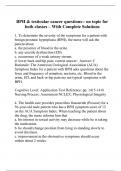
BPH & testicular cancer questions-- on topic for both classes – With Complete Solutions
1. To determine the severity of the symptoms for a patient with benign prostatic hyperplasia (BPH), the nurse will ask the patient about a. the presence of blood in the urine. b. any erectile dysfunction (ED). c. occurrence of a weak urinary stream. d. lower back and hip pain. correct answer: Answer: C Rationale: The American Urological Association (AUA) Symptom Index for a patient with BPH asks questions about the force and frequency of urination, nocturia, etc. Blood in the urine, ED, and back or hip pain are not typical symptoms with BPH. Cognitive Level: Application Text Reference: pp. Nursing Process: Assessment NCLEX: Physiological Integrity 4. The health care provider prescribes finasteride (Proscar) for a 56-year-old male patient who has a BPH symptom score of 12 on the AUA Symptom Index. When teaching the patient about the drug, the nurse informs him that a. his interest in sexual activity may decrease while he is taking the medication. b. he should change position from lying to standing slowly to avoid dizziness. c. improvement in the obstructive symptoms should occur within about 2 weeks. d. he will need to monitor his blood pressure frequently to assess for hypertension. correct answer: Answer: A Rationale: A decrease in libido is a side effect of finasteride because of the androgen suppression that occurs with the drug. Orthostatic hypotension is a side effect of the α-blocking agents. Improvement in symptoms of obstruction takes 3 to 6 months. The medication does not cause hypertension. Cognitive Level: Application Text Reference: p. 1417 Nursing Process: Implementation NCLEX: Physiological Integrity 5. A patient with irritative and obstructive bladder symptoms has an enlarged prostate on digital rectal examination (DRE) and an elevated PSA level. The nurse will anticipate that the patient will need teaching about a. uroflometry studies. b. cystourethroscopy. c. transrectal ultrasonography (TRUS). d. magnetic resonance imaging (MRI). correct answer: Answer: C Rationale: In a patient with an abnormal DRE and e
Document information
- Uploaded on
- September 12, 2023
- Number of pages
- 5
- Written in
- 2023/2024
- Type
- Exam (elaborations)
- Contains
- Questions & answers


