

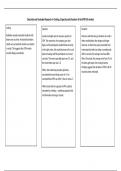
Describe and Evaluate Research in Coding, Capacity and Duration of the STM (16 marks)
Coding Capacity Duration
Baddeley visually presented students with Jacobs used digit span to measure capacity of Peterson and Peterson got students to recall 3
letters one at a time. He found that letters STM. The researcher, for example, gave four letter combinations after longer and longer
which were acoustically similar were harder digits, and if participants recalled these correctly intervals, in which they were prevented from
to recall. This suggests that STM mainly in the right order, this would increase to five, and rehearsing the letters by doing a counting task.
encodes things acoustically. keep increasing until the participant can’t recall After 3 seconds, the average recall was 80%.
correctly. The mean span digit span was 9.3, and After 18 seconds, the average recall was 3%. As
the mean letter span was 7.3. the delay got longer, the recall got worse.
Findings suggest that duration of STM is 18-30
Miller, after observing everyday practices, seconds unless rehearsed.
concluded that most things come in 7s. He
concluded that STM can hold ‘7 plus or minus 2’.
Miller found that the capacity of STM could be
extended by chunking – combining separate bits
of information into larger chunks.
, Cowan reviewed other memory research and discovered that the average capacity of STM is 4 items.
Point
This is a weakness of Miller’s research into the capacity of STM because it suggests that Miller may have over-
Evidence/
Example
estimated the amount of information STM can hold.
This suggests that Miller’s initial research may be flawed and that STM may hold around three items less than the
7 originally proposed.
Link back
Explain/
Baddely’s study identified a clear difference between two memory stores.
Point
Despite some exceptions, Baddeley’s ideas that STM codes acoustically and LTM codes semantically has not
Evidence/
failed over time.
Example
This is important in understanding the memory system, which led to the multi-store memory.
Link back
Explain/
Peterson and Peterson’s study on the duration of STM used artificial stimulus material.
Point
Recalling consonant syllables does not reflect most everyday memory activities where we are trying to remember
Evidence/
Example
meaningful information.
This is a weakness as it lacks external material.
Link back
Explain/
, Describe and Evaluate the Multi-Store Model of Memory (16 marks)
Aim Process
By Atkinson and Shiffrin to describe how information flows through the memory 1. All the stimuli from the environment pass into the sensory register.
system. 2. Information passes further into the memory store only if you pay
attention to it.
3. We can keep the information in our STM if we rehearse it. This requires
maintenance rehearsal, which occurs when we repeat material
repeatedly.
4. If elaborative rehearsal takes place – if we rehearse it long enough – it
passes into the LTM.
5. When we want to recall information from the LTM, it must be
transferred back into STM by a process called retrieval.
Coding Capacity Duration
Baddeley visually presented students with Jacobs used digit span to measure capacity of Peterson and Peterson got students to recall 3
letters one at a time. He found that letters STM. The researcher, for example, gave four letter combinations after longer and longer
which were acoustically similar were harder digits, and if participants recalled these correctly intervals, in which they were prevented from
to recall. This suggests that STM mainly in the right order, this would increase to five, and rehearsing the letters by doing a counting task.
encodes things acoustically. keep increasing until the participant can’t recall After 3 seconds, the average recall was 80%.
correctly. The mean span digit span was 9.3, and After 18 seconds, the average recall was 3%. As
the mean letter span was 7.3. the delay got longer, the recall got worse.
Findings suggest that duration of STM is 18-30
Miller, after observing everyday practices, seconds unless rehearsed.
concluded that most things come in 7s. He
concluded that STM can hold ‘7 plus or minus 2’.
Miller found that the capacity of STM could be
extended by chunking – combining separate bits
of information into larger chunks.
, Cowan reviewed other memory research and discovered that the average capacity of STM is 4 items.
Point
This is a weakness of Miller’s research into the capacity of STM because it suggests that Miller may have over-
Evidence/
Example
estimated the amount of information STM can hold.
This suggests that Miller’s initial research may be flawed and that STM may hold around three items less than the
7 originally proposed.
Link back
Explain/
Baddely’s study identified a clear difference between two memory stores.
Point
Despite some exceptions, Baddeley’s ideas that STM codes acoustically and LTM codes semantically has not
Evidence/
failed over time.
Example
This is important in understanding the memory system, which led to the multi-store memory.
Link back
Explain/
Peterson and Peterson’s study on the duration of STM used artificial stimulus material.
Point
Recalling consonant syllables does not reflect most everyday memory activities where we are trying to remember
Evidence/
Example
meaningful information.
This is a weakness as it lacks external material.
Link back
Explain/
, Describe and Evaluate the Multi-Store Model of Memory (16 marks)
Aim Process
By Atkinson and Shiffrin to describe how information flows through the memory 1. All the stimuli from the environment pass into the sensory register.
system. 2. Information passes further into the memory store only if you pay
attention to it.
3. We can keep the information in our STM if we rehearse it. This requires
maintenance rehearsal, which occurs when we repeat material
repeatedly.
4. If elaborative rehearsal takes place – if we rehearse it long enough – it
passes into the LTM.
5. When we want to recall information from the LTM, it must be
transferred back into STM by a process called retrieval.


