

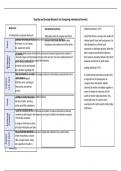
Describe and Evaluate Research into Caregiving Interactions(16 marks)
Reciprocity Interactional Synchrony Meltzoff and Moore (1977)
An interaction is reciprocal when each Takes place when the caregiver and infant Found that infants as young as two weeks old
person responds to the
A limitation other
is that simplyand elicitsaabehaviour does notinteract
observing tell us itsindevelopmental
such a way importance.
that their actions, imitated specific facial and hand gestures. An
Point
response from them, in a turn taking behaviours, and emotions mirror the others. adult displayed one of three facial
conversation, usually non-verbal. expressions or distinctive gestures. When the
ForEidelman
Feldman and example, Feldman points out that ideas like synchrony and reciprocity simply give names to patterns of baby’s response was filmed by observers,
observable caregiver and infant behaviours that occur at the same time. These can be reliably observed, but it they found an association between the infant
Evidence/
Example
doesn’t
Research from tell us theand
Feldman purpose of these caregiver-infant interactions.
Eidelman behaviour and that of the adult model
shows that mothers pick up and respond
Isabella and Belsky (1991)
to their baby’s alertness -signalling that
they are ready for interaction
This means – around
that we cannot be certain that caregiver interactions and the behaviours associated with it have a It is believed that interactional synchronicity
special meaning.
two-thirds of the time. Finegood
Link back
is important for the development of
Explain/
suggested that this varies according to caregiver-infant attachment. Isabella
the skill of the mother and external observed 30 mothers and babies together to
factors e.g. stress. assess the degree of synchrony and the
Feldman said this interaction
A limitation increases
is that it is hard to interpret a baby’s behaviour. quality of mother-baby attachment. They
found high levels of synchrony were
Point
from around three months, involving
both the mother and child’s attention to associated with a better-quality mother-baby
each other’s verbal attachment.
Babies lackand facial signals.
coordination and much of their bodies are immobile. The observed movements are small hand
movements or subtle changes in facial expression, even though it is difficult to tell what these are caused by
Evidence/
Example
Brazleton
from the baby’s perspective.
Babies and caregivers both take an active
role, as both initiate interactions and take
turns in doing so. Brazleton
We cannot be certaindescribed
that the behaviours seen in caregiver-infant interactions have a special meaning.
Link back
Explain/
caregiver-infant interactions as a dance
as it is just like a couple’s dance, where
each partner responds to the other’s
movements.
, Point A strength is that caregiver-infant interactions are usually filmed in a laboratory.
This means activity that may distract the baby can be controlled, observations can be recorded and analysed later
so researchers won’t miss key behaviours. As babies are unaware of being filmed, their behaviour does not
Evidence/
Example
change.
Data collected has good reliability and validity.
Link back
Explain/
, Describe and Evaluate research in the Role of the Father (16 marks)
Parent-infant interaction The role of the father Fathers as primary care givers
Schaffer and Emerson (1964)
One issue with research into the role of the father is thatGrossman (2002) findings on the role of the father.
there is inconsistent Field (1978)
Point
Research into the role of the fathers in attachment is confusing because different researchers are interested in
Schaffer and Emerson provided evidence Grossman carried out a longitudinal study There is evidence to suggest that when
different research questions.
to suggest fathers are much less likely to looking at both parents’ behaviour and its fathers are primary caregivers, they adopt
become babies’
On onefirst attachment
hand, figure are interested in understanding
some psychologists the role
relationship of the
to the fathersof
quality as the
a secondary
children’s typical behaviour of mothers.
Evidence
/Example
compared toattachment
mothers. figure whereas others are more concerned with the father as a primary attachment figure. The
attachment into their teens. Quality of infant
former have tended to see the father behaving differently from mothers and having a distinct role. The latter Field filmed 4-month-old babies in face-to-
They foundhave
thattended
the majority can take on a ‘maternal’ role.attachment with mothers but not father was
of babies
to find fathers face interaction with primary caregiver
first become attached to their mother at related to the children’s attachment in
This is an issue because it makes it difficult to offer a simple answer as suggesting
to the role of the father because it really mothers, secondary caregiver fathers and
around 7 months. adolescence that father
depends In only
what 3% of
specific rolecases thediscussed.
is being primary caregiver fathers. Primary caregiver
Link back
attachment was less important than the
Explain/
father was the first sole object of fathers, like the mothers, spent more time
attachment. In 27% of cases both mother mothers.
smiling, imitating, and holding infants than
and father were joint first object of The quality of the father’s play with babies the secondary caregiver fathers.
attachment. was related to the quality of adolescent
The key to the attachment relationship is the
Fathers go on to become an important attachments, suggesting fathers have a
level of responsiveness, not the gender of
attachment figure as Schaffer and different role from mothers that’s more to do
A strength is that fathers have distinctive roles that canwith
be overcome if they
play and lessare
to not
do present.
with emotional the parent.
Emerson found that 75% of babies
Point
studied formed an attachment by 18 development.
months old, as they protested when their
In single
father walked away.mother families, they may simply have to adapt to accommodate the role played by fathers.
Evidence/
Example
The distinctive role of the father is clear, while families can still adapt to not having a father.
Link back
Explain/
Reciprocity Interactional Synchrony Meltzoff and Moore (1977)
An interaction is reciprocal when each Takes place when the caregiver and infant Found that infants as young as two weeks old
person responds to the
A limitation other
is that simplyand elicitsaabehaviour does notinteract
observing tell us itsindevelopmental
such a way importance.
that their actions, imitated specific facial and hand gestures. An
Point
response from them, in a turn taking behaviours, and emotions mirror the others. adult displayed one of three facial
conversation, usually non-verbal. expressions or distinctive gestures. When the
ForEidelman
Feldman and example, Feldman points out that ideas like synchrony and reciprocity simply give names to patterns of baby’s response was filmed by observers,
observable caregiver and infant behaviours that occur at the same time. These can be reliably observed, but it they found an association between the infant
Evidence/
Example
doesn’t
Research from tell us theand
Feldman purpose of these caregiver-infant interactions.
Eidelman behaviour and that of the adult model
shows that mothers pick up and respond
Isabella and Belsky (1991)
to their baby’s alertness -signalling that
they are ready for interaction
This means – around
that we cannot be certain that caregiver interactions and the behaviours associated with it have a It is believed that interactional synchronicity
special meaning.
two-thirds of the time. Finegood
Link back
is important for the development of
Explain/
suggested that this varies according to caregiver-infant attachment. Isabella
the skill of the mother and external observed 30 mothers and babies together to
factors e.g. stress. assess the degree of synchrony and the
Feldman said this interaction
A limitation increases
is that it is hard to interpret a baby’s behaviour. quality of mother-baby attachment. They
found high levels of synchrony were
Point
from around three months, involving
both the mother and child’s attention to associated with a better-quality mother-baby
each other’s verbal attachment.
Babies lackand facial signals.
coordination and much of their bodies are immobile. The observed movements are small hand
movements or subtle changes in facial expression, even though it is difficult to tell what these are caused by
Evidence/
Example
Brazleton
from the baby’s perspective.
Babies and caregivers both take an active
role, as both initiate interactions and take
turns in doing so. Brazleton
We cannot be certaindescribed
that the behaviours seen in caregiver-infant interactions have a special meaning.
Link back
Explain/
caregiver-infant interactions as a dance
as it is just like a couple’s dance, where
each partner responds to the other’s
movements.
, Point A strength is that caregiver-infant interactions are usually filmed in a laboratory.
This means activity that may distract the baby can be controlled, observations can be recorded and analysed later
so researchers won’t miss key behaviours. As babies are unaware of being filmed, their behaviour does not
Evidence/
Example
change.
Data collected has good reliability and validity.
Link back
Explain/
, Describe and Evaluate research in the Role of the Father (16 marks)
Parent-infant interaction The role of the father Fathers as primary care givers
Schaffer and Emerson (1964)
One issue with research into the role of the father is thatGrossman (2002) findings on the role of the father.
there is inconsistent Field (1978)
Point
Research into the role of the fathers in attachment is confusing because different researchers are interested in
Schaffer and Emerson provided evidence Grossman carried out a longitudinal study There is evidence to suggest that when
different research questions.
to suggest fathers are much less likely to looking at both parents’ behaviour and its fathers are primary caregivers, they adopt
become babies’
On onefirst attachment
hand, figure are interested in understanding
some psychologists the role
relationship of the
to the fathersof
quality as the
a secondary
children’s typical behaviour of mothers.
Evidence
/Example
compared toattachment
mothers. figure whereas others are more concerned with the father as a primary attachment figure. The
attachment into their teens. Quality of infant
former have tended to see the father behaving differently from mothers and having a distinct role. The latter Field filmed 4-month-old babies in face-to-
They foundhave
thattended
the majority can take on a ‘maternal’ role.attachment with mothers but not father was
of babies
to find fathers face interaction with primary caregiver
first become attached to their mother at related to the children’s attachment in
This is an issue because it makes it difficult to offer a simple answer as suggesting
to the role of the father because it really mothers, secondary caregiver fathers and
around 7 months. adolescence that father
depends In only
what 3% of
specific rolecases thediscussed.
is being primary caregiver fathers. Primary caregiver
Link back
attachment was less important than the
Explain/
father was the first sole object of fathers, like the mothers, spent more time
attachment. In 27% of cases both mother mothers.
smiling, imitating, and holding infants than
and father were joint first object of The quality of the father’s play with babies the secondary caregiver fathers.
attachment. was related to the quality of adolescent
The key to the attachment relationship is the
Fathers go on to become an important attachments, suggesting fathers have a
level of responsiveness, not the gender of
attachment figure as Schaffer and different role from mothers that’s more to do
A strength is that fathers have distinctive roles that canwith
be overcome if they
play and lessare
to not
do present.
with emotional the parent.
Emerson found that 75% of babies
Point
studied formed an attachment by 18 development.
months old, as they protested when their
In single
father walked away.mother families, they may simply have to adapt to accommodate the role played by fathers.
Evidence/
Example
The distinctive role of the father is clear, while families can still adapt to not having a father.
Link back
Explain/


