

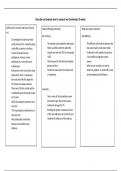
Describe and Evaluate Asch’s research into Conformity (16 marks)
Outline Asch’s research and what he found Factors Affecting Conformity What does each one lead to?
out.
Size of Group Task Difficulty
To investigate the extent to which
social pressure from a majority group The majority was increased or decreased. The difficulty of the task increased as the
could affect a person to conform. There was little conformity when the lines were made to look more similar.
Tested 123 male American majority was only one (3%) or two people Conformity to the majority increased as
participants. Asch put a naïve (13%). it was harder to judge the correct
participant in a room with seven This increased to 30% when the majority answer.
confederates. group was three. When we are uncertain, we look to
Each person in the room had to state Further increases did not increase levels others for guidance, so conformity is due
aloud which of the 3 comparison of conformity. to informational social influence.
lines was most like the target line.
The answer was always obvious.
There were 18 trials in total and the Unanimity
confederates gave the wrong answer
on 12 trials. One or more of the confederates were
36.8% of participant responses were instructed to give the correct answer.
incorrect. Conformity dropped to 5%.
75% of participants conformed on at Breaking the groups consensus was one
least one trial. of the main influences of conformity as it
Most participants conformed weakens the influence of the majority.
because of normative social
influence.
, One strength of Asch’s research is that is has a range of research to support the difficulty of the task variation.
Point
Lucas asked students to give answers to mathematical problems that were easy or more difficult. There was
Evidence/
greater conformity to incorrect answers when they were difficult rather than when they were easier ones. This was
Example
most true for those who rated their mathematical ability as poor. This is because when the problems are easy the
participants ‘knew their own mind’ but when the problems were hard the situation became ambiguous (unclear).
The participants did not want to be wrong, so they relied on the answers that were given.
This is good support for Asch’s research as it clearly shows that when the situation is manipulated to make the task
harder that levels of conformity are clearly affected and levels of conformity increase.
Link back
Explain/
However, a limitation is that conformity is more complex than Asch suggested.
Point
The Lucas study found that participants with the high confidence in their maths abilities conformed less on hard
tasks than those with low confidence. This shows that individual level factors can influence conformity by
Evidence/
Example
interacting with situational variables.
This is a limitation because Asch did not research the role of individual factors, so was not considered as part of his
Link back
study.
Explain/
A limitation is that culture can affect conformity rates.
Point
Smith and Bond conducted a meta-analysis of studies in 1998 from a range of different countries and found that
Evidence/
the average conformity rate in collectivist countries was 37%, whereas individualist countries have a rate of 25%.
Example
In collectivist cultures, members are socialized to value the collective goals of the group, while in individualist
cultures, the emphasis is on personal achievement and independence.
This means that Asch’s findings tell us little about conformity in people from other cultures than the USA, where
the study was conducted.
Link back
Explain/
,
Outline Asch’s research and what he found Factors Affecting Conformity What does each one lead to?
out.
Size of Group Task Difficulty
To investigate the extent to which
social pressure from a majority group The majority was increased or decreased. The difficulty of the task increased as the
could affect a person to conform. There was little conformity when the lines were made to look more similar.
Tested 123 male American majority was only one (3%) or two people Conformity to the majority increased as
participants. Asch put a naïve (13%). it was harder to judge the correct
participant in a room with seven This increased to 30% when the majority answer.
confederates. group was three. When we are uncertain, we look to
Each person in the room had to state Further increases did not increase levels others for guidance, so conformity is due
aloud which of the 3 comparison of conformity. to informational social influence.
lines was most like the target line.
The answer was always obvious.
There were 18 trials in total and the Unanimity
confederates gave the wrong answer
on 12 trials. One or more of the confederates were
36.8% of participant responses were instructed to give the correct answer.
incorrect. Conformity dropped to 5%.
75% of participants conformed on at Breaking the groups consensus was one
least one trial. of the main influences of conformity as it
Most participants conformed weakens the influence of the majority.
because of normative social
influence.
, One strength of Asch’s research is that is has a range of research to support the difficulty of the task variation.
Point
Lucas asked students to give answers to mathematical problems that were easy or more difficult. There was
Evidence/
greater conformity to incorrect answers when they were difficult rather than when they were easier ones. This was
Example
most true for those who rated their mathematical ability as poor. This is because when the problems are easy the
participants ‘knew their own mind’ but when the problems were hard the situation became ambiguous (unclear).
The participants did not want to be wrong, so they relied on the answers that were given.
This is good support for Asch’s research as it clearly shows that when the situation is manipulated to make the task
harder that levels of conformity are clearly affected and levels of conformity increase.
Link back
Explain/
However, a limitation is that conformity is more complex than Asch suggested.
Point
The Lucas study found that participants with the high confidence in their maths abilities conformed less on hard
tasks than those with low confidence. This shows that individual level factors can influence conformity by
Evidence/
Example
interacting with situational variables.
This is a limitation because Asch did not research the role of individual factors, so was not considered as part of his
Link back
study.
Explain/
A limitation is that culture can affect conformity rates.
Point
Smith and Bond conducted a meta-analysis of studies in 1998 from a range of different countries and found that
Evidence/
the average conformity rate in collectivist countries was 37%, whereas individualist countries have a rate of 25%.
Example
In collectivist cultures, members are socialized to value the collective goals of the group, while in individualist
cultures, the emphasis is on personal achievement and independence.
This means that Asch’s findings tell us little about conformity in people from other cultures than the USA, where
the study was conducted.
Link back
Explain/
,


