
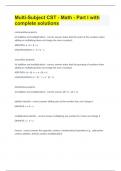
Multi-Subject CST - Math - Part I with complete solutions
commutative property (of addition and multiplication) states that the order of the numbers when adding or multiplying does not change the sum or product. ADDITION: a + b = b + a MULTIPLICATION: a b = b a associative property (of addition and multiplication) states that the grouping of numbers when adding or multiplying does not change the sum or product ADDITION: (a + b) + c = a + (b + c) MULTIPLICATION: (a b) c = a (b c) distributive property (of addition and multiplication) a(b*c) = ab + ac additive identity adding zero to the number does not change it EXAMPLE: a + 0 = a multiplicative identity multiplying any number by 1 does not change it EXAMPLE: a * 1 = a inverse the opposite; undoes a mathematical operation (e.g., subtraction undoes addition, division undoes multiplication) additive inverse when the additive inverse of a number is added to that number, the sum will be zero. EXAMPLE: a + (-a) = 0 multiplicative inverse when the number is multiplied by its multiplicative inverse, the product will be 1. EXAMPLE: a * 1/a = 1 reciprocal the multiplicative inverse of a number (when the numerator and denominator are switched). EXAMPLE: 7, 1/7 closure refers to the numbers within a set (e.g., all even numbers, all positive numbers); if a mathematical operation is performed on two numbers from a particular set, and the answer is also from that same set of numbers, then that set of numbers is closed under the operation performed. multiplicative property of zero states that multiplying any number by zero equals zero EXAMPLE: a * 0 = 0 rational number any number that can be expressed in the fractional form a/b, where a and b are both integers and the denominator ≠ 0 terminating decimal v. repeating decimal When a rational number is expressed as a decimal, the number will appear as a terminating decimal, which means the decimal stops, or as a repeating decimal, which mans the decimal goes on forever, repeating the same values over and over. TERMINATING: 1/4 = 0.25 REPEATING: 1/3 = 0.333... irrational number any number that cannot be expressed as a rational number; cannot be expressed as a terminating or repeating decimal 2 kinds of irrational numbers 1. irrational numbers known by other symbols, such as π 2. square roots that can't be simplified into rational numbers perfect square the square of an integer EXAMPLE: √81 = 9 rationalizing the denominator It's not acceptable to leave a radical in the denominator of a fraction. The way to leave an answer without a radical in the denominator is to multiply the numerator and the denominator by the same radical that is in the denominator. square root (a.k.a. radical) The square root of a given number is a value that when multiplied by itself produces that given number; square roots come in pairs, a positive root an a negative root. EXAMPLE: √4 = ± 2 simplifying square roots To simplify a square root of a number, find two factors of that number, one of which is a perfect square EXAMPLE: √18 = √9 * √2 = 3√2 scientific notation a way of expressing numbers without writing out too many digits. EXAMPLE: a * 10^n, where 1 ≤ a ≤ 10 rule of exponents for multiplying monomials a^m * a^n = a^m+n rule of exponents for dividing monomials a^m/a^n = a^m-n To add or subtract fractions, find the ______________ and then add or subtract the ______________ common denominator, numerators How do you multiply 2 fractions? multiply straight across - numerator times numerator and denominator times denominator How do you divide 2 fractions? multiply by the reciprocal of the second fraction EXAMPLE: a/b ÷ c/d = a/b * d/c = ad/bc 3 ways to order fractions from smallest to largest 1. Rewrite all the fractions with a common denominator and compare numerators. 2. Compare cross-products. 3. Convert the fractions into decimals and compare their values. order of operations 1. Perform operations within grouping symbols ( ) [ ] √ | | 2. Simplify all exponents (including square roots) 3. Multiply and/or divide terms from left to right 4. Add and/or subtract terms from left to right absolute value a number's distance from zero. EXAMPLE: |a| = |-a| = a percent of change When the value of something increases or decreases, that change can be expressed as a percentage. The percent of change will be positive for a percent increase and negative for a percent decrease. percent of change = new # - original #/original # factor an integer that divides evenly into another number composite number any whole number that is greater than 1 and not prime prime factorization used to find the greatest common factor between two numbers. EXAMPLE: 140 = 2 2 5 * 7 72 = 2 2 2 3 3 GCF = 4 How do you see if 2 ratios are proportional? cross-multiply and see if the numbers are the same direct variation a pair of variables related by a constant of variation. EXAMPLE: If you work at a job that pays $8/hour, the relationship between the number of hours worked (x) and the amount of income earned (y) can be expressed as y = 8x, where 8 is the constant of variation. formula for direct variation x_1/y_1 = x_2/y_2 EXAMPLE: If you earn $32 for 4 hours, how much will you earn for working 12 hours? $32/4 hrs = x/12 hrs x=$96 inverse variation refers to 2 variables that are inversely proportional to each other, meaning that as one variable increases in value, the other variable decreases in value proportionally. x_1 y_1 = x_2 y_2 EXAMPLE: The faster you drive (x_1), the less time (y_1) it will take you to complete a trip. sequence an ordered set of numbers that can be either finite or infinite Each term of a sequence is determined by a ______________ or _____________ (a.k.a. ____________) function formula (a.k.a. recursion formula) arithmetic sequence any sequence defined by adding or subtracting the same number over and over a_n = a_1 + (n - 1) + d a_1 = first term in the sequence d = common difference between each term geometric sequence when a sequence is created by starting with some first term and then multiplying or dividing the same number over and over again. a_n = a_1 * r a_1 = first term in the sequence r = common ratio
Document information
- Uploaded on
- September 8, 2023
- Number of pages
- 21
- Written in
- 2023/2024
- Type
- Exam (elaborations)
- Contains
- Questions & answers


