

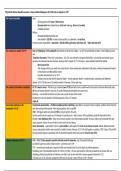
Why did the Weimar Republic surmount so many political challenges in the 1920s only to collapse by 1933?
The Treaty of Versailles Land:
- All land gained at the Treaty of Brest-Litovsk
- (European land taken included areas rich in coal + iron e.g., Alsace and Lorraine)
- Forbidden Anschluss
Military:
- Rhineland demilitarised buffer zone
- Army limited to 100,000, no tanks or heavy artillery, no submarines + no air force.
Forced to accept responsibility + reparations = 132,000 million gold marks. Guilt clause 231 – ‘Stab in the back myth’
The creation of a republic 1918-19 Paul von Hindenburg + Erich Ludendorff took Germany to the point of collapse – oct 1917 army leadership set down + Max of Baden gov took
over.
*Revolution from above* Prince Max’s government – Oct 1918, navy refused to sail against British fleet + set off strikes and mutinies across
Germany. Nov, Bavaria broke from Germany, declaring itself a republic (1/5 th of Germany) = kaiser abdicated and fled to Holland.
- Ebert-Groener Pact
- After signing armistice, gov made some social reforms; 8 hour working day, independent trade unions, widened unemployment benefit,
to help improve unsettled political system.
- December fixed elections for Jan 1919
- Freikorps asked to deal with the Spartacist leaders – brutally captured, beaten + murdered leaders Luxemburg and Liebknecht.
Between 1919-1922 there were 376 political murders in Germany, 356 by right-wing.
The creation of the Weimar Constitution 82.7% of electors voted – SPD did not get a majority (won 37.9%) and had to form a coalition with centre party and German democratic party.
All men and women allowed to vote over 20, Lander Reichstag and president every seven years.
Reichstag – a secret ballot of electors every four years, passes the laws of the country
Reichsrat can veto a law passed by the Reichstag unless it has 2/3 rd majority.
Article 48
Overcoming challenges to the Proportional representation – 29 different political parties in Reichstag, impossible for any party to have a majority, coalitions did not have the
constitution 1918-29 same aims and spent the majority of time arguing policies. Had to use A48
1928 – SPD biggest party only reached 29.8% of vote giving them 153 seats.
Germans would vote for a party out of 35 instead of a specific person – didn’t connect. Felt no politicians specifically interested in them.
Election of von Hindenburg 1926 – shows most Germans wanted a more right-winged president. He was a military high command WW1 and
strong supporter of kaiser. He was the first to voice stab in the back theory.
Gustav Stresemann – urged parties to form a ‘great coalition’, spoke against the ‘trust no one, betray everyone’ attitude, believed economic
recovery and peaceful relations were essential to stabilize Germany. Between 1923- 29 he held together a coalition of DVP, Centre, SPD and DDP.
No major political figures assassinated 1924-29 and extremist parties (NAZI) only received 2% of the vote 1928.
Collapse of democracy 1930-33 1930 – 1932, 109 laws passed by president A48 and created by chancellor, only 29 passed by Reichstag.
Gov failed to agree to a policy to help economy – wall street crash 1929.
1930 – extremist party made gains, Support for Hitler was boosted by the SA and its attacks to political opponents.
Hindenburg won 1932 presidential election 19.4 mil to 13.4 Hitler – 84 years and wanted to retire but persuaded to run to keep Hitler out.
Hindenburg offered chancellorship to Schleicher as he didn’t want to work with Hitler, however appointed chancellor 1933.
1932 nazis won 37.4%, 230 seats compared to DDP won 1% and only 4 seats. KPD won 14.6% = 89 seats.
The Treaty of Versailles Land:
- All land gained at the Treaty of Brest-Litovsk
- (European land taken included areas rich in coal + iron e.g., Alsace and Lorraine)
- Forbidden Anschluss
Military:
- Rhineland demilitarised buffer zone
- Army limited to 100,000, no tanks or heavy artillery, no submarines + no air force.
Forced to accept responsibility + reparations = 132,000 million gold marks. Guilt clause 231 – ‘Stab in the back myth’
The creation of a republic 1918-19 Paul von Hindenburg + Erich Ludendorff took Germany to the point of collapse – oct 1917 army leadership set down + Max of Baden gov took
over.
*Revolution from above* Prince Max’s government – Oct 1918, navy refused to sail against British fleet + set off strikes and mutinies across
Germany. Nov, Bavaria broke from Germany, declaring itself a republic (1/5 th of Germany) = kaiser abdicated and fled to Holland.
- Ebert-Groener Pact
- After signing armistice, gov made some social reforms; 8 hour working day, independent trade unions, widened unemployment benefit,
to help improve unsettled political system.
- December fixed elections for Jan 1919
- Freikorps asked to deal with the Spartacist leaders – brutally captured, beaten + murdered leaders Luxemburg and Liebknecht.
Between 1919-1922 there were 376 political murders in Germany, 356 by right-wing.
The creation of the Weimar Constitution 82.7% of electors voted – SPD did not get a majority (won 37.9%) and had to form a coalition with centre party and German democratic party.
All men and women allowed to vote over 20, Lander Reichstag and president every seven years.
Reichstag – a secret ballot of electors every four years, passes the laws of the country
Reichsrat can veto a law passed by the Reichstag unless it has 2/3 rd majority.
Article 48
Overcoming challenges to the Proportional representation – 29 different political parties in Reichstag, impossible for any party to have a majority, coalitions did not have the
constitution 1918-29 same aims and spent the majority of time arguing policies. Had to use A48
1928 – SPD biggest party only reached 29.8% of vote giving them 153 seats.
Germans would vote for a party out of 35 instead of a specific person – didn’t connect. Felt no politicians specifically interested in them.
Election of von Hindenburg 1926 – shows most Germans wanted a more right-winged president. He was a military high command WW1 and
strong supporter of kaiser. He was the first to voice stab in the back theory.
Gustav Stresemann – urged parties to form a ‘great coalition’, spoke against the ‘trust no one, betray everyone’ attitude, believed economic
recovery and peaceful relations were essential to stabilize Germany. Between 1923- 29 he held together a coalition of DVP, Centre, SPD and DDP.
No major political figures assassinated 1924-29 and extremist parties (NAZI) only received 2% of the vote 1928.
Collapse of democracy 1930-33 1930 – 1932, 109 laws passed by president A48 and created by chancellor, only 29 passed by Reichstag.
Gov failed to agree to a policy to help economy – wall street crash 1929.
1930 – extremist party made gains, Support for Hitler was boosted by the SA and its attacks to political opponents.
Hindenburg won 1932 presidential election 19.4 mil to 13.4 Hitler – 84 years and wanted to retire but persuaded to run to keep Hitler out.
Hindenburg offered chancellorship to Schleicher as he didn’t want to work with Hitler, however appointed chancellor 1933.
1932 nazis won 37.4%, 230 seats compared to DDP won 1% and only 4 seats. KPD won 14.6% = 89 seats.


