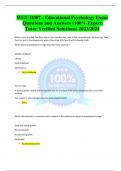
Exam WGU D307 - Educational Psychology Test Questions A+ RATED
When recess is called, two boys slip on their hoodies and, with a little concentration, zip them up. They then run out to the playground, where they draw stick figures with sidewalk chalk. Which physical development stage describes these students? Middle childhood Infancy Early childhood Adolescence Early Childhood True or False A second-grade student tells his teacher that he is being bullied on the playground by some older children. The student is attempting to meet his physiological needs. False Which characteristic is consistent with a student in the adolescence physical development stage? Slow and steady growth Stunted growth Accelerated growth No growth Accelerated growth A teacher asked children of different ages this question: "What would it be like if humans had gills and lived underwater?" Which answer is characteristic of a child in the formal operations stage? "We would be wet all the time." "I would not like to live underwater." "We would have to invent waterproof paper to write on." "This is a stupid question because we don't live underwater." "We would have to invent waterproof paper to write on." True or False According to Vygotsky, a person learns best through his or her own experiences. False Which characteristic would be consistent with a student in Piaget's pre-operational level of cognitive development? Pretending to be a cartoon character Playing with a mobile Solving "what-if" questions Understanding that A + B = C is the same as B + A = C Pretending to be a cartoon character True or False Gilligan theorized that women are more involved in the care of others rather than in the care of themselves. True A 10-year-old student works hard to master multiplication so her teacher and peers will be proud of her. Which of Erikson's stages is this student displaying? Identity versus role confusion Autonomy versus shame Trust versus mistrust Industry versus inferiority Industry versus inferiority A third-grade student wants his classmates to think he is "nice," so he always obeys the classroom rules. According to Kohlberg, this student's sense of morality is at the Conventional Level Which example demonstrates Bandura's theory of observational learning and modeling? A new student sees a group of children kick the ball, so he joins them and does likewise. A teacher tells her class to line up by the door; they line up. A student picks up his backpack and walks toward the door even though the rest of the class has not done so. A student does not want to finish a math test, but the teacher offers her a reward if she does. A new student sees a group of children kick the ball, so he joins them and does likewise. Which characteristic is typical of individuals in the telegraphic stage of language development? Using words that have meaning and serve a purpose Using correct noun and verb structure Using consonant and vowel sounds to make word-like syllables Using one-word sentences Using words that have meaning and serve a purpose Which example best demonstrates Skinner's operant conditioning theory of language development? A baby coos, smiles when his mother turns toward him, and coos again. A child raised without much human interaction learns to talk without difficulty. A fifth grader listens as her teacher models the correct way to answer a question, then tries it herself. A student learning English makes progress when placed with peers who engage her in social interaction. A baby coos, smiles when his mother turns toward him, and coos again. Which theorist's approach stated that language acquisition can be enhanced if it is paired with a positive or rewarding outcome? Skinner's operant conditioning Vygotsky's zone of proximal development Maslow's hierarchy of needs Chomsky's universal grammar Skinner's Operant Conditioning True or False Chomsky believed that humans are born with the ability to learn language. True Which student behavior is characteristic of a student with autism spectrum disorder? Persistent challenges with communication, sensory issues, and repetitive behaviors Inability to read or write at grade level, despite extensive teacher support Inability to focus, complete tasks, remain seated, or avoid interrupting. Oppositional behavior, including noncompliance with directions and difficulty forming relationships with peers Persistent challenges with communication, sensory issues, and repetitive behaviors William is a bright high school student who tends to sit in the back of the classroom near his friends. However, when he does so, he has difficulty seeing what the teacher is writing on the board. Which type of barrier does William seem to be encountering? Language Physical Cognitive Social and emotional Physical A student has been diagnosed with a TBI after an auto accident and experiences difficulty with attention. In addition, the student is experiencing nightmares, flashbacks, and post-traumatic stress from the accident. Which two types of barriers is the student currently experiencing? Cognitive and social-emotional A classroom teacher is working with a diverse student population. One student, Kamal, has a physical disability and uses a wheelchair. Another student, Jack, has a hearing impairment (for which he uses a hearing aid) and an expressive language disorder. A third student, Maria, lives in a house where there is chronic food insecurity, and she typically comes to school hungry, pays little attention in class, and sleeps. A fourth student, Fatima, has an autism spectrum disorder. Fatima has difficulties with speech and communication, sensory sensitivity, and challenges in social interaction with peers. Which two students might have difficulties in communicating their needs to the teacher? Jack & Fatima A classroom teacher is working with a diverse student population. One student, Kamal, has a physical disability and uses a wheelchair. Another student, Jack, has a hearing impairment (for which he uses a hearing aid) and an expressive language disorder. A third student, Maria, lives in a house where there is chronic food insecurity, and she typically comes to school hungry, pays little attention in class, and sleeps. A fourth student, Fatima, has an autism spectrum disorder. Fatima has difficulties with speech and communication, sensory sensitivity, and challenges in social interaction with peers. What is Maria's primary learning need? the issue underlying her challenges, is access to nutritious, sufficient food. A student has an intellectual disability. What is the primary way this might affect her classroom performance? The student is likely to need modified curriculum and support with independent functioning. A student has a learning disability. How is this need likely to impact her functioning and performance? The student is likely to complete work more slowly and less accurately.
Document information
- Uploaded on
- September 6, 2023
- Number of pages
- 33
- Written in
- 2023/2024
- Type
- Exam (elaborations)
- Contains
- Questions & answers