
WGU C207 Data Driven Decision Making 5
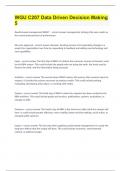
Results-based management (RBM)* management strategy that uses results as the central measurement of performance life-cycle approach dynamic, iterative process of incorporating changes in a project (or organization) over time by responding to feedback and adding new technology and new capabilities Input The first step of RBM is to define the resources, human or financial, used by the RBM system. This could include the people who are doing the work, the funds used to finance the work, and the information being accessed. Activities This second step of RBM involves the process that converts inputs to outputs. It includes the actions necessary to produce results. This could include training, evaluating, developing action plans, or working with media. Output This third step of RBM is when the outputs have been created by the RBM activities. This could include goods and services, publications, systems, evaluations, or changes in skills. Outcome This fourth step of RBM is the short-term effect that the outputs will have. It could include greater efficiency, more viability, better decision making, social action, or changed public opinions. Impact This last step when applying results-based management is to study the long-term effects that the output will have. This could include economic, environmental, cultural, or political change. big data a catch phrase that describes a massive volume of data that is so large that it is difficult to process using traditional database and software techniques Data Mining the process of searching customer data in order to detect patterns to guide marketing decision making index numbers measure the change in quantity or price over time for a good or a number of goods and services consumer price index a measure of the price level of a defined "basket" of consumer items purchased by households base period a period in time used as a point of reference when being compared to other time periods simple index number shows the change in price or quantity of a single good or service over time - It = (Yt / Y0) * 100 simple composite index data gathered from many different sources without any data weighing more significantly than any other data weighted composite index in an index number calculation, when more weight is applied to certain goods or services than others Epidemiology the study of the incidence, distribution, and possible control of diseases and other factors relating to health rate measure of an event occurring over time ratio measures one quantity in relation to another quantity proportion relative relationship of numbers, shapes, or forms to one another prevalence measures the number of cases of a particular disease that exist in a population, without regard for whether cases are new or existing P = (number of cases)/(total population) incidence measure of the number of new cases of a particular disease occurring within a population cumulative incidence (CI) proportion that measures the number of new cases that arise in a particular time period compared to the population CI = (number of new cases in a particular time period)/(population) incidence rate (IR) the number of new cases divided by person-time units, which a cumulative measure of the amount of time each person was studied IR = (number of new cases)/(person-time units) Percentiles percentile signifies the percent of the population that falls below a certain value Standard Scores z-scores, measure the distance of a piece of data from the mean compared to the entire population. Norm-referenced tests tests that compare an individual to other individuals Criterion-referenced tests tests that compare an individual to certain defined standards observed score a score that is actually achieved on a test true score the average score an individual would achieve if he or she were to take the test infinite times random measurement error errors in measurement caused by unpredictable statistical fluctuations systematic measurement error errors in measurement that are constant within a data set, sometimes caused by faulty equipment or bias True Score Theory theory which states that, in a test without systematic error, the observed score is the true score plus the random error Item Response Theory (IRT) model of designing, analyzing, and scoring tests - (also known as latent trait theory) reliability index measure that determines how well a person's observed score on a test represents that person's true score test-retest method a method of determining a test's reliability by giving the same test to the same sample on two different occasions parallel-forms method method of determining a test's reliability by giving two different tests, prepared in the same way, to the same sample
Document information
- Uploaded on
- September 4, 2023
- Number of pages
- 5
- Written in
- 2023/2024
- Type
- Exam (elaborations)
- Contains
- Questions & answers


