
C207 WGU Data Driven Decision Making exam(solved)
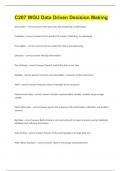
Descriptive Past data only; Not predicting or optimizing Predictive Past to predict the future; Predicting, no optimizing Prescriptive Past to predict the future and optimizing Omission Missing information Out of Range Doesn't match the data or not true Reliable Constant and repeatable. A measure of the instrument Valid Measures what is intended to be measured Measurement bias Includes representative sample, random, large enough sample Information bias Ignore the purpose of the information collection; not truthful answers Big Data Both structure and unstructured; to large to process using traditional database and software techniques Data mining Process of discovering pattern in large data sets Why collect big data? Used to encourage buying behavior Analytics the extensive use of data, statistical and quantitative analysis, explanatory and predictive models, and fact-based management to drive decisions and and add value Variable An expression that can be assigned to data Continuous data Data that can lay along any point in a range of data (age 22.6 old) Discrete data Whole values only and clear boundaries Nominal data Categorical data used to label subjects in a study; discrete (male female) Ordinal data Allows you to place objects on some in some kind of order according to some quality; discrete (black belts 3rd degree higher than 1st degree) Interval data has order; all objects are equal interval apart; no natural zero point and zero does not represent the absence of the property measured; Continuous (time, date, temperature) Ratio data Has a unique zero point - numbers can be compared as multiples of one another, continuous (income, stock, repeat customers) Observational studies used when impractical and impossible to control the conditions of the study Prospective cohort study Observe people going forward in time from the time of their entry into the study Experimental studies All variable measurements and manipulations are under researcher's control. Experimental studies: Experimental units Subjects or objects under observations Experimental studies: Experimental treatments Procedure applied to each subject Experimental studies: Responses Effects of the experimental treatments 1st step of statistical experiment Identify the experimental units from which you want to measure something 2nd step of statistical experiment Id the treatments and controls that you will use on control group 3rd step of statistical experiment Generate a testable hypothesis construct validity study actual measure what is being investigated content validity Construct measures what it claims to measure Internal validity Biases may have entered the study Blind study participants are not told if they are in treatment group or control group Double blind neither treatment allocator nor participant know which group participant is in Triple blind participant, allocator and response gather do not know which group the participant is in Random errors occur because of random and inherently unpredictable events in the measurement process Correlation extent or degree of statistical associations among two or more variables systematic errors errors in measurement at are constant within a data set, sometimes caused by faulty equipment or bias Skewness a measure of the degree to which data "leans" toward one side Not a truly representative sample sample not representative of entire population Response bias respondents say what they believe the questioner wants to hear Conscious Bias When surveyor actively seeks a response; Researcher manipulates phrasing of question Missing data and refusals Sample gets lost or subjects refuses to contribute; distorts survey data when demographic is missing, leads to false conclusion Association and Causation the mistaken assumption that because two events seem to occur together, one causes the other Training and test data Data used to form hypothesis is used again to test hypothsis Unfounded assumptions Assumption is made that has not been proven Faulty operationalization Occurs when the development of specific research procedures that allow for observation and measurement of abstract concepts is flawed. Lack of binding when users fail to place barriers between themselves and subjects and influence behavior Confidence interval Range around a sample that has a specific probability of containing the true population mean
Document information
- Uploaded on
- September 4, 2023
- Number of pages
- 13
- Written in
- 2023/2024
- Type
- Exam (elaborations)
- Contains
- Questions & answers


