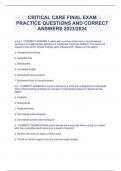
CRITICAL CARE FINAL EXAM PRACTICE QUESTIONS AND CORRECT ANSWERS 2023/2024
CRITICAL CARE FINAL EXAM PRACTICE QUESTIONS AND CORRECT ANSWERS 2023/2024 a,d,e,f - CORRECT ANSWER-A client with a primary brain tumor has developed syndrome of inappropriate secretion of antidiuretic hormone (SIADH). The nurse will expect to see which clinical findings upon assessment? (Select all that apply). a. Nausea and vomiting b. Hyperthermia c. Bradycardia d. Increased weight e. Decreased serum sodium f. Decreased level of consciousness a,b - CORRECT ANSWER-A nurse is caring for a child with a diagnosis of meningitis. What clinical findings indicate an increase in intracranial pressure? (Select all that apply). a. Irritability b. Bradycardia c. Hyperalertness d. Decreased pulse pressure e. Decreased systolic blood pressure a - CORRECT ANSWER-What action should the nurse take when caring for a client who has a possible skull fracture as a result of trauma? a. Monitor the client for signs of brain injury. b. Check for hemorrhaging from the oral and nasal cavities. c. Elevate the foot of the bed if the client develops symptoms of shock. d. Observe for clinical indicators of decreased intracranial pressure and temperature. a,b,e - CORRECT ANSWER-The nurse is caring for a client who was just admitted to the hospital with the diagnosis of head trauma. Which clinical indicators should the nurse consider as evidence of increasing intracranial pressure? (Select all that apply). a. Vomiting b. Irritability c. Hypotension d. Increased respirations e. Decreased level of consciousness a - CORRECT ANSWER-The nurse uses the Glasgow Coma Scale to assess a client with a head injury. Which Glasgow Coma Scale score indicates that the client is in a coma? a. 6 b. 9 c. 12 d. 15 a - CORRECT ANSWER-A client is scheduled for a computed tomography (CT) of the brain with contrast. When reviewing the client's medical record, what significant finding should the nurse report to the primary healthcare provider before the diagnostic procedure? a. The client takes metformin daily. b. The client has not been nothing by mouth (NPO). c. The client reports an allergy to gadolinium. d. The client was not prescribed a bowel prep. d - CORRECT ANSWER-After a head injury, a client develops a deficiency of antidiuretic hormone (ADH). What should the nurse consider before assessing the patient about the response to secretion of ADH? a. Serum osmolarity increases b. Urine concentration decreases c. Glomerular filtration decreases d. Tubular reabsorption of water increases a,d,e - CORRECT ANSWER-What interventions should the nurse implement in caring for a client with diabetes insipidus (DI) following a head injury? (Select all that apply). a. Providing adequate fluids within easy reach b. Reporting an increasing urine specific gravity c. Administering prescribed erythromycin d. Assessing for and reporting changes in neurological status e. Monitoring for constipation, weight loss, hypotension, and tachycardia c - CORRECT ANSWER-A client is admitted with a head injury. The nurse identifies that the client's urinary catheter is draining large amounts of clear, colorless urine. What does the nurse identify as the most likely cause? a. Increased serum glucose b. Deficient renal perfusion c. Inadequate antidiuretic hormone (ADH) secretion d. Excess amounts of intravenous (IV) fluid c - CORRECT ANSWER-After surgical clipping of a ruptured cerebral aneurysm, a client develops the syndrome of inappropriate secretion of antidiuretic hormone (SIADH). What manifestations are exhibited with excessive levels of antidiuretic hormone? a. Increased blood urea nitrogen (BUN) and hypotension b. Hyperkalemia and poor skin turgor c. Hyponatremia and decreased urine output d. Polyuria and increased specific gravity of urine c - CORRECT ANSWER-A construction worker fell off the roof of a two-story building and was taken to the hospital in an unconscious state. During the initial assessment, what clinical finding should the nurse report immediately? a. Reactive pupils b. Depressed fontanel c. Bleeding from the ears d. Increased body temperature d - CORRECT ANSWER-After an automobile collision, a client who sustained multiple injuries is oriented to person and place but is confused to time. The client complains of a headache and drowsiness, but assessment reveals that the pupils are equal and reactive. Which nursing action takes priority? a. Moving the client as little as possible b. Preparing the client for mannitol administration c. Stimulating the client to maintain responsiveness d. Monitoring the client for increasing intracranial pressure d - CORRECT ANSWER-A client who sustained a closed head injury is being monitored for increased intracranial pressure. Arterial blood gases are obtained, and the results include a PCO 2 of 33 mm Hg. What action is most important for the nurse to take? a. Encourage the client to slow the breathing rate. b. Auscultate the client's lungs and suction if indicated. c. Advise the healthcare provider that the client needs supplemental oxygen. d. Inform the healthcare provider of the results and continue to monitor for signs of increasing intracranial pressure. d - CORRECT ANSWER-Initially after a stroke, a client's pupils are equal and reactive to light. Later, the nurse assesses that the right pupil is reacting more slowly than the left and that the systolic blood pressure is beginning to rise. What complication should the nurse consider that the client is developing? a. Spinal shock b. Hypovolemic shock c. Transtentorial herniation d. Increasing intracranial pressure a - CORRECT ANSWER-A client is at risk for increased intracranial pressure (ICP). Which assessment finding reflects an increase in ICP? a. Unequal pupil size b. Decreasing systolic blood pressure c. Tachycardia d. Decreasing body temperature b - CORRECT ANSWER-A nurse is caring for a client who had a traumatic brain injury with increased intracranial pressure. Which healthcare provider prescription should the nurse question? a. Continue anticonvulsants b. Teach isometric exercises c. Continue osmotic diuretics d. Keep head of bed at 30 degrees a - CORRECT ANSWER-A client is diagnosed with a brain attack (cerebrovascular accident, CVA). The baseline vital signs are a pulse rate of 78 bpm and a blood pressure (BP) of 120/80 mm Hg. The nurse continues to monitor the vital signs and recognizes that which changes in vital signs indicate increased intracranial pressure (ICP)? a. Pulse 50 bpm and BP 140/60 mm Hg b. Pulse 56 bpm and BP 130/110 mm Hg c. Pulse 60 bpm and BP 126/96 mm Hg d. Pulse 120 bpm and BP 80/60 mm Hg d - CORRECT ANSWER-A client sustains a crushing injury of the spinal cord above the level of origin of the phrenic nerve. As a result of this injury, the nurse expects what client response? a. Ventricular fibrillation b. Dysfunction of the vagus nerve c. Retention of sensation but paralysis of the lower extremities d. Respiratory paralysis and cessation of diaphragmatic contractions a - CORRECT ANSWER-The nurse is caring for a client with a spinal cord injury. Which assessment findings alert the nurse that the client is developing autonomic hyperreflexia (autonomic dysreflexia)? a. Hypertension and bradycardia b. Flaccid paralysis and numbness c. Absence of sweating and pyrexia d. Escalating tachycardia and shock d - CORRECT ANSWER-Initially after a brain attack (stroke, cerebrovascular accident), a client's pupils are equal and reactive to light. Four hours later the nurse identifies that one pupil reacts more slowly than the other. The client's systolic blood pressure is beginning to increase. On which condition should the nurse be prepared to focus care? a. Spinal shock b. Brain herniation c. Hypovolemic shock d. Increased intracranial pressure d - CORRECT ANSWER-A client had a craniotomy for excision of a brain tumor. After surgery, the nurse monitors the client for increased intracranial pressure. Which clinical finding supports an increase in intracranial pressure? a. Thready, weak pulse b. Narrowing pulse pressure c. Regular, shallow breathing d. Lowered level of consciousness b - CORRECT ANSWER-A client has sustained a spinal cord injury at the T2 level. The nurse assesses for signs of autonomic hyperreflexia (autonomic dysreflexia). What is the rationale for the nurse's assessment
Written for
- Institution
- Critical Care
- Course
- Critical Care
Document information
- Uploaded on
- August 31, 2023
- Number of pages
- 59
- Written in
- 2023/2024
- Type
- Exam (elaborations)
- Contains
- Questions & answers
Subjects
-
critical care final exam practice questions and c
-
a client with a primary brain tumor has developed
-
a nurse is caring for a child with a diagnosis of
-
the nurse is providing discharge instructions to

Also available in package deal