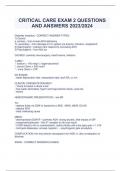
CRITICAL CARE EXAM 2 QUESTIONS AND ANSWERS 2023/20242
CRITICAL CARE EXAM 2 QUESTIONS AND ANSWERS 2023/2024 Diabetes Insipidus - CORRECT ANSWER-TYPES: 1) Central a. primary - from innate ADH deficiency *b. secondary - from damage to h-h system via trauma, infection, neoplasms* 2) Nephrogenic - kidneys cant respond to circulating ADH 3) Psychogenic - from h2o tox CAUSES: (central) neurosurgery, head trauma, infection *LABS:* *- sodium > 145 meq/l = hypernaturemia* *- serum Osmo > 300 mos/l* * - urine Osmo < 100* DX EXAMS: - water deprevation test, vasopressin test, skull XR, ct, mri CLINICAL PRESENTATION/WHY: - *sharp increase in dilute urine* - free water eliminated, hypoT and hypovolemic shock, seizures - stachy HEMODYNAMIC PRESENTATION: - low BP TX: - replace fluids via D5W or hypotonics (.9NS, .45NS, d5NS, D5.45) - replace ADH - treat underlying cause MEDS: - desmopressin/DDAVP - synthetic ADH. strong diuretic, little impact on BP - vasopressin/pitressin - hits V1 receptor so htn can result * if ADH leads to htn or overhydration, restrict fluids until urine spec grav < 1.015 - mild gets diabenase, orinase, tegretol.......psychogenic gets anxiolytics COMPLICATION: htn and arterial vasospasm from ADH rx. also constipation or diarrhea SIADH - CORRECT ANSWER-CAUSES: - head trauma, CNS diseases - tumors that produce ADH, pulm disease - neurogenic stimuli, endocrine disturbances - drugs: hypoglycemics, diuretics, phenothiazine, thioxanthenes, opiates, carbmazepine, tylonol, ocy, vasopressin, anesthetics LABS: *- hypo Na <130* *- hypo serum osmo < 270* - increased urine osmo - increased specific gravity >1.030 CLINICAL PRESENTATION/WHY: - overhydration, low sodium, concentrated urine - edema not usually present but slight weight gain - early s/s: anorexia, n/v, may not have s/s - severe: when Na is less than 120 = tetany. confusion, seizures, coma, death TX: - treat underlying cause - restrict fluid (500ml < output) - replace sodium (hypertonic solution slowly) MEDS: to increase h2O excretion - demeclocycline/declomycin - Li carbonate - Conivaptan/vaprisol - blocks V1 (vessels) and V2 (kidney) = vassodilation ETC - no water/hypotonic enemas - seizure precautions <125 na Addison's Disease - CORRECT ANSWER-= hyposecretion of cortisol and some ALD LABS: *- Na < 130* *- K > 4.5* *- Glu < 70* DX EXAMS: ACTH stimulation test primary - give ATCH but doesnt improve secondary - give ATCH and does improve CLINICAL PRESENTATION/WHY: - low ALD: hyperK, hypoNa, HypoVol - low cortisol: hypoG, slow GI, low vascular tone, hyperCa - other: anorexia, n/v/ tachy, HEMODYNAMIC PRESENTATION: hypoT, fatigue, hyperK on ECG, bronzing CONSEQUENCES IF UNTREATED: Addisonian Crisis nonfunctional adrenal gland from trauma. Pt has hypoT, hyperK, hyopG, hypoNA. TX: fluid replacement, no stimuli TX: - 5 S's: sugar, salt, steroid, support, serch - IV fluids D5NS MEDS: hormone replacement - hydrocortisone, solucortef (must be tapered) - take with snack or antacid, watch for hypoK - monitor glu - may need more rx when stressed Cushing's Syndrome - CORRECT ANSWER-TYPES: Primary - excess cortisol release (rare) Secondary/iatrogenic - chronic steroids LABS: DX EXAMS: CLINICAL PRESENTATION/WHY: - emotional lability - hyperglycemia - round face, acne, ab fat, hairy, weakness, thick skin that bruises, osteopenia HEMODYNAMIC PRESENTATION: - high ALD and cortisol = Na and H2O retention, htn, JVD, hypoK CONSEQUENCES IF UNTREATED: TX: based on cause - remove tumor - decrease steroids - too much ACTH secretion = give inhibitors Lysodren and Elipten Corticosteroids - CORRECT ANSWER-ALD - minderalcorticoids reg Na and K - release inresponse to hypovol, hypoNa, hyperK, decreased CO - inhibited: ANP and hypoK goal: keep Na and h20, lose K and H+, increase Co Cortisol - glucocorticoid for metabolism, gluconeogenisis, anti-inflammation - release in response to infection, stress, hypoglycemia, fever, anxiety goal: increase blood glu, decrease inflam response, keep fluid volume and vascular integrity, has mineralcorticoid affect cardiac biomarkers - CORRECT ANSWER-hrs @elevate peak return2bl cTnI 3-4 10-24 5-10 *most specific cTnT 3-4 10-24 5-14 CK-MB 4-8 15-24 2-3 CRP+MG 1-4 6-7 (non specific but rises earlier) clinical manifestations of AMI - CORRECT ANSWER-- tachycardia w/ or w/out ectopy - bradycardia - normo or hypotension - tachypnea - diminished heart sounds, esp S1 - LV dysfunction, may have S3 +/S4 - systolic murmur - pulmonary crackles/edema - air hunger - orthopnea - frothy sputum - decrease UO and CO - decreased PP's - slow cap refill (longer than 3 sec) - restlessness - confusion - anxiety - agitation - denial - anger FOR WOMEN 1 mo prior: extra fatigue, sleep trouble, sob, indigestion, anxiety During: SOB, weakness, extra fatigue, cold sweat, dizzy, n/v, tachycardia ami/stemi ecg changes - CORRECT ANSWER-- you want to get a 12-lead w/in 10 minutes ISCHEMIA: t-wave inversion INJURY: st segment elevation INFARCTION: q wave pharmacological interventions for AMI - CORRECT ANSWER-OANM (our aunt in new mexico) 1. OXYGEN to keep sat >90% 2. anti platelets: ASA 162, plavix 3. Nitrates: NTG q5min x3 or via IV CI: SB<90; HR <50 or >100, RV MI, viagra 4. IV morphine for pain and less preload THEN ALSO - antidysrhythmics: o2, amio, BB - fibrinolytics w/in 12 hours - ACE/ARB to stop V remodeling *NSTEMI - asa+plavix but not fibrinolytics anterior wall stemi (LAD) - CORRECT ANSWER-v1-v4 S/S: - *tachycardia* bc LV impaired - intraventricular block (BBB) - atrial/vent ectopy Complications: - vent septal wall rupture - free wall rupture - *aneurysm/embolism* -leads to HF, Vtach - LV failure - cardiogenic shock, death TX: - volume mgmt, vasopressor, ionotropes, antidysrhythmias, cpr lateral wall stemi (circumflex) - CORRECT ANSWER-- I, aVL, V5, V6 S/S: sinus brady and a or v ectopy * often occurs with other areas* Complications: - free wall rupture - cardiac tampnade (PEA rhythm)
Written for
- Institution
- Critical Care
- Course
- Critical Care
Document information
- Uploaded on
- August 31, 2023
- Number of pages
- 23
- Written in
- 2023/2024
- Type
- Exam (elaborations)
- Contains
- Questions & answers
Subjects
- diabetes insipidus
- clinical presentationwhy
- paracentesis
-
critical care exam 2 questions and answers 20232
-
arteries mammary last longer but saphenous vein

Also available in package deal